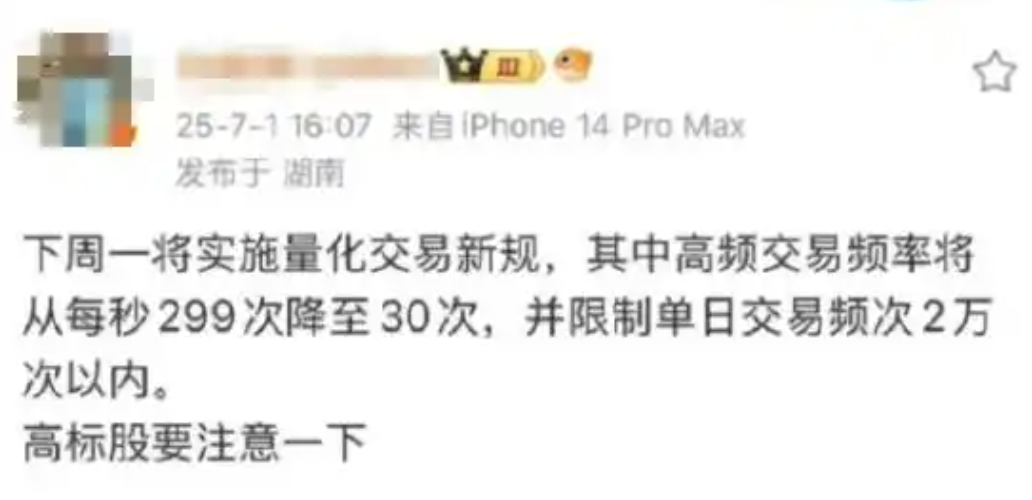
小作文

Search documents
又有19个大V账号被封
第一财经· 2026-01-20 10:40
Core Viewpoint - The article discusses the recent crackdown on accounts involved in illegal activities related to the capital market on the Xueqiu platform, highlighting the regulatory efforts to maintain market order and prevent manipulation [5][6]. Group 1: Account Bans - A total of 22 accounts were permanently banned in a single day due to violations related to capital market activities [3]. - The first batch of bans included accounts such as "Hangzhou New City Road" and "Lunhui 666," while subsequent announcements included additional accounts like "Crazy Shuoha Ge" and "Fortune to Buy a House" [4][5]. Group 2: Types of Violations - The crackdown focuses on four main types of violations: excessive speculation and market manipulation, illegal securities investment consulting, organized illegal operations, and spreading false information [5]. - Specific practices targeted include "retail investor strategies," "team trading," and the use of AI technology to spread rumors or distort public information [5]. Group 3: Regulatory Actions - The Zhejiang Securities Regulatory Bureau imposed a fine of over 83 million yuan on a prominent account for manipulating 32 stocks, alongside a three-year market ban for the individual involved [6].


牛市全靠“小作文”?
虎嗅APP· 2025-08-25 00:16
Core Viewpoint - The article discusses the phenomenon of "small essays" in the stock market, highlighting their role in manipulating stock prices and the challenges in regulating such activities [4][35][37]. Group 1: Characteristics of "Small Essays" - "Small essays" are essentially rumors or unverified information that can significantly impact stock prices, often exploiting the curiosity and speculative nature of retail investors [6][12]. - They can be categorized into five types: policy rumors, company operations, fund movements, market sentiment/conspiracy theories, and over-interpretation of public information [9][8]. - The spread of these rumors typically begins in social media circles, where they are crafted to maximize impact and reach [11][19]. Group 2: Impact on the Market - The influence of "small essays" can lead to rapid stock price changes, sometimes within minutes, as seen in the case of companies like 淳中科技 [12][20]. - The phenomenon reflects a broader trend in the market where speculative behavior is heightened, particularly in a bull market environment [30][35]. - The presence of a large retail investor base in the Chinese stock market, which often lacks access to reliable information, creates fertile ground for the proliferation of these rumors [20][36]. Group 3: Regulatory Challenges - Despite regulatory efforts to curb the spread of "small essays," their prevalence has not diminished, indicating a gap between policy and enforcement [27][28]. - The anonymity and rapid dissemination of these rumors complicate the ability of regulatory bodies to trace and penalize offenders effectively [21][37]. - The article emphasizes the need for a multi-faceted approach involving technology and collaboration among regulatory agencies to combat the issue [38]. Group 4: Future Outlook - The article suggests that while "small essays" may continue to thrive in the short term, advancements in regulatory technology and a shift towards more rational investment practices could eventually reduce their prevalence [38]. - The ongoing evolution of the market and investor behavior will determine the future landscape of information dissemination and its impact on stock pricing [36][37].



牛市全靠“小作文”?
Hu Xiu· 2025-08-24 22:46
Core Viewpoint - The article discusses the phenomenon of "small essays" in the stock market, which are essentially rumors or unverified information that can significantly influence stock prices, particularly in the context of a bullish market. The article highlights how these rumors exploit retail investors' psychology and the current market dynamics, leading to rapid price fluctuations and potential financial losses for uninformed investors [3][30]. Group 1: Nature and Impact of "Small Essays" - "Small essays" are characterized as low-cost, high-reward ventures that rely on information asymmetry to create or amplify rumors, thus driving stock price movements [13][21]. - The spread of "small essays" often begins in social media circles, where they are crafted to maximize impact and reach, utilizing various platforms for dissemination [8][12]. - The influence of "small essays" can be immediate, with stock prices reacting within minutes, or they may linger until a suitable moment for emotional triggers arises [10][16]. Group 2: Types and Mechanisms of "Small Essays" - The content of "small essays" can be categorized into five main types: policy rumors, company operations, funding movements, market sentiment, and over-interpretation of public information [6][5]. - The creation of "small essays" often targets specific companies or market conditions, exploiting investor interest and emotional responses to drive speculation [5][27]. - The article notes that the current market environment, characterized by high liquidity and speculative behavior, has made "small essays" more prevalent and impactful [24][26]. Group 3: Regulatory Challenges and Market Dynamics - Despite regulatory efforts to curb the spread of "small essays," their prevalence has increased, reflecting the challenges in enforcing laws against such practices [23][30]. - The article emphasizes that the current market conditions, including a large retail investor base and significant information asymmetry, provide fertile ground for the proliferation of "small essays" [16][29]. - The ongoing evolution of technology and social media has facilitated the rapid spread of these rumors, complicating regulatory responses and increasing the difficulty of tracing their origins [18][30].