工业周期

Search documents
The Timken Company (TKR) Presents at Citi's Global Industrial Tech & Mobility Conference 2026 Transcript
Seeking Alpha· 2026-02-18 15:54
Core Insights - The company is experiencing strong cash generation and has a healthy balance sheet, positioning it well for potential growth as the industrial cycle begins to pick up [1] Group 1: Company Performance - The CEO highlights the strength of the company's cash generation engine, indicating robust financial health [1] - The company's balance sheet is described as very strong, suggesting a solid financial foundation [1] - The current debt leverage is in a healthy range, particularly at the bottom of the industrial cycle, which is advantageous for future growth [1] Group 2: Future Opportunities - The CEO expresses optimism about the potential for growth as the industrial cycle is expected to improve [1] - The company has made several acquisitions and faced difficult choices, indicating a strategic approach to portfolio management [2]



一个新的全球“工业周期”正在兴起
Hua Er Jie Jian Wen· 2026-02-12 03:26
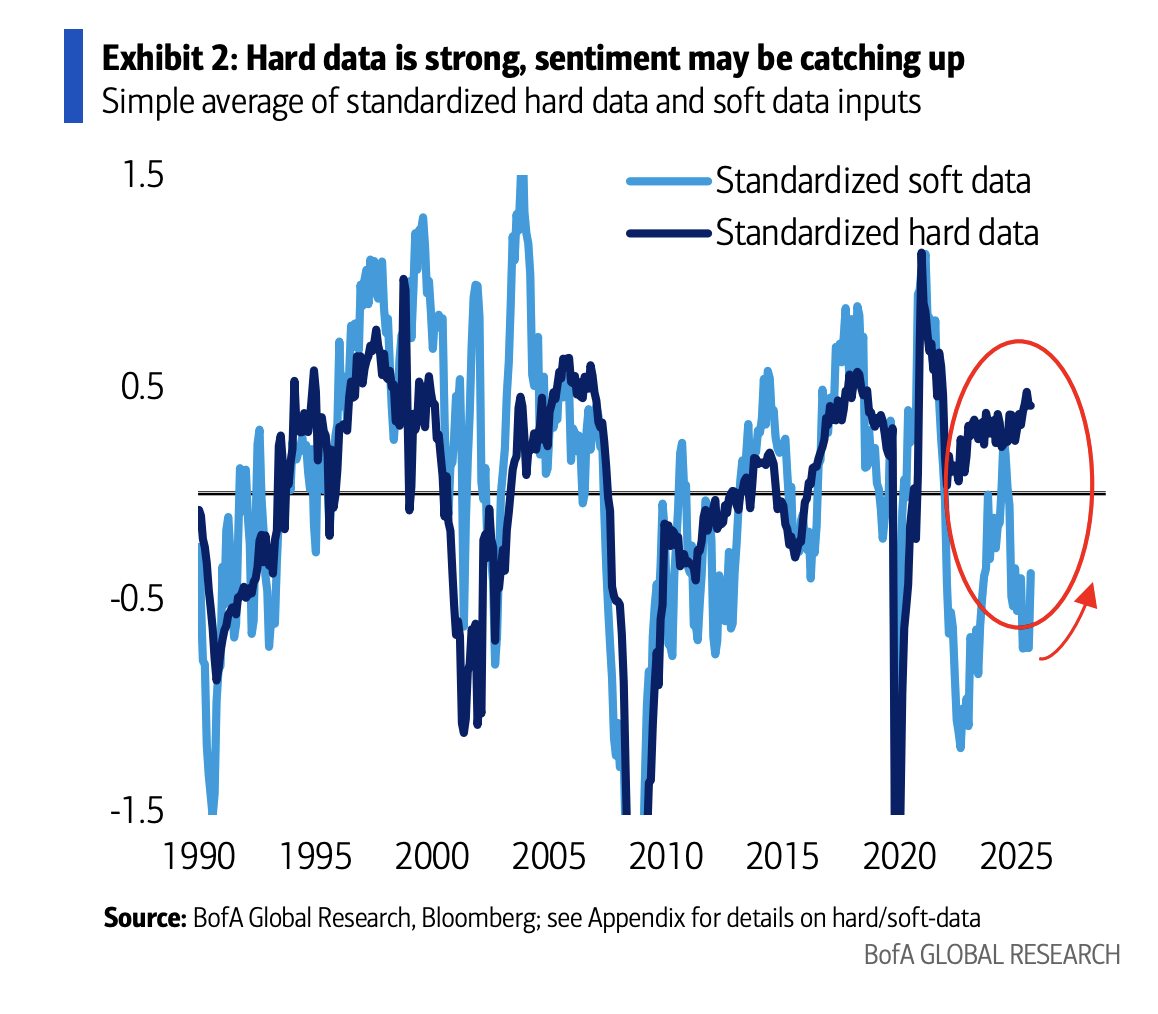
Core Insights - The narrative of global assets may shift from "technology dominance" to "industrial and credit expansion" as new industrial cycles appear to be starting, indicating potential for higher-than-consensus earnings in 2026 [1] - Bank of America (BofA) suggests that the combination of strong hard data, improving soft data, and strengthening industrial momentum points to more opportunities outside crowded trades [1][2] Group 1: Industrial Cycle Indicators - BofA's analysis shows that hard data is above long-term averages, while soft data indicators have improved significantly, with the Michigan Consumer Sentiment Index reaching its highest level since August [2][5] - Several proprietary high-frequency indicators from BofA have strengthened, indicating a positive outlook for global manufacturing PMI and industrial demand [5][10] - The current market narrative may shift from debt-driven consumption to visible organic growth in the industrial sector [8] Group 2: Credit Conditions and Expansion - BofA identifies unfavorable credit terms as a barrier to manufacturing expansion, suggesting that regulatory changes could unlock over $1 trillion in new capital from the banking system by 2026 [9][10] - Specific data points indicate that large U.S. banks hold excess capital above regulatory requirements, and capital requirements are expected to decrease, which could facilitate credit improvements [9][10] Group 3: Semiconductor Industry Impact - The semiconductor sector, particularly analog chips, is viewed as a leading indicator for the industrial cycle, with expectations of a 30% year-over-year growth in chip sales by 2026 [10][11] - The rebound in storage chip prices and increased AI demand are driving significant growth in exports from South Korea, which is linked to broader global earnings revisions [14] Group 4: Market Performance and Asset Allocation - Year-to-date returns show that expansion trades have outperformed stagnant assets, with small and mid-cap industrial stocks leading the gains [15] - Despite strong performance in expansion assets, there remains a significant underallocation in these areas compared to stagnant assets, indicating a potential shift in investment strategies [15][16] Group 5: Risks in Less Transparent Markets - The report highlights risks associated with SPACs, cryptocurrencies, and private credit, which have become more prominent in a low liquidity environment [16][17] - Historical data shows that SPACs have underperformed compared to small-cap stocks, raising concerns about the sustainability of returns in these less transparent markets [16][17]