工业硅期货行情

Search documents
建信期货工业硅日报-20250731
Jian Xin Qi Huo· 2025-07-31 01:17
Group 1: Report Information - Report Date: July 31, 2025 [2] - Research Team: Energy and Chemical Research Team [3] - Researchers: Li Jie, CFA (Crude Oil and Fuel Oil); Ren Junchi (PTA/MEG); Peng Haozhou (Industrial Silicon/Polycrystalline Silicon); Peng Jinglin (Polyolefins); Liu Youran (Pulp) [3] Group 2: Market Performance and Outlook Market Performance - Futures: The main contract price of industrial silicon futures opened higher and closed with fluctuations. The Si2509 contract closed at 9,285 yuan/ton, up 2.20%. The trading volume was 605,161 lots, and the open interest was 242,677 lots, a net decrease of 34,057 lots [4] - Spot: The spot price of industrial silicon stabilized. The price of Inner Mongolia 553 was 9,350 yuan/ton, and that of Sichuan 553 was 8,850 yuan/ton. The price of Inner Mongolia 421 was 9,800 yuan/ton, that of Xinjiang 421 was 9,800 yuan/ton, and that of Sichuan 421 was 9,950 yuan/ton [4] Outlook - Supply and demand: The supply - demand relationship has not improved significantly. The resumption of production in the southwest offsets the production cuts of large factories in Xinjiang. The production in July is expected to remain at around 310,000 tons, slightly higher than the average monthly production from January to June this year. The operating rate of polysilicon has increased slightly, and the short - term production increase capacity of organic silicon is limited [4] - Market trend: In the short term, the market will mainly fluctuate in a wide range. The 10,000 - yuan mark is a significant resistance level [4] Group 3: Market News - Futures warehouse receipts: On July 30, the number of futures warehouse receipts on the Guangzhou Futures Exchange was 49,846 lots, a net decrease of 236 lots from the previous trading day [5] - Exports: The export volume of industrial silicon in June was 68,323 tons. The cumulative export from January to June was 338,900 tons, with an average monthly export of 56,500 tons [5] - Power generation: As of the end of June, the cumulative installed power generation capacity nationwide was 3.65 billion kilowatts, a year - on - year increase of 18.7%. Among them, the installed capacity of solar power generation was 1.1 billion kilowatts, a year - on - year increase of 54.2%; the installed capacity of wind power was 570 million kilowatts, a year - on - year increase of 22.7%. From January to June, the average utilization hours of national power generation equipment were 1,504 hours, a decrease of 162 hours compared with the same period last year. In June, the newly installed photovoltaic capacity was only 14.36GW, a year - on - year decrease of 38% and a month - on - month decrease of 85% [5]
【工业硅】期货行情再度反弹,供需博弈下观望情绪仍未“消散”??
Sou Hu Cai Jing· 2025-07-29 12:48
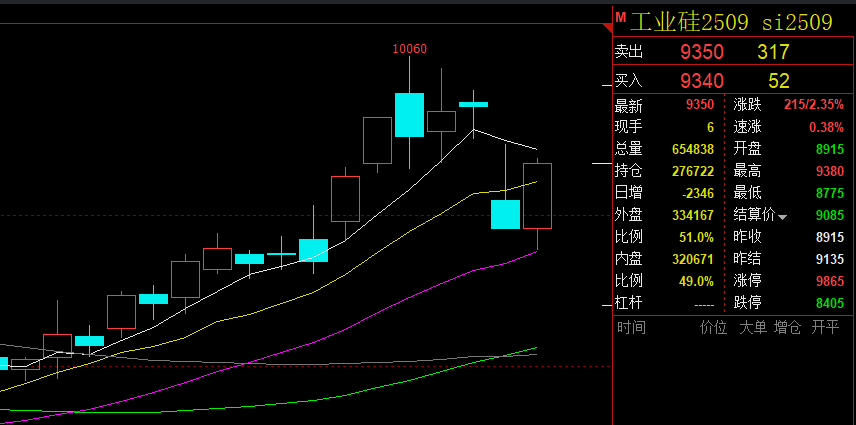
Core Viewpoint - The industrial silicon futures market has shown a rebound, with prices increasing due to various market factors, although actual demand recovery remains slow [1][3]. Group 1: Market Performance - As of July 29, the industrial silicon main contract 2509 closed at 9350, up 215 from the opening price of 8915, reflecting a 2.35% increase [1]. - The total trading volume for the main contract was 654,844 lots, with an open interest of 276,734 lots, leading to a total open interest of 532,376 lots [1]. Group 2: Supply and Demand Dynamics - The market is experiencing a strong bullish sentiment, with active inquiries from buyers, but actual demand recovery is lagging, leading to a continued pressure on prices [3]. - Prices in various regions are reported as follows: 421 in Yunnan at around 10,000 CNY/ton, Guangzhou Port at approximately 10,100 CNY/ton, and 441 in Kunming also around 10,000 CNY/ton [3]. Group 3: Raw Material Market - The prices for raw materials such as polysilicon and organosilicon have remained stable, with no significant fluctuations noted [5]. Group 4: Future Outlook - The short-term outlook for industrial silicon prices is expected to remain stable, with limited potential for significant adjustments, although the supply-demand imbalance continues to exert pressure on the market [7].