巴纳姆效应

Search documents
“人生K线”为何爆火?
Huan Qiu Wang Zi Xun· 2026-01-03 05:29
Core Insights - The "Life K-Line" project combines traditional fortune-telling with stock market K-line charts, utilizing AI to generate a visual representation of an individual's life trajectory [3][4][6] - The project has gained significant popularity on social media, with a single tweet reaching over 3 million views and the topic accumulating over 1 million reads on domestic platforms [1][6] - The AI-generated life K-line chart provides a quantifiable and visual way to interpret one's fate, offering insights into personality, career, and emotional aspects [5][6] Summary by Sections Concept and Functionality - "Life K-Line" allows users to input their birth information, which the system uses to calculate a life chart based on a lunar calendar and true solar time [3][4] - The resulting chart spans 100 years and uses a color-coded system where green indicates good fortune and red indicates bad fortune, with annual scores for "opening," "closing," "highest," and "lowest" fortunes [4] Popularity Factors - Low entry barriers and high efficiency make it easy for users to understand their fortunes without needing to grasp complex terminology [6] - The social aspect of sharing personal life trajectories fosters connections among users, as they compare their "ups" and "downs" [6] - Continuous updates and improvements based on user feedback aim to evolve the project into a comprehensive predictive ecosystem that bridges Web2 and Web3 [6] Psychological and Market Insights - The "Barnum Effect" plays a role in user engagement, as vague yet relatable descriptions create a sense of personalized insight [7] - The rise of AI fortune-telling products reflects a societal response to uncertainty, providing emotional support and a sense of control amid life decisions [7][8] - The market for "fortune and luck economy" in China is significant, with a reported 18.29% preference among consumers, indicating a growing demand for such products [8]

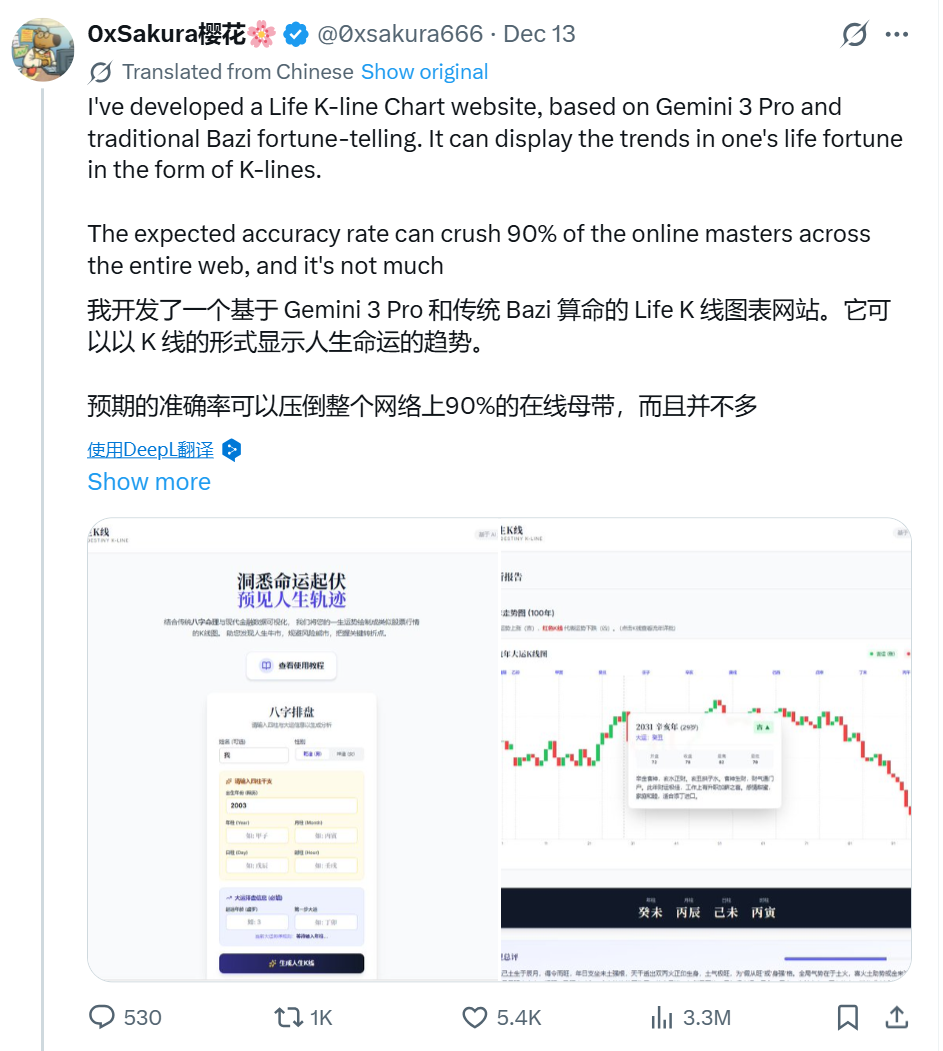
“人生K线”爆火,命运轨迹真的可预测?
Xin Lang Cai Jing· 2026-01-02 11:14
Core Viewpoint - The "Life K-Line" phenomenon combines traditional fortune-telling with stock market K-line charts, utilizing AI to create a visual representation of an individual's life trajectory, sparking widespread interest and discussion on social media platforms [1][5]. Group 1: Concept and Functionality - The "Life K-Line" project merges traditional BaZi fortune-telling with stock market K-line analysis, generating a visual chart based on user-provided birth information [3]. - The AI-generated report uses K-line visuals to depict life events, where green indicates good fortune and red indicates bad fortune, providing annual ratings and brief insights [4]. Group 2: Popularity Factors - Low entry barriers and high efficiency allow users to easily understand their fortunes without needing to grasp complex BaZi terminology, making the product accessible [5]. - The social aspect of sharing personal "K-line" charts fosters connections among users, as they compare life trajectories in a visually engaging manner [5]. - Continuous updates and improvements based on user feedback indicate a commitment to evolving the product into a comprehensive ecosystem that bridges Web2 and Web3 [5]. Group 3: Psychological Insights - The "Barnum Effect" suggests that vague and general personality descriptions resonate with users, leading them to perceive the AI-generated insights as personalized and accurate [6]. - The product addresses the anxieties of young individuals in a rapidly changing society, providing emotional support and a sense of control over their futures [6]. Group 4: Market Trends - According to a report by iiMedia Consulting, "mysticism and luck economy" accounts for 18.29% of consumer sentiment preferences in China, indicating a growing market for such products [7]. - The commercialization of these products has established clear monetization pathways, including standardized data offerings and the sale of related merchandise [7].
赛博算命“拿捏”年轻人
3 6 Ke· 2025-08-08 05:48
Core Insights - The rise of interest in metaphysics among young people is highlighted by the popularity of astrology influencer Tao Baibai, whose recent divorce has sparked discussions about the credibility of metaphysical beliefs [2] - The emotional economy in China is projected to grow significantly, with a market size expected to reach 23,077.67 billion yuan in 2024 and surpass 45,000 billion yuan by 2029, indicating a strong consumer preference for metaphysical and luck-related services [3] - The integration of AI technology into metaphysical practices is creating new opportunities and attracting more participants, as seen with the use of AI models for fortune-telling [6] Group 1: Technology and Metaphysics - The popularity of AI models like DeepSeek has led to a surge in young people using these tools for fortune-telling, with many sharing their experiences in social media groups [7][9] - AI models provide personalized readings based on traditional Chinese metaphysics, which are shared widely among users, indicating a blend of technology and traditional practices [10][13] - The overall user engagement with AI-assisted fortune-telling is significant, with 612 million monthly active users in this sector, second only to search engines [10] Group 2: Consumer Behavior and Trends - Young consumers are increasingly viewing metaphysical practices as a form of psychological counseling rather than superstition, with tarot reading and astrology becoming popular among this demographic [20] - The monetization of metaphysical services is evolving, with influencers and practitioners offering personalized consultations and selling related products, such as crystals, at varying price points [25][23] - The psychological appeal of metaphysics is rooted in the Barnum effect and self-fulfilling prophecies, which help alleviate decision-making anxiety for consumers [25] Group 3: Social Media Influence - Social media platforms have transformed tarot reading from one-on-one sessions to mass engagement through video content, allowing users to participate in collective experiences [16][19] - The format of tarot videos on platforms like Bilibili and Douyin is designed to maximize user interaction and engagement, often leading to prolonged viewing sessions [17][19] - Influencers often tailor their content to resonate with a broad audience, enhancing the perceived accuracy and relevance of their readings [19]