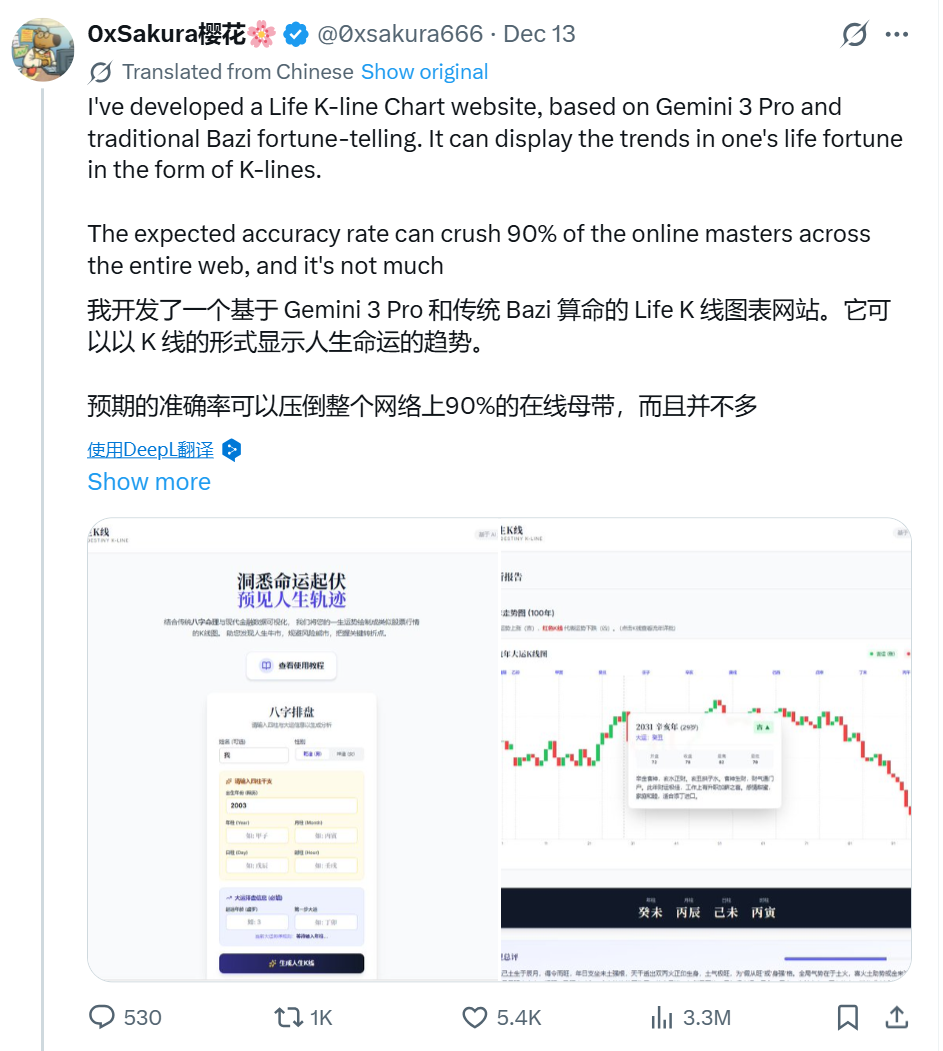
AI玄学

Search documents
“人生K线”为何爆火?
Huan Qiu Wang Zi Xun· 2026-01-03 05:29
Core Insights - The "Life K-Line" project combines traditional fortune-telling with stock market K-line charts, utilizing AI to generate a visual representation of an individual's life trajectory [3][4][6] - The project has gained significant popularity on social media, with a single tweet reaching over 3 million views and the topic accumulating over 1 million reads on domestic platforms [1][6] - The AI-generated life K-line chart provides a quantifiable and visual way to interpret one's fate, offering insights into personality, career, and emotional aspects [5][6] Summary by Sections Concept and Functionality - "Life K-Line" allows users to input their birth information, which the system uses to calculate a life chart based on a lunar calendar and true solar time [3][4] - The resulting chart spans 100 years and uses a color-coded system where green indicates good fortune and red indicates bad fortune, with annual scores for "opening," "closing," "highest," and "lowest" fortunes [4] Popularity Factors - Low entry barriers and high efficiency make it easy for users to understand their fortunes without needing to grasp complex terminology [6] - The social aspect of sharing personal life trajectories fosters connections among users, as they compare their "ups" and "downs" [6] - Continuous updates and improvements based on user feedback aim to evolve the project into a comprehensive predictive ecosystem that bridges Web2 and Web3 [6] Psychological and Market Insights - The "Barnum Effect" plays a role in user engagement, as vague yet relatable descriptions create a sense of personalized insight [7] - The rise of AI fortune-telling products reflects a societal response to uncertainty, providing emotional support and a sense of control amid life decisions [7][8] - The market for "fortune and luck economy" in China is significant, with a reported 18.29% preference among consumers, indicating a growing demand for such products [8]

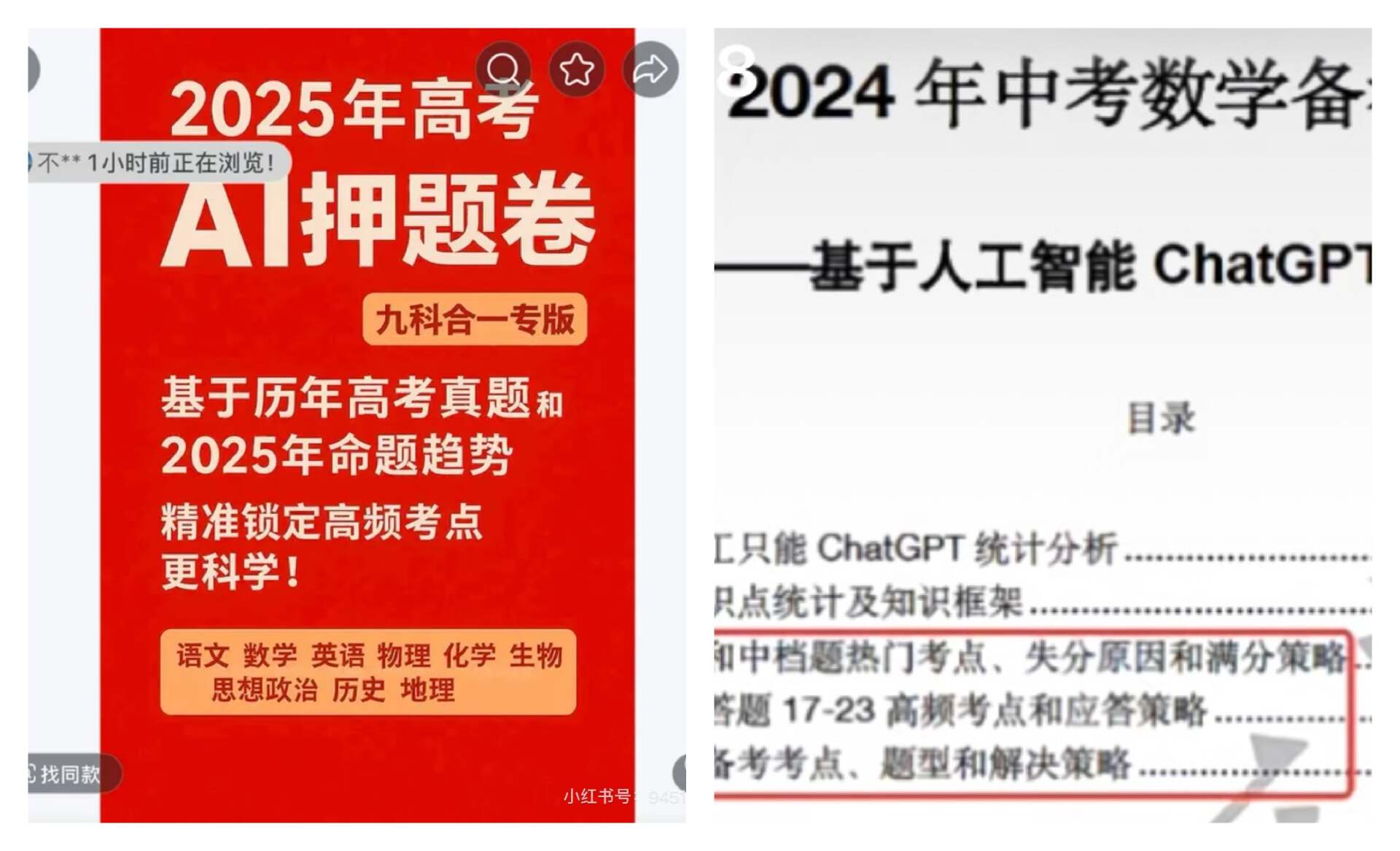
AI大模型押题卷,要价398元!“80%命中率”并不可信
21世纪经济报道· 2025-05-29 08:58
Core Viewpoint - The article discusses the rise of AI-assisted exam prediction materials being marketed to students preparing for the college entrance examination in China, highlighting the questionable reliability of these products and the associated risks in the market [1][2]. Group 1: AI Exam Prediction Products - Various tutoring institutions are selling "AI model prediction papers" for prices up to 398 yuan, with discounts available [1]. - A math teacher named Kang Wu claims to have an 80% accuracy rate in predicting exam questions using AI, specifically by feeding past exam questions into the AI model DeepSeek [1]. - The AI prediction process involves analyzing past exam questions to identify frequently tested topics and generating a new set of questions based on that analysis [1]. Group 2: Reliability and Marketing Concerns - The claimed "80% accuracy" is misleading, as the comparison reports used to validate this claim are overly simplistic, categorizing questions as "correct" based on broad topic similarities rather than specific content [2]. - Despite criticisms regarding the quality of AI-generated questions, these products remain popular on social media, indicating a high level of anxiety among parents and students [2]. - Experts suggest that AI exam prediction is primarily a marketing tactic, as the structure of the exams has remained consistent over the years, rather than being accurately predicted by AI [2]. Group 3: Regulatory and Ethical Considerations - Most AI products in China have restrictions on directly predicting exam questions due to legal and ethical concerns [3][4]. - The Chinese government has initiated measures to regulate the misuse of AI technologies, particularly in areas that could mislead or deceive users, such as AI predictions for exams [4].
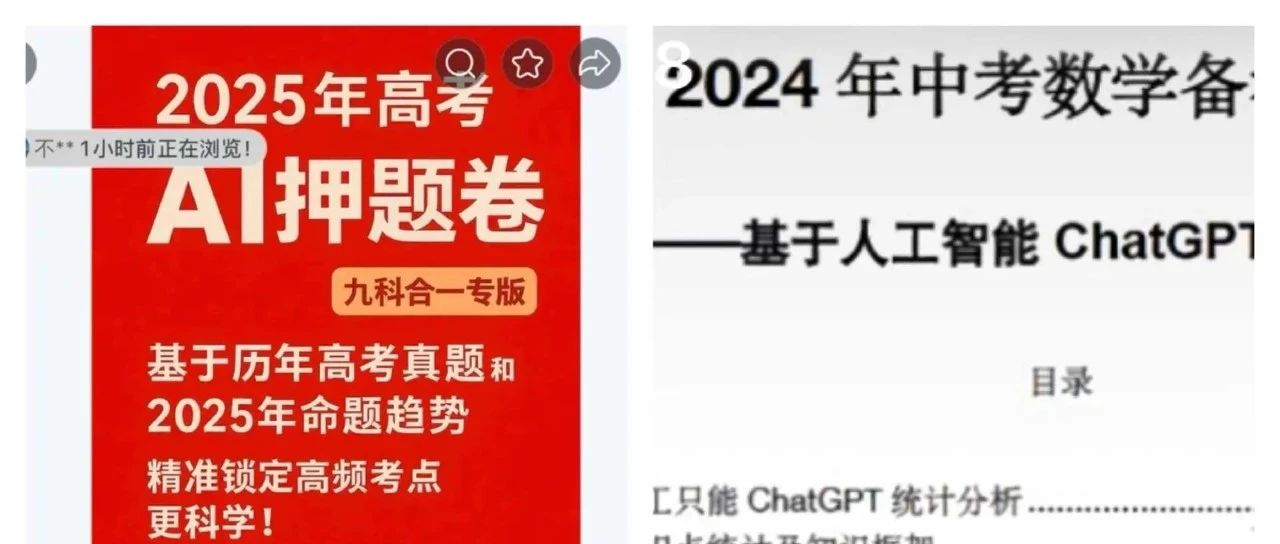
AI高考押题做成生意经,收割谁的焦虑
2 1 Shi Ji Jing Ji Bao Dao· 2025-05-29 04:08
Core Viewpoint - The rise of AI-assisted exam preparation materials, particularly "AI prediction papers," has become a new trend among students preparing for the national college entrance examination in China, despite concerns about their reliability and the potential for scams [1][5]. Group 1: AI Prediction Papers - Various tutoring institutions are selling "AI prediction papers" for prices up to 398 yuan, with discounts available [1]. - A math teacher named Kang Wu claims to have achieved an 80% accuracy rate in predicting exam questions using AI tools like DeepSeek, which analyzes past exam questions [1][3]. - The methodology involves feeding five years of past exam questions and two years of prestigious school test papers into the AI to identify frequently tested topics [3]. Group 2: Market Response and Concerns - Despite skepticism about the accuracy of AI predictions, these materials are gaining popularity on social media platforms, with some posts receiving thousands of likes [4]. - Experts have pointed out that the AI prediction papers are primarily a marketing strategy, as the exam format has remained consistent over the years, making it easier to predict certain types of questions [5]. - The transaction risks associated with these AI prediction papers are significant, as many sellers are small tutoring institutions or individual accounts that do not use formal e-commerce platforms, leading to potential scams [5]. Group 3: Regulatory Environment - Most AI products in China have restrictions on predicting exam questions due to legal and regulatory concerns, emphasizing that high school exam content is confidential [6]. - The government has initiated measures to address the misuse of AI technologies, including the promotion of AI-related scams, which highlights the need for caution in this emerging market [6].