市场互补

Search documents
全球动力电池前三季度“答卷”出炉
Zhong Guo Qi Che Bao Wang· 2025-12-05 09:55
Core Insights - The global electric vehicle (EV) battery installation volume reached 811.7 GWh in the first three quarters of 2025, marking a 34.7% year-on-year increase, with Asian companies dominating the market [2][3] Market Overview - Six Chinese companies, three South Korean companies, and one Japanese company remain in the top ten global battery manufacturers, with Chinese companies increasing their market share to 68.2% from 65.5% in the same period last year [2][3] - The total battery installation volume for the top six Chinese companies was 553.6 GWh, while South Korean companies' market share fell to 16.9%, a decline of 3.3 percentage points year-on-year [2][3] Company Performance - CATL maintained its leading position with a battery installation volume of 297.2 GWh, but its growth rate slowed to 31.5%, resulting in a slight decrease in market share to 36.8% [4] - BYD's battery installation volume grew by 45.6% to 145 GWh, increasing its market share to 17.9% [4] - Other notable performers include: - Zhongxin Innovation with a 41.5% increase to 39.3 GWh and a market share of 4.8% [5] - Guoxuan High-Tech with a 65.8% increase to 29.7 GWh and a market share of 3.7% [5] - EVE Energy with a 73.2% increase to 21.9 GWh and a market share of 2.7% [5] - Honeycomb Energy with an impressive 89.5% increase to 20.5 GWh and a market share of 2.5% [5] Regional Dynamics - South Korean companies LG Energy, SK On, and Samsung SDI saw their combined market share drop to 16.9%, with Samsung SDI being the only top ten company to experience a decline in installation volume [8][10] - Japanese company Panasonic's market share slightly decreased from 4.2% to 4.1% [8] Market Challenges - The slowdown in growth for South Korean and Japanese companies is attributed to weak demand from core customers and a mismatch between their strategies and market needs [8][9] - The U.S. EV market growth has slowed significantly, with a 11.7% increase in sales year-on-year, primarily due to the expiration of federal tax credits [8][10] Technological Trends - The shift towards lithium iron phosphate (LFP) batteries is gaining momentum, with LFP batteries expected to account for over 50% of global installations by 2024 [9] - Chinese companies dominate the LFP battery market, while South Korean companies continue to rely heavily on nickel-cobalt-manganese (NCM) batteries, which are losing market share [9] International Expansion - Chinese battery companies are aggressively expanding into international markets, with significant growth in battery installation volumes outside of China [12][13] - BYD's international battery installation volume reached 25.8 GWh, a 145.9% increase, while Honeycomb Energy's international volume surged by 425.2% [13][14] Strategic Shifts - Both Chinese and international battery manufacturers are increasingly focusing on the energy storage market as a new growth avenue, driven by rising demand and the need to diversify from the competitive EV battery market [16][17] - Major companies like CATL and LG Energy are ramping up their energy storage battery production, with significant orders already in place [16][18]




君亭酒店还要再找多少个“合伙人”?
Tai Mei Ti A P P· 2025-07-30 09:15
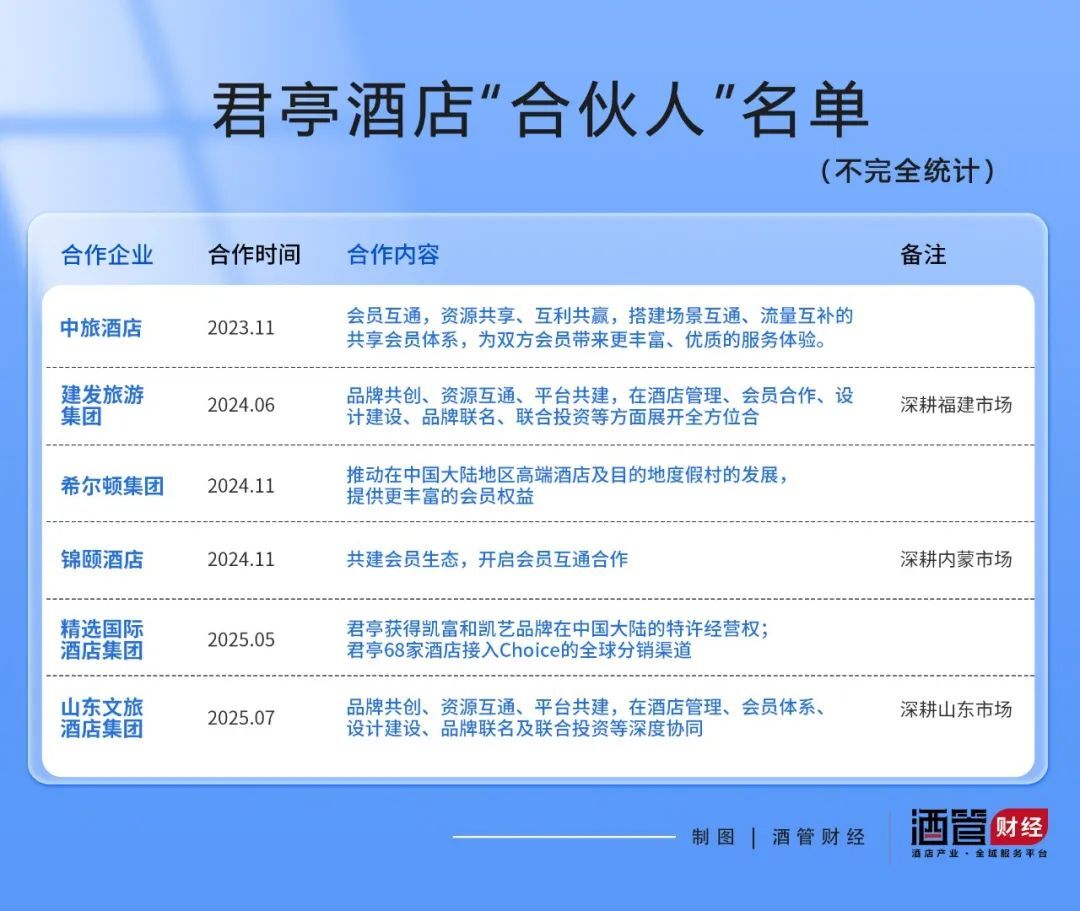
Core Viewpoint - Junting Hotel is actively seeking partnerships to expand its market presence and enhance its brand recognition through strategic collaborations with various hotel groups [1][3][8]. Group 1: Strategic Partnerships - Junting Hotel has signed a strategic cooperation framework agreement with Shandong Cultural Tourism Hotel Group, focusing on brand co-creation, resource sharing, and platform building [3][4]. - Previous partnerships include collaborations with China Travel Hotels, Jianfa Tourism Group, and Hilton Group, all emphasizing similar themes of resource sharing and brand development [5][6][7]. - The cooperation with Shandong Cultural Tourism Hotel Group aims to enhance user experience and asset value through integrated advantages in investment, operation, and design [3][8]. Group 2: Market Expansion Strategy - Junting Hotel's partnerships are strategically aimed at complementing its market presence, particularly in regions where it has limited brand recognition, such as Fujian and Inner Mongolia [8][9]. - The collaboration with Select International Hotel Group will allow Junting's hotels to access a global distribution channel, enhancing visibility for inbound tourists [8][9]. - The company is also looking to expand its membership base and enhance member benefits through these partnerships, which is crucial for its growth strategy [9][10]. Group 3: Growth Pathways - Junting Hotel's expansion strategy is summarized as "three axes": forming alliances, establishing a franchise model, and leveraging equity investments for growth [11][14]. - The company aims to become one of the top three brands in the domestic mid-to-high-end hotel sector within three years, targeting over 1,000 hotels [13][14]. - Junting Hotel has established a joint venture to manage its franchise operations, which will help address challenges related to customer acquisition and operational efficiency [13][14]. Group 4: Competitive Positioning - Junting Hotel currently ranks 21st among the top 60 hotel groups in China, indicating a need for further growth to improve its competitive standing [20][22]. - The company is under pressure to narrate a compelling growth story as it navigates its expansion strategy, especially following a leadership change [22][23]. - The recent strategic moves reflect Junting Hotel's ambition to explore the growth path of high-end domestic hotel brands, with a focus on both partnerships and internal development [23].