市场供应紧张

Search documents
外媒:全球大宗商品海运成本激增
Huan Qiu Shi Bao· 2025-12-04 22:51
Group 1 - Global shipping costs for bulk commodities are experiencing a rare year-end increase due to disruptions in supply chains caused by conflicts, sanctions, and production surges [1] - The average daily cost of shipping crude oil on major global routes has surged by 467% this year, while shipping rates for liquefied natural gas (LNG) and iron ore have increased by over four times and more than two times, respectively [1] - Shipping executives anticipate that the overall market supply tightness will persist at least until early next year, indicating a highly strained shipping market [1] Group 2 - Despite a slight decline in freight rates from peak levels by the end of November, high transportation costs continue to trigger a chain reaction throughout the shipping market, leading U.S. LNG buyers to consider delaying cargo loading [2] - The international container shipping prices have decreased, with the Drewry World Container Index dropping by 2% to $1,806 per 40-foot container, primarily due to falling rates on trans-Pacific and Asia-Europe routes [2] - Major U.S. retailers, such as Walmart, have rushed to import goods to avoid tariffs imposed by the White House, creating an early "peak season" but potentially weakening freight prospects for the remainder of the year [2]
1959到1961三年经济困难主要表现在哪些方面?
Sou Hu Cai Jing· 2025-07-03 06:16
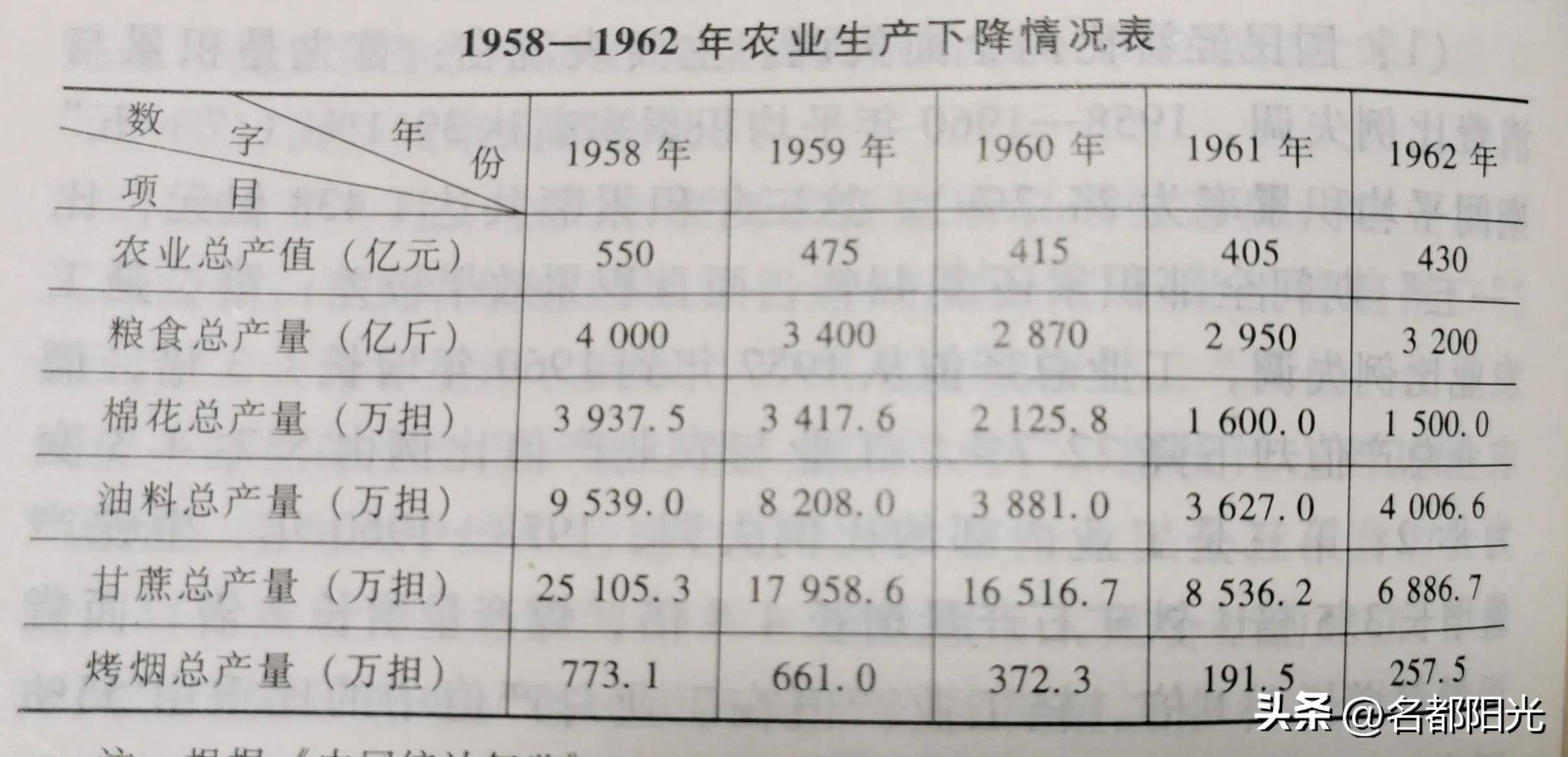
Core Viewpoint - The article emphasizes the importance of acknowledging historical mistakes during the early stages of socialist construction in China, particularly the Great Leap Forward, to avoid repeating past tragedies [2][4]. Economic Impact of the Great Leap Forward - The Great Leap Forward led to a significant decline in agricultural production, with total agricultural output in 1960 only reaching 47.2% of the planned target, a 12.6% decrease from 1959 [6]. - Grain production fell to 48.3% of the planned target in 1960, a 15.6% drop from 1959, while cotton and oilseed production saw declines of 37.8% and 50.9%, respectively [6][7]. - By the end of 1960, grain reserves had decreased to 28.65 billion kilograms, a 29% reduction from 40.2 billion kilograms in 1955, leading to severe food shortages [6][8]. Social Consequences - The population faced severe food shortages, with per capita grain consumption dropping from 203 kg in 1957 to 163.5 kg in 1960, a 19.4% decrease [8]. - The rural population experienced a drastic reduction in livestock, with pig numbers falling by 43.6% from 1957 to 1960 [7]. - Non-normal death rates surged, with the mortality rate reaching 25.43‰ in 1960, significantly higher than the 10.8‰ in 1957 [9]. Economic Imbalance - The Great Leap Forward caused a severe imbalance in the national economy, with industrial output growing by 1.3 times from 1957 to 1960, while agricultural output fell by 22.7% [11][12]. - Heavy industry saw a disproportionate increase, with its share of total industrial output rising from 25.5% in 1957 to 52.1% in 1960, while light industry lagged behind [12][13]. - Infrastructure investment during this period exceeded planned amounts by 71%, leading to a consumption squeeze and economic tension [16]. Inflation and Market Supply Issues - The rapid increase in infrastructure investment led to a workforce surge from 24.51 million in 1957 to 50.44 million in 1960, exacerbating fiscal pressures [17]. - The money supply increased by 82% from 1957 to 1960, resulting in significant inflation and a decline in purchasing power [17]. - The government implemented rationing and coupon systems for essential goods, further straining consumer living standards [17][18].