供应链扰乱

Search documents
全球大宗商品海运成本激增,原油今年增幅最大达467%
Huan Qiu Shi Bao· 2025-12-05 00:29
Group 1 - Global shipping freight rates for bulk commodities are experiencing a rare year-end increase due to disruptions in supply chains caused by conflicts, sanctions, and production surges [1] - The average daily cost of shipping crude oil on major global routes has surged by 467% this year, while liquefied natural gas (LNG) and iron ore shipping rates have increased by over four times and more than two times, respectively [1] - Shipping executives anticipate that the overall market supply tightness will persist at least until early next year, indicating a highly strained shipping market [1] Group 2 - Despite a slight decline in freight rates from peak levels by the end of November, high transportation costs continue to trigger chain reactions throughout the shipping market, leading U.S. LNG buyers to consider delaying cargo loading [2] - The international container shipping prices have seen a decrease, with the Drewry World Container Index dropping by 2% to $1,806 per 40-foot container, primarily due to falling rates on trans-Pacific and Asia-Europe routes [2] - Major U.S. retailers, such as Walmart, have rushed to import goods to avoid tariffs imposed by the White House, creating an early "peak season" but potentially weakening freight prospects for the remainder of the year [2]
外媒:全球大宗商品海运成本激增
Huan Qiu Shi Bao· 2025-12-04 22:51
Group 1 - Global shipping costs for bulk commodities are experiencing a rare year-end increase due to disruptions in supply chains caused by conflicts, sanctions, and production surges [1] - The average daily cost of shipping crude oil on major global routes has surged by 467% this year, while shipping rates for liquefied natural gas (LNG) and iron ore have increased by over four times and more than two times, respectively [1] - Shipping executives anticipate that the overall market supply tightness will persist at least until early next year, indicating a highly strained shipping market [1] Group 2 - Despite a slight decline in freight rates from peak levels by the end of November, high transportation costs continue to trigger a chain reaction throughout the shipping market, leading U.S. LNG buyers to consider delaying cargo loading [2] - The international container shipping prices have decreased, with the Drewry World Container Index dropping by 2% to $1,806 per 40-foot container, primarily due to falling rates on trans-Pacific and Asia-Europe routes [2] - Major U.S. retailers, such as Walmart, have rushed to import goods to avoid tariffs imposed by the White House, creating an early "peak season" but potentially weakening freight prospects for the remainder of the year [2]
美国拟重启美墨加贸易协定谈判
Guo Ji Jin Rong Bao· 2025-09-05 09:56
Group 1 - The U.S. Trade Representative (USTR) will initiate public consultation for the USMCA in the coming weeks, marking the first formal step towards renegotiation [1] - The consultation process must be completed by October 4, 2023, as mandated by the law governing the agreement [1] - The USMCA includes a mandatory six-year review clause, with the first trilateral review meeting scheduled for no later than July 1, 2026 [1] Group 2 - The USMCA is considered a significant trade achievement of the Trump administration, replacing NAFTA, which was criticized for causing job losses in the U.S. [2] - Tariffs imposed by the Trump administration on Canada and Mexico have undermined the effectiveness of the USMCA, particularly affecting the automotive, steel, aluminum, and lumber industries [2] Group 3 - The tariffs serve to increase leverage for the U.S. in the renegotiation process, disrupting North America's complex supply chains, especially in the automotive sector [3] - Recent discussions between U.S. Secretary of State Rubio and Mexican President Claudia Sheinbaum focused on cross-border security, which is seen as a prerequisite for USMCA renegotiation [3] - Mexico is highly sensitive to the negotiation outcomes, as 80% of its exports go to the U.S., and the U.S. has extended tariffs on Mexican goods for an additional 90 days [3] Group 4 - The U.S. has criticized Mexico's policies in energy, telecommunications, agriculture, and intellectual property, highlighting issues such as state-owned enterprise bias and lack of fair competition [4] - Mexico's Economy Minister Marcelo Ebrard acknowledged that the upcoming reviews and negotiations will be challenging but emphasized the need for cooperation among the three countries to maintain North America's competitiveness [4]
国际货币基金组织小幅上调全球经济增长预测
Shang Wu Bu Wang Zhan· 2025-08-02 15:47
Group 1 - The International Monetary Fund (IMF) forecasts global economic growth at 3.0% for this year, an increase of 0.2 percentage points from the April prediction, and 3.1% for 2026, also up by 0.1 percentage points [1] - The global trade growth forecast has been raised by 0.9 percentage points to 2.6% for this year, indicating resilience in the global economy amid increasing uncertainties [1] - China's economic growth forecast has been adjusted upward by 0.8 percentage points to 5.6% for this year, and by 0.2 percentage points to 4.4% for next year [1] - The growth forecast for India has been slightly increased by 0.2 percentage points to 6.4% for this year and by 0.1 percentage points for next year [1] - Developed economies' growth predictions have been raised by 0.1 percentage points to 1.5% for this year and 1.6% for next year [1] - The U.S. economic growth forecast has been increased by 0.1 percentage points to 1.9% for this year and by 0.3 percentage points to 2.0% for next year [1] - The growth forecast for developing countries has been raised by 0.4 percentage points to 4.1% for this year and by 0.1 percentage points to 4.0% for next year [1] - The Eurozone growth forecast has been adjusted upward by 0.2 percentage points to 1.0% for this year, while the next year's forecast remains at 1.2% [1] Group 2 - The IMF warns that there are still widespread downside risks to the economic situation, including potential increases in average tariff rates and unresolved trade tensions stemming from the Trump administration [2] - Ongoing uncertainties may begin to suppress economic activity, while geopolitical tensions could exacerbate inflationary pressures and disrupt supply chains [2] - High debt levels, unstable public finances, and various structural imbalances continue to pose significant risks [2]
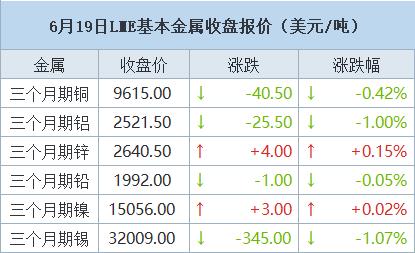
金属多飘绿 期铜创近一周新低,因美元走强和经济增长担忧【6月19日LME收盘】
Wen Hua Cai Jing· 2025-06-20 00:53
Group 1 - LME copper prices fell to a near one-week low due to a stronger dollar and increasing concerns over global economic growth, with three-month copper down by $40.5 or 0.42% to $9,615 per ton [1][2] - Other base metals also experienced declines, with three-month aluminum down by $25.5 or 1% to $2,521.5 per ton, while zinc saw a slight increase of $4 or 0.15% to $2,640.5 per ton [2] - LME copper has rebounded 19% since hitting a near 19-month low of $8,105 in April [3] Group 2 - Concerns over regional tensions have strengthened the dollar, which typically weakens the prices of dollar-denominated commodities, leading to a cautious stance among funds [4] - A decrease in trading activity was noted as U.S. traders were absent due to the June holiday [4] - LME copper inventories decreased by 4,025 tons to 103,325 tons, marking the lowest level in over a year [7] Group 3 - The U.S. market has seen an influx of copper due to expectations of tariffs on copper imports, resulting in a premium for copper in the U.S. [8] - The aluminum market in the U.S. is experiencing a decline in premiums, with a drop of over 7% in consumer purchases, amid speculation of potential tariff reductions on Canadian aluminum imports [9] - The global lead market is projected to shift to a surplus of 6,900 tons by April 2025, contrasting with a shortage of 11,900 tons in March [9]