
市场化电价改革

Search documents
市场化电价冲击波下,中国风光年新增装机仍创新高
Xin Lang Cai Jing· 2026-01-29 05:14
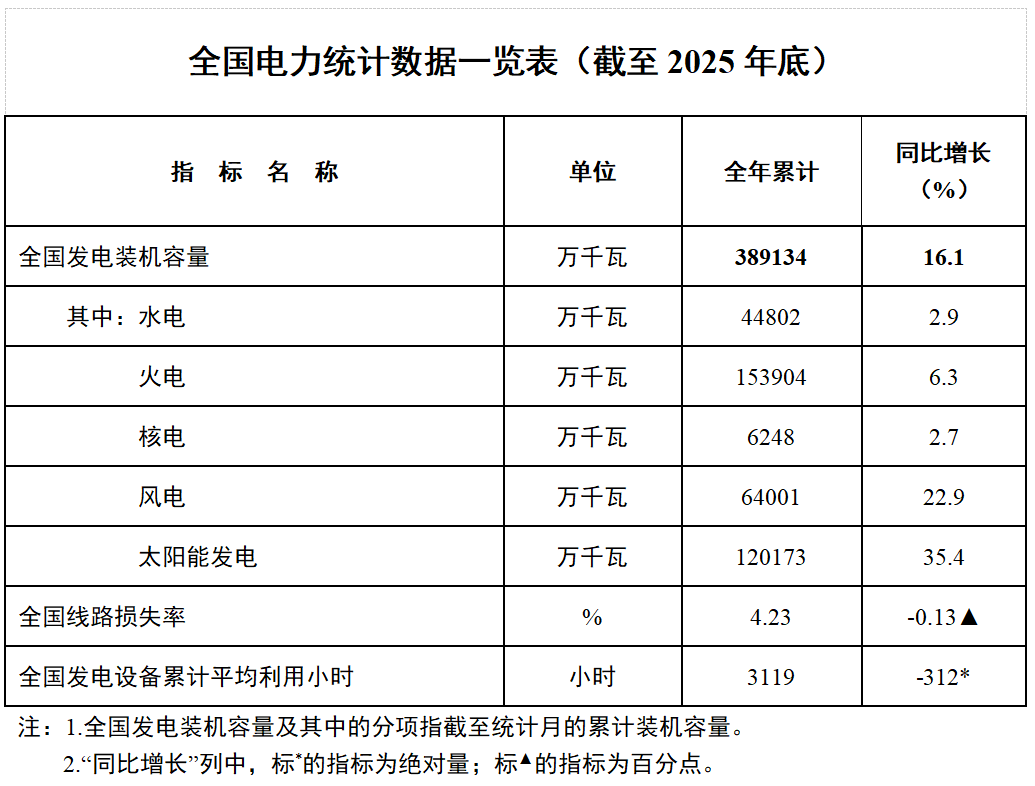
Core Insights - The renewable energy sector in China has achieved record-high installed capacity despite market fluctuations in electricity pricing [1][2] Group 1: Installed Capacity Growth - As of the end of 2025, China's total installed power generation capacity reached 389.134 million kilowatts, marking a year-on-year increase of 16.1% [2][3] - Solar power capacity reached 120.173 million kilowatts, with a year-on-year growth of 35.4%, while wind power capacity reached 64.001 million kilowatts, growing by 22.9% [2][3] - For the first time, the cumulative installed capacity of solar and wind power exceeded 180 million kilowatts, accounting for 47.3% of the total installed capacity, surpassing thermal power [2][3] Group 2: Yearly Additions and Trends - In 2025, the annual addition of installed capacity for solar power is projected to be 31.5 million kilowatts, a year-on-year increase of approximately 13%, while wind power is expected to add 11.9 million kilowatts, a significant year-on-year increase of about 49% [2][4] - The annual addition of wind and solar capacity has consistently surpassed 10 million, 20 million, 30 million, and 40 million kilowatts over the past four years [2] Group 3: Market Dynamics and Future Projections - The introduction of market-based pricing for renewable energy projects has led to more stable bidding results for wind power compared to solar, making wind a focal point for market investment [4] - The China Photovoltaic Industry Association has revised its forecast for new solar installations in 2025 from 21.5-25.5 million kilowatts to 27-30 million kilowatts, indicating stronger-than-expected growth [4] - Long-term projections suggest a slowdown in solar installation growth, with Bloomberg New Energy Finance predicting a compound annual growth rate of 3% for global solar installations from 2025 to 2035, and a decline in China's growth rate to -5% [7]

REITs二季报:基本面有哪些超预期变化?
2025-07-30 02:32
Summary of Key Points from REITs Conference Call Industry Overview - The REITs market has experienced a valuation correction, providing entry opportunities for investors as valuations have returned to a reasonable range, with the standard deviation indicating a departure from previously high levels [1][2] Core Insights and Arguments - **Industrial Park Sector**: The industrial park segment continues to show weakness, particularly in second-tier cities where the marginal decline has exceeded expectations due to poor supply-demand dynamics. The supply side remains large, while demand is contracting as companies focus on cost reduction [1][4] - **Logistics and Warehousing**: The logistics and warehousing sector outperformed expectations in Q2, rebounding after a decline influenced by tariffs. The South China region faces significant supply pressure, while the North and East China regions continue to experience rental pressure. The Chengdu-Chongqing area shows signs of marginal recovery [1][11] - **Affordable Rental Housing**: The affordable rental housing sector demonstrated stability in Q2, with a 3.5% increase in revenue and high occupancy rates around 96%. This sector is noted for its strong anti-cyclical properties [1][14] - **Consumer REITs**: The consumer REITs sector faced seasonal impacts, with a general revenue decline of 5.5% in Q2. REITs with a high proportion of joint ventures experienced more significant fluctuations [1][15] Additional Important Insights - **Highway REITs**: There is operational differentiation within highway REITs, with overall toll revenue declining but EBITDA increasing due to effective cost control. Passenger vehicle revenue decreased while freight vehicle revenue increased, indicating a recovery in freight demand [3][18][20] - **Energy and Environmental REITs**: Wastewater treatment projects outperformed waste-to-energy projects. The market for renewable energy projects is influenced by regional policies and market pricing reforms [3][19][25] - **Market Dynamics**: The REITs market has seen a general adjustment, with an index decline of approximately 3% and individual securities experiencing declines of 5% to 8%. This adjustment is primarily driven by profit-taking behavior [2][27] - **Future Considerations**: Investors are advised to focus on projects with proven operational capabilities and stable income sources, particularly in the context of ongoing market volatility and economic uncertainty [6][9][31] Conclusion - The REITs market is currently characterized by a mix of challenges and opportunities across various sectors, with a notable emphasis on the importance of operational efficiency and market adaptability in navigating the evolving landscape.