
微生物蛋白

Search documents
富祥药业:公司事件点评报告:新业务迎来收获阶段,业绩大幅扭亏-20260327
Huaxin Securities· 2026-03-27 10:24
Investment Rating - The report assigns a "Buy" rating for the company, marking the first coverage of the stock [9]. Core Insights - The company is expected to achieve significant revenue growth, with projected revenues of 1.186 billion yuan in 2025 and 2.163 billion yuan in 2026, reflecting an 82.4% growth rate [11]. - The company's net profit is forecasted to turn positive, with estimates of 597 million yuan in 2026 and 624 million yuan in 2027, indicating a recovery from previous losses [11]. - The company has successfully transitioned its new energy business to profitability, driven by a significant price increase in its products, particularly VC, which rose from 110,000 yuan/ton to 220,000 yuan/ton [5]. - The pharmaceutical segment is benefiting from a decrease in the price of 6-APA, leading to improved gross margins, with expectations of continued margin enhancement in Q1 2026 [6]. - The approval of the company's microbial protein product as a new food ingredient opens new growth opportunities in the health food and alternative meat markets [7]. Summary by Sections Financial Performance - The company reported a net profit of -53.07 million yuan for 2025, with a projected turnaround to a profit of 52 million to 75 million yuan in Q1 2026 [4]. - Revenue projections for 2025, 2026, and 2027 are 11.86 billion yuan, 21.63 billion yuan, and 23.64 billion yuan respectively [9]. Business Segments - The new energy business has shown a turnaround with a gross margin expected to exceed 50% due to price increases and the elimination of outdated production capacity [5]. - The pharmaceutical business is experiencing margin recovery due to lower raw material costs, with gross margins expected to rise in Q1 2026 [6]. Growth Opportunities - The approval of the microbial protein product positions the company to capitalize on emerging markets for health foods and alternative proteins, with a planned production capacity of 20,000 tons [7].

富祥药业(300497):公司事件点评报告:新业务迎来收获阶段,业绩大幅扭亏
Huaxin Securities· 2026-03-27 07:29
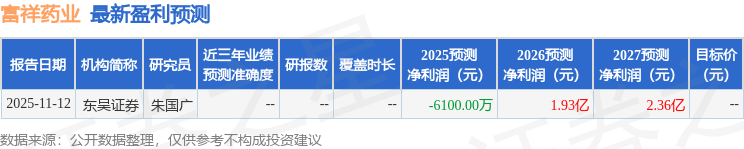
Investment Rating - The report assigns a "Buy" rating for the company, marking the first coverage of the stock [9]. Core Insights - The company is entering a profitable phase with new business ventures, significantly reversing previous losses [4]. - The revenue forecast for 2025 is projected at 1.185 billion yuan, with a net profit attributable to shareholders expected to be -53.07 million yuan. For Q1 2026, the net profit is anticipated to be between 52 million and 75 million yuan [4]. - The company has seen a turnaround in its new energy business, with significant price increases in key products leading to profitability [5]. - The pharmaceutical segment is benefiting from a decrease in raw material costs, improving gross margins [6]. - The approval of a new food ingredient, "Weiran Protein," opens new growth opportunities for the company [7]. Summary by Sections Business Performance - The new energy business (electrolyte additives VC/FEC) has transitioned from losses to profitability, with a gross margin improvement expected to exceed 50% in Q1 2026 due to price increases [5]. - The price of VC has risen from 110,000 yuan/ton to 220,000 yuan/ton, with current prices at 140,000 yuan/ton [5]. Pharmaceutical Segment - The price of the key raw material 6-APA has decreased from 320 yuan/kg in February 2025 to 180 yuan/kg in January 2026, leading to improved gross margins in the pharmaceutical business [6]. - Gross margins for the pharmaceutical manufacturing segment are projected to rise, with 2025 H1 margins already at 21% [6]. Growth Opportunities - The company’s product "Weiran Protein" has received approval as a new food ingredient, positioning it for entry into the artificial meat and health food markets [7]. - The company is accelerating the construction of a 20,000-ton capacity for microbial protein, having also obtained SELF-GRAS certification in the U.S. [7]. Financial Forecast - Revenue projections for 2025, 2026, and 2027 are 1.186 billion, 2.163 billion, and 2.364 billion yuan respectively, with EPS expected to improve from -0.09 to 1.16 yuan [9]. - The current stock price corresponds to a PE ratio of -195.8 for 2025, improving to 15.9 by 2027 [9].
富祥药业:11月16日进行路演,鹏华基金、东方基金等多家机构参与
Sou Hu Cai Jing· 2025-11-17 01:43
Core Viewpoint - The company is experiencing significant growth in demand for its products, particularly in the VC and FEC segments, driven by the rapid expansion of the energy storage and power battery markets, alongside strategic capacity expansion plans [1][2]. Group 1: Market Demand and Pricing - Recent rapid increases in VC product prices are attributed to the growing demand from energy storage and power batteries, with VC prices around 50,000 yuan/ton [1]. - In the first half of 2025, the cumulative sales of power batteries reached 485.5 GWh, a year-on-year increase of 51.6%, while the shipment of energy storage lithium batteries was 265 GWh, up 128% year-on-year [1]. - The energy storage market in China is expected to exceed 500 GWh in scale, with a year-on-year growth rate of over 50% anticipated [1]. Group 2: Production Capacity and Expansion Plans - The company currently has a production capacity of 8,000 tons/year for VC and 4,000 tons/year for FEC, with plans to increase VC capacity to 10,000 tons/year by Q2 2026 [2]. - Future plans include increasing VC capacity to 20,000 tons/year and FEC capacity to 5,000 tons/year, depending on market demand and industry capacity releases [2]. Group 3: Cost Management and Profitability - The company is focused on reducing production costs for its VC products through technological improvements and has a strong position in cost control within the industry [3]. - The procurement price of 6-APA has decreased by 38% compared to the end of 2024, which is expected to enhance the gross margin of the company's pharmaceutical manufacturing business [4]. Group 4: Product Development and Market Position - The company is the largest global supplier of sulbactam and a major supplier of tazobactam, with ongoing efforts to expand production capacity for these products [5]. - The company has achieved significant milestones in the microbial protein sector, with a current capacity of 1,200 tons/year and plans for a project that will scale up to 20,000 tons/year [6]. Group 5: Financial Performance - For the first three quarters of 2025, the company reported a main revenue of 769 million yuan, a year-on-year decrease of 21.24%, and a net profit attributable to shareholders of -62.75 million yuan [7]. - The company's gross margin stands at 12.05%, with a debt ratio of 51.15% [7].

富祥药业(300497) - 300497富祥药业投资者关系管理信息20251114
2025-11-14 00:44
Production Capacity and Expansion Plans - The company currently has a production capacity of 8,000 tons/year for VC products and 4,000 tons/year for FEC products, with plans to increase VC capacity to 10,000 tons/year by Q2 2026 through technical upgrades [2][3] - Future capacity increases for VC and FEC products will depend on market demand and industry capacity releases, with potential targets of 20,000 tons/year for VC and 5,000 tons/year for FEC [2] Impact of Raw Material Price Changes - The price of 6-APA, a key raw material for the company's main pharmaceutical products, has decreased by 38% as of November 3, 2025, which is expected to enhance the gross margin of the pharmaceutical manufacturing business [3] - The company's pharmaceutical products, including Hezobactam and Shubactam, account for approximately 40% of total revenue in 2024 [3] Growth Opportunities in Pharmaceutical Business - The company is a major global supplier of Hezobactam and has successfully completed supplier qualification for its new production process, which is expected to reduce production costs and improve market competitiveness [4] - As the largest supplier of Shubactam, the company is experiencing a price increase trend for this product [4] - The company is expanding the production capacity of Piperacillin, which is a mainstream product with broad market demand [4] Synthetic Biology and Microbial Protein Initiatives - The company has become a pioneer in the domestic microbial protein industry, achieving a production capacity of 1,000 tons/year for filamentous fungal protein and is accelerating the construction of a project with an annual capacity of 200,000 tons for microbial protein and resource utilization [6] - The company has developed a new production strain with independent intellectual property rights and has applied for patents in nine countries, achieving international advanced levels in key production technologies [6][7] - The company’s microbial protein has received multiple international certifications, including HALAL and KOSHER, and is set to expand its market presence upon receiving new food ingredient registration [7][8] Environmental and Economic Benefits - The production process for the new protein not only efficiently converts raw materials but also produces high-value products like amino acid water-soluble fertilizers, contributing to cost reduction and economic benefits [8] - The company aims for zero emissions in its production processes, aligning with green manufacturing goals [8]
瑞普生物(300119) - 300119瑞普生物投资者关系管理信息20251027
2025-10-26 23:48
Financial Performance - The company achieved a revenue of 2.544 billion yuan in the first three quarters, representing a year-on-year growth of 13.50% [3] - Net profit attributable to shareholders reached 362 million yuan, a significant increase of 45.64% year-on-year [3] - Basic earnings per share rose to 0.7972 yuan, up 47.60% compared to the previous year [3] Operational Efficiency - The company improved its product structure and achieved a higher gross profit margin, contributing to substantial profit growth [3] - Sales and management expense ratios decreased by 0.27 percentage points year-on-year [3] - Non-recurring gains and losses amounted to 93.03 million yuan, an increase of 59.82 million yuan compared to the same period last year [3] Strategic Initiatives - The company is investing 679 million yuan in a microbial protein industrialization project, with 296 million yuan sourced from raised funds [5] - The project aims to produce mycelium protein and related products, targeting high-growth markets such as meat alternatives and protein beverages [5] - Expected annual revenue from the project upon full operation is projected to be 1.3 billion yuan [5] Marketing and Product Development - The company has initiated promotional activities for its pet product line in preparation for the Double Eleven shopping festival, including collaborations with key e-commerce platforms [6] - New products launched this year include "Chao Bi Xin" and "Miao Pu Jing" for deworming, as well as health products like "Enzyme Qiu Er" [7] - The company plans to continue developing new vaccines for pets, including mRNA vaccines [7] Export and Global Strategy - The company is focusing on expanding its global presence, particularly in markets along the Belt and Road Initiative [7] - Efforts include enhancing international trade channels and exploring various business models for internationalization [7]

20小时“长出”相当于一头猪的蛋白、合成牛黄原料成本下降超90%记者实探这个规模近万亿产业取得的颠覆性成果
Mei Ri Jing Ji Xin Wen· 2025-10-01 14:22
Core Insights - The Chinese biological manufacturing industry is experiencing robust growth, with a total scale nearing 1 trillion yuan and fermentation capacity accounting for over 70% of the global market [1][2] - Microbial protein represents a disruptive innovation in the food supply system, offering a more efficient and environmentally friendly alternative to traditional agriculture and livestock farming [3][4] Industry Overview - The biological manufacturing sector is characterized by the use of industrial biotechnology, leveraging microorganisms, cells, and enzymes for product production [2] - The industry is currently in a "blue ocean" phase, with less than 1% of microbial species on Earth having been discovered, indicating significant potential for resource exploration and development [2] Technological Advancements - New strains of fungi developed through large-scale industrial fermentation can yield protein content exceeding 50%, comparable to animal-derived meat in terms of nutrition and taste [1] - Synthetic biology techniques are significantly reducing the costs of pharmaceuticals, such as the production of bear bile acid substitutes, which are now much more affordable and environmentally sustainable [4][5] Environmental Impact - Microbial protein production can replace the protein generated from traditional sources like soybeans and livestock, leading to a reduction of over 90% in land, water usage, and carbon emissions [3] - The production facility for fungal protein can replace the protein output of 10,000 cattle or 24 million chickens, showcasing its environmental advantages [3] Policy and Investment - The growth of the biological manufacturing industry is supported by targeted industrial policies and patient capital, which are crucial for scaling production and fostering innovation [5][6] - The Ministry of Industry and Information Technology (MIIT) is actively promoting the application of artificial intelligence in biological manufacturing and facilitating the transition from research to industrial application [7] Collaboration and Innovation - Successful innovation in the biological manufacturing sector requires collaboration between academia and industry, with a focus on integrating research outcomes into practical applications [6][7] - The establishment of innovation centers aims to bridge the gap between basic research and industrial implementation, facilitating the transfer of scientific achievements into market-ready products [7]
富祥药业2024年年度报告业绩网上说明会问答实录
Quan Jing Wang· 2025-05-20 01:27
Core Viewpoint - The company is actively engaging with investors and addressing concerns regarding its financial performance and future prospects, particularly in the pharmaceutical and new energy sectors. Financial Performance - The company reported that its production and operations are normal, and it is focusing on improving its performance despite facing uncertainties due to market conditions and industry policies [3][6][14]. - The company has been operating at a loss for three consecutive years, but management is committed to enhancing operational efficiency and performance across its key business segments [6][14]. Business Segments - The company is concentrating on three main areas: pharmaceutical manufacturing, lithium battery electrolyte additives, and synthetic biological protein [6][12]. - The pharmaceutical sector is expected to benefit from a stable market demand and the approval of new formulations, which will drive sales growth [13][15]. - The lithium battery additive business is projected to grow due to increasing demand in downstream applications like power and energy storage batteries [12][15]. - The synthetic biological protein segment is seen as a blue ocean market with significant growth potential, supported by government policies and rising demand for alternative proteins [12][15]. Regulatory Approvals - The company has submitted a new food raw material registration for its synthetic protein product to the National Health Commission and has received an acceptance notice, indicating progress towards market entry [2][10]. Market Outlook - The pharmaceutical industry is characterized as a stable growth sector, while the new energy sector is recognized as a strategic development area with ongoing demand growth [12][15]. - The synthetic biological protein market is anticipated to reach a substantial size by 2035, with microbial fermentation protein expected to capture a significant market share [13][15].