
快递包装治理

Search documents
“十四五”期间中国快递包装治理取得阶段性成效
Zhong Guo Xin Wen Wang· 2025-12-25 13:19
Core Insights - The Chinese express delivery industry has made significant progress in green and low-carbon development during the "14th Five-Year Plan" period, particularly in packaging governance [1][2] Group 1: Achievements in Packaging Governance - The State Post Bureau reported that during the "14th Five-Year Plan," the express delivery industry achieved full coverage of electronic waybills and reusable transit bags, with a packaging standardization rate of 86% [1] - The thickness of packaging boxes and bags has been reduced by over 50%, and tape width has been reduced by 25% [1] - Smart packing algorithms have decreased material usage by nearly 20%, while the proportion of reusable packaging in same-city deliveries has reached 10% [1] - Over 800 million cardboard boxes are recycled annually, indicating a continuous improvement in the greening, reduction, and recyclability of express packaging [1] Group 2: Regulatory and Policy Framework - The regulatory framework for the industry has become more comprehensive, with the introduction of 3 laws, 15 standards, and 9 policies that align with green principles [2] - A systematic framework has been established that features complementary legal regulations, coordination between national and local policies, and integration of national and industry standards [2] - The effectiveness of the "four transformations" (standardization, circularity, reduction, and harmlessness) in packaging governance has been continuously enhanced [2] Group 3: Carbon Reduction Strategies - The postal industry is advancing carbon reduction through collaboration at four key nodes: collection, transfer, transportation, and delivery [2] - In the collection phase, carbon reduction is achieved through source reduction and green alternatives [2] - The transfer phase focuses on optimizing energy structure with green intelligent facilities [2] - The transportation phase employs a dual approach of "new energy + multimodal transport" to enhance low-carbon efficiency [2] - In the delivery phase, the use of unmanned technology and intelligent algorithms promotes carbon reduction at the final delivery stage [2]
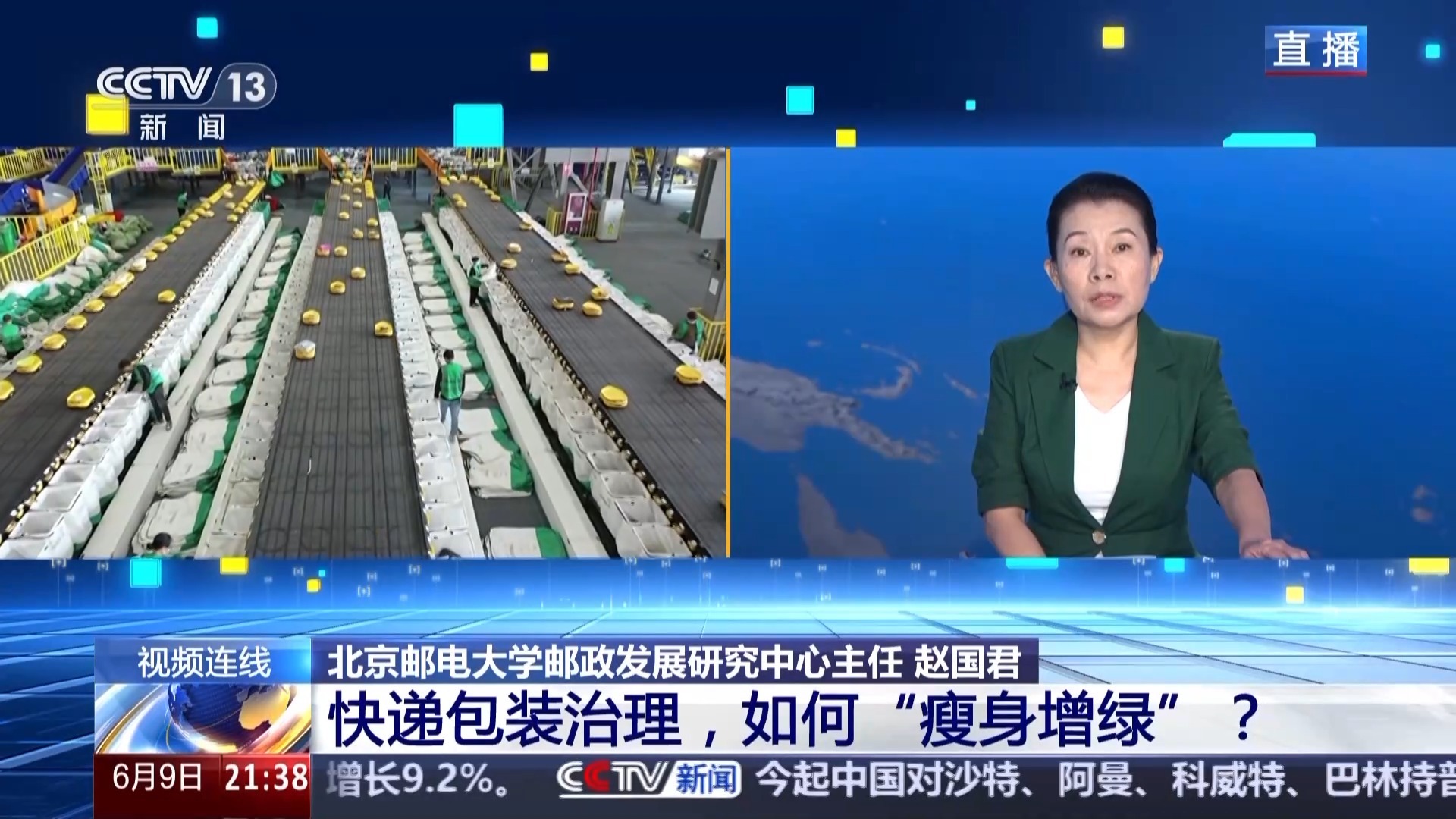
新闻1+1丨快递包装治理,如何“瘦身增绿”?
Yang Shi Xin Wen Ke Hu Duan· 2025-06-10 03:48
Core Viewpoint - The express delivery industry in the country is projected to handle 175 billion packages in 2024, marking a 21.5% year-on-year growth, maintaining its position as the world's largest market for 11 consecutive years. However, this increase in package volume raises concerns about environmental impact and the need for effective packaging governance [1]. Group 1: Current State of Express Delivery Packaging - The new revised "Interim Regulations on Express Delivery" has been implemented, specifically addressing express packaging in a dedicated chapter, initiating comprehensive governance of the packaging chain [1][11]. - Significant progress has been made in addressing packaging issues, including the use of environmentally friendly materials, reduction of packaging materials, and the establishment of a preliminary standard system [5][7]. Group 2: Challenges in Packaging Governance - Key challenges remain in defining responsibilities among stakeholders in the supply chain, including manufacturers, e-commerce platforms, delivery companies, and consumers, complicating the governance of green packaging [7]. - The cost of green packaging is currently higher, and there are concerns regarding the increased costs of recycling and potential efficiency losses [7]. Group 3: End-of-Chain Recycling Issues - The ideal closed-loop recycling system faces significant challenges, particularly in last-mile delivery scenarios where delivery personnel cannot wait for consumers to unpack and return packaging [9]. - Consumer privacy concerns and the lack of convenient recycling infrastructure further complicate the effective recovery of packaging materials [9]. Group 4: Regulatory Measures and Penalties - A series of national standards related to express packaging have been introduced, including mandatory standards to limit excessive packaging and recommendations for reusable packaging [11]. - In Zhejiang province, over 20 administrative penalties related to environmental packaging were issued last year, with violations primarily concerning failure to inform users about packaging requirements and inadequate training for staff [11][13]. - The revised regulations impose fines ranging from 5,000 to 20,000 yuan for non-compliance, emphasizing the need for express companies to enhance training and compliance efforts [13].

三部门负责人就《国务院关于修改〈快递暂行条例〉的决定》答记者问
Zhong Guo Chan Ye Jing Ji Xin Xi Wang· 2025-04-26 22:32
Core Viewpoint - The State Council's decision to amend the "Interim Regulations on Express Delivery" aims to address environmental issues related to packaging in the rapidly growing express delivery industry, which has seen significant growth in recent years [2][3]. Background - The express delivery industry is a crucial part of modern services, significantly contributing to cost reduction in logistics, supporting e-commerce, and creating employment opportunities. In 2024, the industry handled 1.75 trillion packages, maintaining its position as the world's largest for 11 consecutive years. However, this growth has led to excessive resource consumption and environmental pollution, necessitating comprehensive regulatory measures [2]. Overall Approach to Amendment - The amendment focuses on packaging issues, emphasizing three main principles: 1. Problem-oriented approach to enhance packaging management systems for green development [3]. 2. Systematic perspective to clarify responsibilities across the entire packaging chain, including design, production, usage, and recycling [3]. 3. Balancing regulation and guidance to foster a supportive environment for green development while considering industry realities [3]. Responsibilities of Express Delivery Companies - The decision reinforces the responsibilities of express delivery companies in packaging management, mandating compliance with national standards and regulations to prevent excessive packaging and environmental pollution. Companies are required to optimize packaging methods, implement operational norms, and report on the use and recycling of single-use plastics [3][4]. Systematic Governance of Packaging - The decision promotes a comprehensive approach to packaging governance, encouraging collaboration among various stakeholders, including manufacturers and e-commerce companies. It also supports the use of biodegradable and reusable materials and aims to improve recycling rates through the establishment of collection facilities [4]. Ensuring Safety in Packaging Reduction - The amendment stipulates that any reduction in packaging must prioritize the safety of deliveries. It emphasizes that companies should optimize packaging while ensuring the protection of goods, supported by national standards that provide technical guidelines for reducing excessive packaging [5]. Implementation Measures - To ensure effective implementation of the decision, three key actions will be taken: 1. Ongoing promotion and training to enhance understanding of the decision among stakeholders [6]. 2. Development of supporting regulations and standards to facilitate the decision's application [6]. 3. Strengthened supervision and enforcement to ensure compliance and address violations [6].