
急救教育

Search documents
苏州市政协委员姚立:建立中小学急救师资体系,让更多师生“会急救、敢急救”
Xin Lang Cai Jing· 2026-01-21 12:21
Core Viewpoint - The need for a shift in campus emergency response capabilities from equipment provision to teacher training and skill development is emphasized, advocating for a systematic establishment of emergency response education in primary and secondary schools [1][4]. Group 1: Current Situation - Many primary and secondary schools in Suzhou have equipped themselves with AEDs and other emergency equipment, but there remains a significant gap between having the equipment and knowing how to use it effectively [3]. - Teachers and students often lack sufficient knowledge of emergency response, leading to hesitance or inability to act in emergencies [3]. Group 2: Challenges - A major challenge in current campus emergency education is the insufficient training resources available [4]. - Relying solely on organizations like the Red Cross for training does not meet the actual needs of all primary and secondary schools in Suzhou due to limitations in manpower and resources [4]. Group 3: Proposed Solutions - It is suggested to explore the establishment of a primary and secondary school emergency response teacher training system, led by professional organizations like the Red Cross to develop training standards, curriculum, and certification mechanisms [4]. - The proposal includes training a group of "seed teachers" within schools who can then provide ongoing training to students and staff, integrating emergency education into the broader educational framework [4]. - This approach aims to enhance the overall emergency response capabilities of schools and instill a scientific safety awareness and emergency response skills in students from a young age [4].

江苏省第二届中小学急救教育展示活动举行
Xin Hua Ri Bao· 2025-11-17 23:29
Core Points - The event, organized by the provincial education department, health commission, and Red Cross, showcases advancements in emergency education in Jiangsu [1] - The event features the launch of a new book on safety and emergency education for primary and secondary schools, along with the flag-raising ceremony for the "Su Yun Emergency Education Volunteer Team" [1] - The event emphasizes the philosophy of "life first, education foremost," with participation from 13 representative teams consisting of 65 teachers and 52 students from across Jiangsu [1] - Experts and frontline medical workers from various provinces provided guidance during the event, highlighting the collaborative effort in emergency education [1] - The event serves as a significant platform for promoting the popularization, systematization, and practical application of emergency education in Jiangsu [1]
少年“急救侠”是全民健康素养提升的生动见证
Bei Jing Qing Nian Bao· 2025-09-02 01:00
Core Viewpoint - The article highlights the importance of first aid education among youth, showcasing examples of young individuals who have successfully applied their training in real-life emergency situations, thus emphasizing the shift from theoretical knowledge to practical application in health education [1][2]. Group 1: First Aid Education Impact - The case of Sheng Xuluo, a student who performed CPR effectively, illustrates the successful integration of life education into the curriculum at his school, which includes practical courses on AED usage and trauma care [2]. - The "First Aid Seed" program at Ningbo Yinxiu Experimental Middle School aims to cultivate student leaders in first aid, creating a replicable model for community engagement and knowledge dissemination [2]. - The transformation of first aid skills into essential competencies for youth signifies a qualitative leap in life education, promoting the idea that understanding and protecting life is crucial [2]. Group 2: National Health Education Initiatives - The advancement of first aid education in schools reflects broader national health literacy initiatives, as seen in policies like the "Healthy China 2030" plan and the "Three-Year Action Plan for Improving National Health Literacy" [2]. - Community-based first aid classes and the availability of AED devices in public spaces contribute to a comprehensive network for health knowledge dissemination [2]. Group 3: Challenges in First Aid Training - Despite the progress, there are significant challenges, including a high incidence of cardiac arrests (544,000 cases annually) and a low on-site rescue success rate of less than 1% [3]. - Disparities in emergency resources between urban and rural areas, with rural AED availability being less than one-third of that in cities, highlight the need for improved access and training [3]. - Misconceptions about first aid being solely the responsibility of medical professionals hinder the widespread adoption of these skills among the general public [3].
苏州市首届中小学急救教育展示活动举行 全市9支县市级代表队的100余名师生参加
Su Zhou Ri Bao· 2025-09-02 00:22
Group 1 - The event aims to promote first aid education in primary and secondary schools, enhancing the knowledge and skills of teachers and students [1] - The event was organized by the Suzhou Education Bureau, Suzhou Health Commission, and Suzhou Red Cross, with a focus on integrating first aid knowledge with moral and quality education [1][4] - Activities included written tests, skill demonstrations, and scenario drills, assessing practical skills in various first aid techniques [1][2] Group 2 - The theoretical test consisted of 80 single-choice questions and 10 multiple-choice questions, demonstrating participants' solid grasp of first aid knowledge [2] - Skills demonstration showcased practical application, including adult CPR and fracture immobilization, emphasizing the importance of precise techniques [2][3] - The event featured team scenario drills, where participants responded to simulated emergency situations, fostering collaboration and quick response [2] Group 3 - Scoring for CPR included both judge evaluations and computer assessments, highlighting the importance of accuracy in various CPR techniques [3] - The winning teams will advance to the second Jiangsu Provincial First Aid Education Display Event, indicating a competitive aspect to the initiative [4]
“冷静小孩姐”为何敢出手(有事说事)
Ren Min Ri Bao Hai Wai Ban· 2025-08-25 01:12
Core Viewpoint - The incident involving a young girl successfully using the Heimlich maneuver to save a woman highlights the importance of first aid education and its impact on society [2][3]. Group 1: Importance of First Aid Education - The young girl, Hu Zihan, is a volunteer in a youth first aid training program and recently learned the Heimlich maneuver, which she applied in a real-life situation [2]. - The incident reflects the results of ongoing efforts in China to promote first aid education in schools and communities, emphasizing the value of instilling a sense of responsibility and compassion in children [2][3]. Group 2: Current Challenges in First Aid Skills - Despite the progress, the overall public awareness and skills in first aid remain low, with many individuals feeling helpless or hesitant in emergencies due to a lack of knowledge [3]. - There is a need for systemic changes, such as integrating first aid training into the national education system and improving the availability of first aid equipment in public spaces [3]. Group 3: Broader Implications of First Aid Training - The concept of "everyone learning first aid" reflects a collective value of community responsibility, where individuals are encouraged to care for the safety of others [5]. - The ability to perform first aid can significantly impact survival rates in emergencies, as many cardiac arrests occur outside of hospitals, highlighting the critical role of bystanders [3].
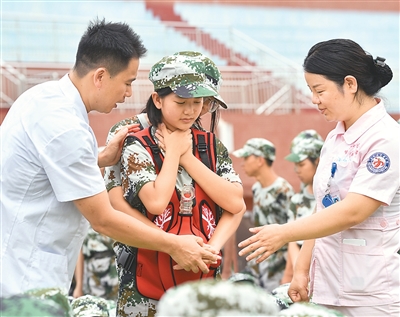
数实融合助力急救教育高质量发展
Xin Hua Ri Bao· 2025-08-14 22:00
Core Viewpoint - The digitalization of education is a crucial breakthrough for developing new advantages in education and enhancing public emergency rescue literacy in China [1][5] Group 1: Emergency Education Development - Emergency education is an essential component of health education in schools, aimed at improving national emergency rescue literacy [1] - The integration of digital and practical approaches is necessary for the high-quality development of emergency education [1][5] Group 2: Teacher Training - Building a qualified emergency education teacher workforce is key to improving education quality, with current shortages and uneven distribution across regions [2] - A collaborative approach involving local governments, medical institutions, and educational bodies is essential for establishing a robust emergency education teacher resource pool [2] - Utilizing advanced technologies such as AI and big data can enhance the precision and effectiveness of teacher training [2] Group 3: Practical Training Bases - Practical training bases are critical for translating emergency education theory into practice, with recent guidelines issued to enhance student health literacy and emergency response capabilities [3] - The establishment of training bases, such as those at Jiangsu Nursing Vocational College, includes various simulated emergency scenarios to meet educational and community needs [3] - The integration of virtual simulation technologies and intelligent devices is being emphasized to create a comprehensive emergency education platform [3] Group 4: Training Models - Effective training models are vital for improving emergency education quality, emphasizing the need for continuous learning and skill reinforcement [4] - The development of a hybrid training model that combines online and offline learning can overcome traditional limitations in emergency skills training [4] - Jiangsu Nursing Vocational College has implemented a smart platform for public emergency training, enhancing accessibility to emergency knowledge and skills [4] Group 5: Public Emergency Literacy - Enhancing public emergency literacy reflects the civilization level of a nation, with emergency education being a key pathway for improvement [5] - The integration of digital technologies in emergency education is essential for creating an accessible and comprehensive emergency education system [5]