恋爱脑

Search documents
青春华章•青春问答 | “恋爱脑”VS幸福大脑:彭凯平教你“拿捏”人生
Yang Shi Wang· 2025-12-21 04:01
Group 1 - The program explores the reasons why young people are reluctant to engage in romantic relationships, questioning the concept of "love brain" and the reliability of AI in love [2] - Professor Peng Kaiping from Tsinghua University, an expert in psychology and cognitive science, provides insights into the essence of love from a psychological perspective [2] - The discussion aims to unlock practical guidelines for achieving happiness in relationships [2]
青春华章•青春问答丨“恋爱脑”VS幸福大脑:彭凯平教你“拿捏”人生
Xin Lang Cai Jing· 2025-12-21 03:17
Group 1 - The program explores the reasons why young people are reluctant to engage in romantic relationships and discusses the concept of "love brain" [1] - It questions the reliability of AI in romantic contexts and its implications for relationships [1] - The discussion features insights from Professor Peng Kaiping of Tsinghua University, who delves into the essence of love from a psychological perspective [1]
青春华章 青春问答 | “恋爱脑”VS幸福大脑:彭凯平教你“拿捏”人生
Yang Shi Wang· 2025-12-21 02:38
Core Insights - The discussion focuses on the reasons why young people are reluctant to engage in romantic relationships, exploring the concept of "love brain" and the reliability of AI in romantic contexts [1] Group 1 - The program features insights from Professor Peng Kaiping of Tsinghua University, who delves into the essence of love from a psychological perspective [1] - The conversation aims to unlock practical guidelines for achieving happiness in relationships [1]
持股市值超10亿元?90后牛散发文征婚,有人质疑是套路,本人回应
Mei Ri Jing Ji Xin Wen· 2025-12-03 22:47
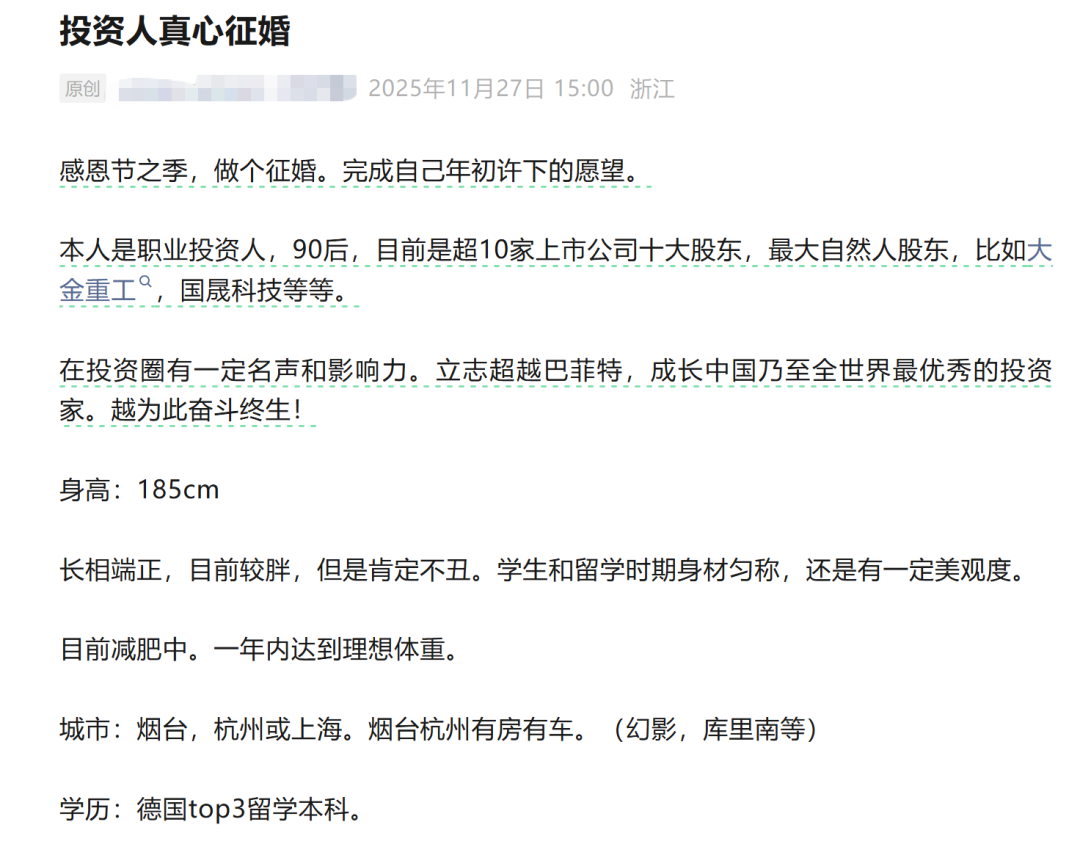
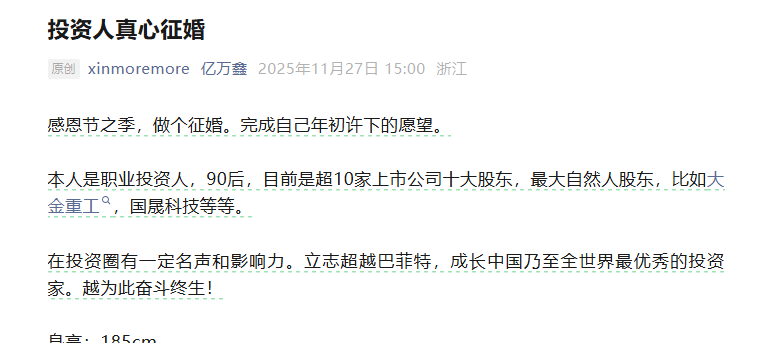
Core Viewpoint - The recent marriage proposal by Liu Xin, a prominent investor in the financial sector, has garnered significant attention, highlighting his ambitions and investment philosophy [1][2]. Group 1: Personal Background and Investment Profile - Liu Xin is a professional investor born in the 1990s, currently among the top ten shareholders of over ten listed companies, including major stakes in companies like Dajin Heavy Industry and Guosheng Technology [1]. - He aims to surpass Warren Buffett and become one of the best investors globally, dedicating his life to this goal [1]. - Liu Xin's stock holdings are valued at approximately 1.008 billion yuan, based on the closing prices as of December 3, with significant investments in Dajin Heavy Industry, China Electric Motor, and Dayuan Pump Industry [4]. Group 2: Investment Philosophy - Liu Xin describes himself as a "romantic brain," emphasizing the importance of emotional intelligence in both relationships and investment strategies [2]. - He believes that successful investors often adopt a flexible mindset, adapting to market trends rather than rigidly adhering to personal opinions [2]. - Liu Xin asserts that many investment failures stem from a subjective and forceful approach, advocating for a more accommodating perspective towards market dynamics [2]. Group 3: Social Engagement and Public Perception - Following his marriage proposal announcement, Liu Xin received numerous friend requests on WeChat, indicating a high level of public interest [4]. - He has expressed a preference for using public platforms to filter potential partners efficiently, given his busy work schedule and limited social interactions [4]. - Despite facing skepticism regarding his investment strategies, Liu Xin maintains that he engages in long-term investments and adheres to legal compliance in his trading practices [5].

身家超10亿!90后“游资大佬”发文征婚,自曝“因做投资成为恋爱脑”
Sou Hu Cai Jing· 2025-12-03 13:33
Group 1 - The core viewpoint of the article revolves around Liu Xin's perspective on investment and relationships, emphasizing the concept of being a "love brain" which involves selflessness and adaptability in both personal and market contexts [2] - Liu Xin has received a significant response to his marriage proposal, with hundreds of people adding him on WeChat daily after the announcement [2] - He describes his lifestyle as relatively introverted and focused on work, dedicating substantial time to researching policies, technological trends, industry dynamics, and company fundamentals, which has contributed to his prolonged single status [2] Group 2 - There are criticisms regarding Liu Xin's investment style, suggesting that he may use emotional manipulation to attract retail investors while selling off stocks at high prices [5] - Liu Xin refutes these allegations, stating that he engages in long-term investments and has held stocks for over three months to six months, emphasizing his commitment to legality and ethical practices in trading [5]
“如果不是真的喜欢,谁愿意做舔狗呢?”
Hu Xiu· 2025-09-04 06:48
Group 1 - The cost of love is increasing, leading many young people to hesitate before pursuing romantic relationships, as love is being demystified in this era [1] - Young people prioritize material needs and do not believe in the idea that love alone is sufficient; they fear the emotional and time investments required in relationships [1] - Despite their hesitations, young people still harbor curiosity and fantasies about love, seeking passion, care, and appreciation in intimate relationships [1] Group 2 - The term "舔狗" (literally "licking dog") refers to individuals who excessively flatter or please their romantic interests without reciprocation, which is viewed negatively by today's youth [2][3] - Young people believe that rational behavior in love involves knowing when to stop pursuing someone who shows no interest, contrasting with the past where such persistence was seen as romantic [2][3] Group 3 - The concept of "恋爱脑" (literally "love brain") describes a mindset where individuals prioritize love above all else, often at the expense of personal growth and rational decision-making [4][5] - Young people are increasingly wary of becoming "恋爱脑," as they associate it with losing personal freedom and autonomy in relationships [5][6] Group 4 - The perception of love among young people has shifted to a more negative view, with many believing that the unpredictability and low return on emotional investment make love not worth pursuing [7] - Young individuals often calculate the costs and benefits of emotional investments, leading to a tendency to avoid relationships that do not offer clear returns [7] Group 5 - Economic pressures play a significant role in young people's reluctance to engage in romantic relationships, as dating is often associated with financial burdens [13][14] - The expectation that men should spend money on dates and gifts has created a competitive environment, leading to feelings of inadequacy among young men [14][15] Group 6 - Young women often face emotional and financial risks in relationships, particularly when they invest in their partners' success without receiving equal support in return [15][16] - The trend of splitting expenses (AA system) in relationships has led to discussions about financial contributions and expectations, often resulting in dissatisfaction [16] Group 7 - The desire for love remains strong among young people, but they often seek it in less traditional forms, such as virtual relationships or reality TV shows, which allow them to experience love without the associated risks [20][21] - Reality dating shows provide a way for young people to engage with romantic narratives while maintaining emotional distance, serving as a substitute for real-life relationships [21] Group 8 - The rise of "甜宠剧" (sweet pet dramas) reflects young people's longing for idealized love stories, offering an escape from the complexities of real relationships [22][23] - These dramas create a fantasy world where love is uncomplicated and fulfilling, contrasting sharply with the challenges faced in actual romantic encounters [22][23] Group 9 - The concept of "麦当劳化" (McDonaldization of love) suggests that young people are seeking to standardize and rationalize their romantic experiences, making love more predictable and manageable [32][33] - Young individuals prefer measurable criteria for choosing partners and efficient processes for dating, reflecting a desire for control and reduced emotional risk in relationships [32][33]
“恋爱脑”自救指南
Hu Xiu· 2025-03-30 09:12
Group 1 - The concept of "love brain" refers to a mindset where love is prioritized above all else, leading individuals to focus entirely on their romantic relationships [1][2] - Individuals with "love brain" often idealize their partners, perceiving them as perfect despite being aware of their flaws, which they choose to ignore [3][16] - "Love brain" individuals experience intrusive thoughts about their partners, dedicating 85% to 100% of their time thinking about them, which negatively impacts their daily lives [6][4] Group 2 - Characteristics of "love brain" include excessive dependence on partners, leading to feelings of anxiety and helplessness when alone [9][7] - The development of "love brain" can stem from childhood experiences, such as lack of parental support or inconsistent caregiving, resulting in anxious attachment styles [20][21] - Individuals may idealize partners as a defense mechanism to avoid disappointment and maintain self-esteem, often leading to a cycle of seeking new partners when the idealization fails [17][19] Group 3 - Strategies for overcoming "love brain" include recognizing personal needs, reprogramming past survival mechanisms, and setting boundaries in relationships [24][28][30] - It is essential for individuals to nurture their inner child and learn to love and respect themselves, which can be facilitated through professional psychological help if necessary [34][38] - Rejecting "love brain" does not equate to rejecting love; rather, it is a step towards healthier and more balanced relationships [40]