房地产市场出清

Search documents
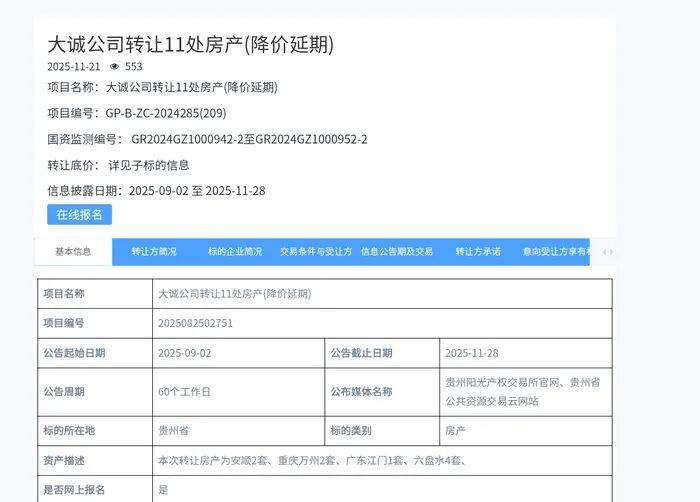
北上广等20个城市地方国资出售房产,部分房源降价超30%
Sou Hu Cai Jing· 2025-11-28 01:45
Core Viewpoint - The recent trend of state-owned enterprises (SOEs) selling real estate assets is driven by the need to alleviate liquidity pressures and optimize asset structures, with significant price reductions observed in various properties [1][4]. Group 1: State-Owned Enterprises' Actions - Multiple local state-owned platforms have joined the trend of selling properties, with examples from cities like Beijing and Guizhou, involving diverse asset types such as repurchased homes and commercial spaces, with some properties seeing price drops exceeding 30% [1][2]. - The Guizhou Sunshine Property Exchange reported that Guizhou Dachen Construction Development Co., Ltd. is selling properties in multiple locations with total prices ranging from 220,000 to 730,000 yuan, indicating a broadening of asset types being sold [2]. - In addition to third-tier cities, first-tier cities like Beijing and Shanghai are also witnessing significant property sales, with high-end residential units listed at prices as high as 16,490 yuan per square meter [2][3]. Group 2: Market Dynamics and Implications - The current trend shows a pragmatic pricing approach and a diverse range of asset types being sold, with the average starting price for certain properties significantly lower than local market averages, indicating a strong price advantage [3]. - Approximately 20 cities have seen local state-owned platforms enter the real estate sales market, reflecting a restructuring of supply and demand dynamics, with an inevitable market clearing process [4]. - Many local state-owned enterprises are under financial pressure, with examples like Tianheng Group reporting a 13.4% year-on-year revenue decline and a net loss of 390 million yuan, leading to property sales as a strategy to maintain operations [4]. Group 3: Long-term Strategic Shifts - The trend of state-owned enterprises selling properties aligns with a broader strategic shift towards divesting from real estate development and focusing on urban renewal and infrastructure operations, as mandated by government policies [4][5]. - The sale of properties by state-owned enterprises is expected to help rebalance the real estate market by reducing excess supply, prompting developers to adjust strategies and improve product quality [5]. - Experts suggest that the current wave of property sales by local state-owned enterprises and banks is a necessary process for market clearing, anticipated to continue until mid-2026 [5].

高盛和摩根士丹利对于地产的研报对比看,能看出些什么有意思的东西?
Sou Hu Cai Jing· 2025-09-06 12:13
Group 1: Market Overview - Both Goldman Sachs and Morgan Stanley agree that the real estate market is still in a downturn, with signs of improvement beginning to emerge [3][4] - Goldman Sachs estimates that there are over 60 million unsold homes in China, with a clearance period of 36 months, while Morgan Stanley highlights a structural oversupply that could meet the housing demand for urban populations over the next five years [3][4] - New home sales are projected to decline by 37.7% year-on-year in 2024, with some third and fourth-tier cities experiencing price drops exceeding 15% [3] Group 2: Policy Effectiveness - Despite a 1.5 percentage point reduction in interest rates by the central bank in 2024, leading to over 2 trillion yuan in long-term funds, new residential mortgage loans have shrunk by 42% compared to the previous year [4] - Goldman Sachs estimates that resolving the "guarantee delivery" and inventory issues would require 8 trillion yuan in fiscal investment, equivalent to 35% of the national fiscal revenue for 2024 [4] - Morgan Stanley points out that the effectiveness of infrastructure investment has decreased significantly, with only 0.2 yuan of GDP growth generated for every 1 yuan invested, a 60% drop in efficiency compared to a decade ago [4] Group 3: Urban Disparities - In the first quarter of 2025, 30 monitored cities showed an 18% increase in new home transactions year-on-year, while lower-tier cities saw a 12% decline [5] - Asset price changes reflect this disparity, with second-hand home prices in Beijing's Chaoyang District slightly increasing by 0.3%, while prices in a central provincial capital have fallen below 2019 levels [5] Group 4: Diverging Recovery Narratives - Goldman Sachs believes that an 8 trillion yuan stimulus plan could create a "policy bottom," projecting a potential recovery in housing prices by the end of 2025 and a sales scale returning to 12 trillion yuan by 2027, still 40% lower than the peak in 2021 [6] - Conversely, Morgan Stanley warns that large-scale stimulus could exacerbate structural imbalances, with the total market value of real estate to GDP ratio remaining at 350%, compared to 169% in the U.S., suggesting that any stimulus could lead to new bubbles [6] Group 5: Economic Dynamics - Goldman Sachs emphasizes the positive impact of manufacturing upgrades, noting a 48% year-on-year increase in exports of new energy vehicles and photovoltaic equipment, which offsets a 0.7 percentage point drag on GDP from declining real estate investment [11] - Morgan Stanley highlights the ongoing erosion of wealth effects, stating that a 1% drop in housing prices could suppress consumption growth by 0.3 percentage points, potentially continuing until 2028 [13] Group 6: Consumer Perspectives - Homebuyers face challenges, with first-time mortgage rates in Beijing dropping to 3.1%, yet average monthly payments consuming 62% of household income, exceeding the international warning line of 40% [14] - Developers are struggling, as evidenced by a promotional offer in Zhengzhou where buying a new home includes a parking space, reflecting a net profit margin below 2% [14] - Younger generations show a 23% decline in home-buying intentions, preferring to invest in vocational education and experiential consumption [14] Group 7: Future Strategies - In major cities like Beijing and Shanghai, mortgage rates have fallen below public fund loan rates, creating a rare opportunity for first-time homebuyers in the second half of 2025 [15] - The asset allocation paradigm is shifting, with real estate's share in household assets needing to decrease from 78% to below 50%, while alternative investments like REITs and affordable rental housing are gaining attention [15] - Awareness of risks is increasing, with a projected 34% debt default rate among the top 50 private real estate companies in 2024 [15]