
制造业升级

Search documents
【公募基金】外乱内稳,筹近谋远——基金配置策略报告(2026年3月期)
华宝财富魔方· 2026-03-12 09:37
Investment Highlights - In February 2026, the equity market experienced fluctuations with mixed performance across indices, while the bond market saw increased volatility. Most major indices recorded gains except for the ChiNext and STAR 50 indices, which declined. The steel, building materials, and machinery sectors led the gains with increases of 9.52%, 7.72%, and 7.56% respectively, while media, non-bank financials, and consumer services sectors faced deeper declines of -4.22%, -3.48%, and -3.37% respectively [1][6][8] Equity Market Review - The A-share market is expected to maintain a wide fluctuation pattern in March 2026, supported by increased liquidity and policy expectations from the National People's Congress. Key focus areas include price increases driven by geopolitical tensions, sectors benefiting from AI technology maturity, and policy implementation post-NPC [2][12][15] Bond Market Review - The bond market in February saw decreased trading activity due to the Spring Festival, but strong liquidity support from the central bank helped maintain stability. The 10-year government bond yield briefly fell below 1.80%. Major bond fund indices showed positive performance, with the long-term pure bond fund index rising by 0.17%, and the convertible bond fund index increasing by 1.17% [8][20] Fund Performance Overview - The active equity fund indices showed a slight increase in February, with the active stock fund index rising by 1.20%. The market's risk appetite improved post-Spring Festival, leading to a recovery in equity performance, particularly in resource-related sectors [7][17] Thematic Fund Performance - The military industry theme fund ranked first in performance due to geopolitical tensions and the commercial aerospace sector's growth. Environmental theme funds also performed well, while the AI application sector faced a downturn due to concerns over profitability and regulatory scrutiny [9][11] Fund Index Construction - The active equity fund selection index aims to balance value, growth, and balanced styles, focusing on performance competitiveness and stability. The short-term bond fund index is designed to provide stable returns with low risk, while the medium to long-term bond fund index focuses on balancing yield and risk control [16][18][20]


中山大学李江帆:广东两业协同恰逢其时,AI正重塑广东制造
2 1 Shi Ji Jing Ji Bao Dao· 2026-02-25 00:18
Core Viewpoint - The Guangdong "New Spring First Meeting" emphasizes the theme of "coordinated development of manufacturing and service industries," marking the start of high-quality economic development for the year [1] Group 1: Manufacturing and Service Industry Coordination - The coordinated development of manufacturing and service industries is essential for achieving industrial upgrading and embracing technological advancements [1] - The Guangdong government aims to enhance the production service industry by promoting specialization and high-end value chain extension [2] - The core challenge in developing the production service industry lies in enhancing capabilities in areas directly impacting production processes, such as R&D and technology transfer [2] Group 2: Key Areas for Improvement - The most urgent need for Guangdong's manufacturing sector is to strengthen technological R&D and technology transfer capabilities [3] - Emphasis should be placed on developing information technology as a common "adhesive" to integrate advanced manufacturing with modern services [3] - Strengthening supply chain and logistics services is crucial for cost reduction and efficiency in manufacturing [3] Group 3: Timing for Industry Coordination - The current period is critical for promoting the coordination of manufacturing and service industries, as many industrial sectors remain at the low end of the global division of labor [4] - Ignoring the role of the production service industry could hinder opportunities for manufacturing upgrades [4] - A broader perspective is needed to integrate production services with various industries, not just advanced manufacturing [5] Group 4: Role of AI in Manufacturing - AI large models are becoming a core engine for upgrading manufacturing processes, impacting everything from R&D to supply chain management [9] - These models represent a new "soft production factor" that can enhance both production services and life services, driving high-quality and diversified development [9] - The transformation driven by AI is not just technological but also involves a systemic reshaping of production modes, management styles, and industrial ecosystems [9]
锻造中国制造硬实力
Jing Ji Ri Bao· 2026-02-24 22:11
Group 1 - The core focus of the representative is on the transformation and upgrading of the manufacturing industry, emphasizing the need for simultaneous upgrades in technology and talent structure [1] - During discussions with medium-sized enterprises, it was highlighted that while automation equipment is being adopted quickly, the shortage of composite technical talent is hindering the full release of production line efficiency [1] - The representative is working on improving recommendations to enhance the stability and competitiveness of the manufacturing industry from an institutional level [1] Group 2 - Skills training for talent is another key focus, with the representative visiting vocational schools to understand the alignment between course offerings and enterprise needs [2] - The company has established a skill grading training system internally, promoting the transition of employees from "operational" to "technical" and "composite" roles through job rotation and technical competitions [2] - The representative emphasizes that for high-quality development in manufacturing, technological advancement must progress in tandem with talent growth to achieve both efficiency and employment quality improvements [2]
明志科技资金面波动,前三季度营收净利双降
Jing Ji Guan Cha Wang· 2026-02-13 10:50
Financial Situation - The main funds of the company experienced a net outflow of 150,400 yuan on February 9, 2026, compared to a net inflow of 811,000 yuan on January 8, 2026, indicating a change in short-term funding sentiment [1] Performance and Operations - For the first nine months of 2025, the company's operating revenue was 370 million yuan, a year-on-year decrease of 15.01%, while the net profit attributable to the parent company was 44.15 million yuan, down 16.56% year-on-year [2] Industry Policy and Environment - The industrial automation sector, to which the company belongs, is benefiting from the trend of manufacturing upgrades, and policy guidance may impact long-term development [3] Shareholder Situation - As of September 30, 2025, the number of shareholders increased by 5.29% compared to the previous period, with new institutional shareholders such as CITIC Prudential Multi-Strategy Mixed Fund entering [4]

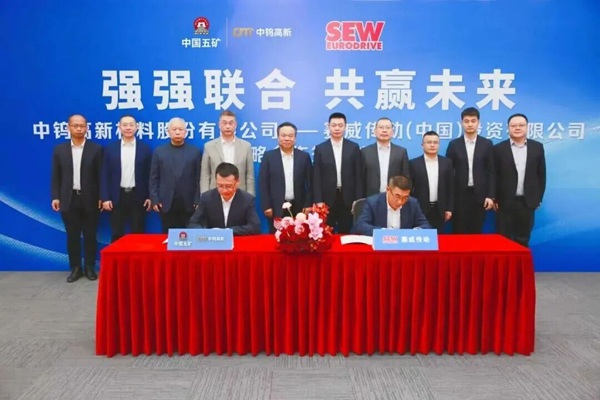
中钨高新:与SEW中国签署战略合作协议 深化产业链协同 共促制造业升级
Zhong Guo Qi Che Bao Wang· 2026-02-13 08:52
Group 1 - The strategic cooperation agreement between Zhongtung High-tech and SEW China marks the beginning of a comprehensive and in-depth collaboration [1][3] - The signing ceremony was attended by key executives from both companies, highlighting the importance of this partnership in enhancing industrial chain synergy [3] - The partnership aims to leverage each other's core strengths to serve the high-quality development and transformation of the manufacturing industry in China and globally [3][4] Group 2 - SEW Group, founded in Germany in 1931, specializes in motors, gearboxes, frequency control devices, and industrial automation systems, with a global presence of 17 manufacturing plants and 92 assembly technology centers [4] - Since entering China in 1993, SEW China has established 7 assembly centers and has become a core partner in several national key projects [4]

从鲁西车间到莫斯科仓,邮储银行科创贷托举“零甲醛地板”出海路
Qi Lu Wan Bao· 2026-02-12 07:58
Group 1 - The core viewpoint of the article highlights the role of Postal Savings Bank in supporting the growth and international expansion of Shandong Xinhai New Materials Co., Ltd, a specialized enterprise in the green building materials sector [1][2] - Xinhai, established in 2003, has evolved from producing automotive plastic parts to becoming a national high-tech enterprise, with products sold in over ten countries [1] - In June 2025, Xinhai faced a funding gap of 5 million yuan due to concentrated raw material procurement, which threatened the expansion of its overseas warehouse and large order fulfillment [1] Group 2 - Postal Savings Bank proactively approached Xinhai during its financial difficulties, providing a 5 million yuan science and technology loan and assisting in applying for interest subsidy policies, thereby reducing financing costs [1] - The bank's support has been integral throughout Xinhai's transformation, facilitating the construction of overseas warehouses and supporting cash flow for large orders, which has enhanced supply chain efficiency [1] - The bank's commitment to serving specialized and innovative enterprises is part of its strategy to support technological innovation and the transformation of traditional manufacturing into high-end, intelligent, and green industries [2]

凌霄泵业资金流入转正,估值处于合理区间
Jing Ji Guan Cha Wang· 2026-02-11 06:48
Group 1 - The core viewpoint is that Lingxiao Pump Industry (002884) has not disclosed specific future events such as earnings releases or shareholder meetings, with current focus on capital flow and valuation levels [1] Group 2 - As of January 5, 2026, Lingxiao Pump Industry experienced a net inflow of 3.637 million yuan in principal funds, indicating a shift from net outflow to inflow, which suggests increased short-term capital participation [2] - The trading activity is reflected in a turnover rate of 1.25% and a volume ratio of 1.36, indicating high trading activity [2] Group 3 - The company's latest valuation shows a price-to-earnings ratio (TTM) of 13.67 times, a price-to-book ratio of 2.74 times, and a dividend yield of 5.64%, all within a historically reasonable range [3] - The general equipment manufacturing industry benefits from manufacturing upgrade policies, indicating a stable long-term demand outlook [3] - Investors are advised to closely monitor the company's upcoming periodic reports (such as annual reports) and changes in industry policies for the latest developments [3]

乐惠国际资金流出收窄,业绩承压估值偏高
Jing Ji Guan Cha Wang· 2026-02-11 06:10
Core Viewpoint - The company has not announced any significant new events recently, indicating a stable operational status [1] Fund Flow - As of January 9, 2026, the net outflow of main funds has narrowed to 55,000 yuan, a significant decrease from the previous day, suggesting a stabilization in short-term market sentiment. However, a turnover rate of 1.39% and a commission ratio of -18.31% indicate active trading with slight selling pressure prevailing [2] Performance and Operations - The company's Q3 2025 report shows a slight revenue increase of 0.28% year-on-year, but the net profit attributable to shareholders has decreased by 17.1% year-on-year. The current TTM price-to-earnings ratio stands at 205.37, which is higher than the industry average, necessitating attention to future financial reports to meet growth expectations [3] Industry Policy and Environment - The machinery equipment sector benefits from manufacturing upgrade policies, and if the industry's prosperity continues, it may lead to potential order growth for the company. However, the high valuation indicates structural risks, and investors should monitor changes in financing data and macro policy trends [4]

IPO对赌倒计时 赎回负债超45亿元 鑫谊麟禾卖身也还不起投资人债
Sou Hu Cai Jing· 2026-02-11 03:38
Core Viewpoint - The MRO (Maintenance, Repair, and Operations) sector, despite being a seemingly low-profile market, is attracting significant capital interest as traditional consumer e-commerce growth slows down. Companies like Xin Yi Lin He are attempting to capitalize on this trend through IPOs and strategic acquisitions [2][3]. Industry Overview - The MRO procurement service market in China is projected to grow from CNY 3.0 trillion in 2020 to CNY 3.7 trillion by 2024, with a compound annual growth rate (CAGR) of 5.6%, indicating a substantial market opportunity [3]. - MRO products include essential items like hardware, lubricants, and various chemicals, which are aggregated on platforms to reduce supply chain costs and enhance pricing [2]. Company Performance - Xin Yi Lin He, established in 2013, operates the B2B e-commerce platform Rui Gu Mall, ranking fifth in the domestic MRO sector. The company reported a revenue increase from CNY 5.05 billion in 2023 to CNY 8.77 billion in 2024, a growth rate of 73.7%. However, its MRO platform business revenue is declining, with a 17.82% drop expected in 2024 [3][5]. - In the first three quarters of 2025, Xin Yi Lin He's revenue reached CNY 11.24 billion, but the contribution from its digital platform continued to decrease, accounting for only 24.4% of total revenue [5]. Financial Challenges - Xin Yi Lin He's sales and marketing expenses were CNY 2.99 billion in 2023, representing 59.21% of its revenue. The company faced operating losses of CNY 3.51 billion in 2023 and CNY 3.83 billion in 2024, with cumulative losses of CNY 9.51 billion over three years [7][19]. - The company holds only a 0.9% market share in the online MRO procurement service market, indicating limited scale and profitability [8]. Strategic Shifts - To address the challenges of its platform business, Xin Yi Lin He has shifted towards acquisitions, purchasing Shanghai Hezong for CNY 90 million in December 2023 and acquiring a 40% stake in Ming Lei Group for CNY 300 million in November 2024, aiming to enhance its control over the supply chain [9][10][11]. - The revenue from manufacturing operations surpassed that of the digital platform for the first time in 2024, contributing CNY 4.63 billion, or 52.7% of total revenue [12]. Debt and Valuation Concerns - Xin Yi Lin He faces significant financial pressure, with redeemable preferred shares amounting to approximately CNY 4.45 billion by September 2025, while total assets were only CNY 32.35 billion, leading to a debt-to-asset ratio of 185.85% [18][19]. - The company’s goodwill balance was CNY 82.26 million as of September 2025, raising concerns about potential impairments if acquired assets underperform [16]. Conclusion - Xin Yi Lin He's upcoming IPO is seen as a critical juncture for the company, which is navigating the complexities of transitioning from an e-commerce platform to a manufacturing entity while managing substantial debt and operational losses. The success of this transition will be pivotal for its long-term sustainability and investor confidence [20].

2025年四川减税降费及退税超850亿元 赋能科技创新和制造业升级
Si Chuan Ri Bao· 2026-02-09 03:07
Core Insights - The Sichuan Provincial Taxation Bureau announced that by 2025, tax reductions and refunds to support technological innovation and manufacturing development will exceed 85 billion yuan, effectively stimulating business vitality and injecting strong momentum for industrial innovation and structural upgrades [1] Group 1: Tax Policies and Financial Support - In 2025, Sichuan will provide over 23 billion yuan in tax reductions related to research and development investments and technology transfer, with over 90% of this amount coming from R&D expense deductions [1] - Policies aimed at addressing "bottleneck" technology challenges and supporting talent recruitment and training will result in over 5 billion yuan in tax reductions, effectively aiding in the gathering of high-end talent and breakthroughs in core technologies [1] Group 2: High-tech Enterprises and Emerging Industries - Sichuan's support for the cultivation and development of high-tech enterprises and emerging industries will lead to over 13 billion yuan in tax reductions, with more than 50% of this amount coming from the exemption of vehicle purchase tax for new energy vehicles, benefiting over 546,000 taxpayers [1] - The reduced corporate income tax rate of 15% for high-tech enterprises will result in a tax burden reduction of 10.1 billion yuan, effectively stimulating the development vitality of high-tech enterprises and emerging industries [1]