
国有资产优化

Search documents
北上广等20个城市地方国资出售房产,部分房源降价超30%
Sou Hu Cai Jing· 2025-11-28 01:45
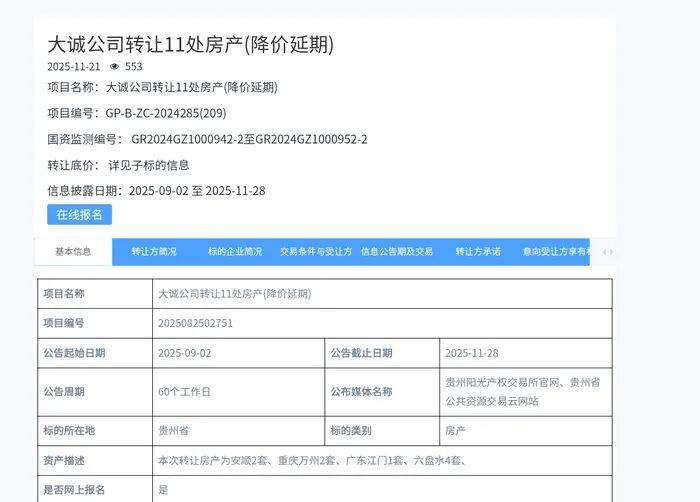
Core Viewpoint - The recent trend of state-owned enterprises (SOEs) selling real estate assets is driven by the need to alleviate liquidity pressures and optimize asset structures, with significant price reductions observed in various properties [1][4]. Group 1: State-Owned Enterprises' Actions - Multiple local state-owned platforms have joined the trend of selling properties, with examples from cities like Beijing and Guizhou, involving diverse asset types such as repurchased homes and commercial spaces, with some properties seeing price drops exceeding 30% [1][2]. - The Guizhou Sunshine Property Exchange reported that Guizhou Dachen Construction Development Co., Ltd. is selling properties in multiple locations with total prices ranging from 220,000 to 730,000 yuan, indicating a broadening of asset types being sold [2]. - In addition to third-tier cities, first-tier cities like Beijing and Shanghai are also witnessing significant property sales, with high-end residential units listed at prices as high as 16,490 yuan per square meter [2][3]. Group 2: Market Dynamics and Implications - The current trend shows a pragmatic pricing approach and a diverse range of asset types being sold, with the average starting price for certain properties significantly lower than local market averages, indicating a strong price advantage [3]. - Approximately 20 cities have seen local state-owned platforms enter the real estate sales market, reflecting a restructuring of supply and demand dynamics, with an inevitable market clearing process [4]. - Many local state-owned enterprises are under financial pressure, with examples like Tianheng Group reporting a 13.4% year-on-year revenue decline and a net loss of 390 million yuan, leading to property sales as a strategy to maintain operations [4]. Group 3: Long-term Strategic Shifts - The trend of state-owned enterprises selling properties aligns with a broader strategic shift towards divesting from real estate development and focusing on urban renewal and infrastructure operations, as mandated by government policies [4][5]. - The sale of properties by state-owned enterprises is expected to help rebalance the real estate market by reducing excess supply, prompting developers to adjust strategies and improve product quality [5]. - Experts suggest that the current wave of property sales by local state-owned enterprises and banks is a necessary process for market clearing, anticipated to continue until mid-2026 [5].

7月24日晚间新闻精选
news flash· 2025-07-24 13:47
Group 1 - The State Council Premier Li Qiang will attend and deliver a speech at the opening ceremony of the 2025 World Artificial Intelligence Conference and Global Governance High-Level Meeting on July 26 in Shanghai [1] - The State-owned Assets Supervision and Administration Commission (SASAC) aims to optimize the allocation of new state-owned assets, adjust the existing structure, resist "involution-style" competition, and strengthen restructuring and integration [2] - The State Administration for Market Regulation has deployed local market regulation departments to conduct a three-month concentrated rectification of power bank quality and safety [3] Group 2 - The People's Bank of China will conduct a 400 billion yuan MLF operation on July 25, with a fixed quantity, interest rate bidding, and multiple price-level bidding for a one-year term [4] - The Zhengzhou Commodity Exchange announced that there are many uncertain factors affecting the glass and soda ash markets, urging member units to enhance investor education and risk prevention, and reminding investors to participate rationally and trade compliantly [5] - Deepwater Institute, which has seen a 20CM four consecutive trading limit, stated that it is currently not involved in the construction of the downstream hydropower project of the Yarlung Tsangpo River [6]