房地产市场筑底修复

Search documents
中国金茂去年营收微增1%
Feng Huang Wang· 2026-03-25 16:06
Financial Performance - In 2025, China Jinmao reported revenue of approximately 59.371 billion yuan, a year-on-year increase of 1% [1] - Gross profit was approximately 9.221 billion yuan, up 7% year-on-year [1] - Profit before tax reached approximately 4.967 billion yuan, reflecting a 12% increase compared to the previous year [1] - Net profit attributable to shareholders was approximately 1.253 billion yuan, an 18% increase year-on-year [1] - Total assets amounted to approximately 441.7 billion yuan, a year-on-year increase of 8% [1] - Equity attributable to shareholders decreased by 1% to approximately 53.237 billion yuan [1] Revenue Breakdown - Property development sales revenue was approximately 49.475 billion yuan, accounting for 80% of total revenue, remaining stable compared to the previous year [1] - Property investment revenue was approximately 1.672 billion yuan, accounting for 3% of total revenue, down 1% year-on-year due to the previous year's asset transfer [1] - Hotel operation revenue was approximately 1.62 billion yuan, also accounting for 3% of total revenue, down 5% due to the sale of a hotel [1] - Jinmao Services revenue was approximately 3.667 billion yuan, accounting for 6% of total revenue, up 24% year-on-year due to increased managed area [1] - Other income, including various real estate-related businesses, accounted for 8% of total revenue, with a 15% year-on-year increase [1] Debt and Land Acquisition - As of the end of 2025, accounts payable and notes payable were 24.219 billion yuan, a 6% increase from 22.858 billion yuan in 2024 [2] - The company achieved a contracted sales amount of approximately 113.5 billion yuan and acquired 21 land parcels, adding over 100 billion yuan in value [2] - The company successfully revitalized 15 land parcels throughout the year [2] Funding and Market Outlook - In 2025, the company continued to diversify its funding sources, issuing multiple bonds with varying interest rates [2] - The management noted that the overall performance of real estate companies continued to face pressure, with challenges in sales due to buyer confidence and market risks [2] - The hotel market is undergoing a deep adjustment period, with expectations for further brand and chain development despite short-term profit challenges [3] - The commercial leasing market is entering a phase of inventory management, with a significant reduction in new investments [3] - The chairman expressed optimism about a potential market rebound after a period of stabilization, particularly in first- and second-tier cities [3]
一线城市二手房价降幅明显收窄
21世纪经济报道· 2026-02-13 08:54
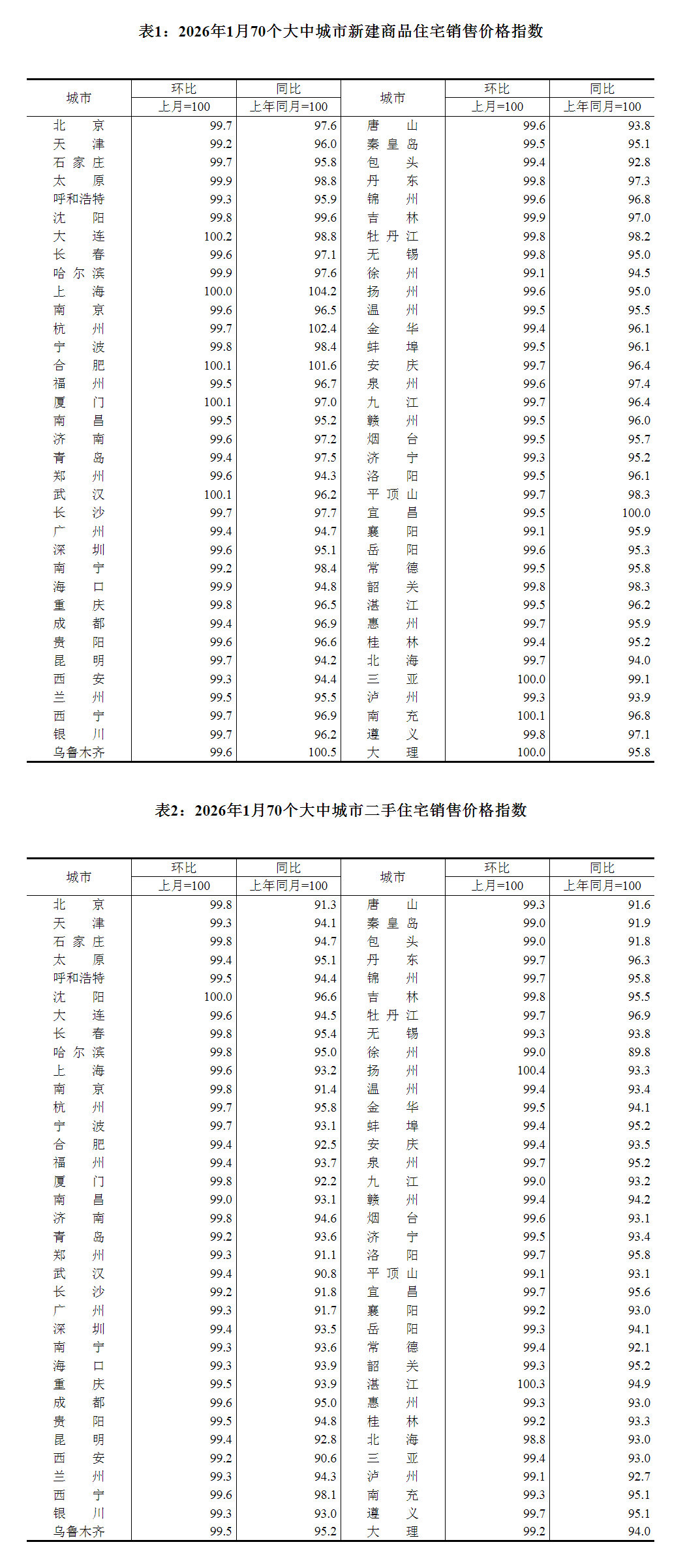
Core Viewpoint - The real estate market in China is showing signs of stabilization and recovery, particularly in January 2026, with a narrowing decline in housing prices across major cities, indicating a potential bottoming out of the market [1][2][4]. Group 1: Housing Price Trends - In January 2026, new residential sales prices in first-tier cities decreased by 0.3% month-on-month, with Shanghai remaining stable and other cities like Beijing, Guangzhou, and Shenzhen experiencing declines of 0.3%, 0.6%, and 0.4% respectively [1]. - Second-tier cities saw a month-on-month decline of 0.3% in new home prices, while third-tier cities experienced a 0.4% drop, both showing a slight narrowing of the decline compared to previous months [1]. - The second-hand housing market in first-tier cities recorded a month-on-month price drop of 0.5%, but this was a reduction of 0.4 percentage points from the previous month, indicating a potential recovery trend [1][4]. Group 2: Market Dynamics and Recovery Signals - The increase in transaction volume in the second-hand housing market, with a 16% month-on-month rise in January 2026 across 13 key cities, suggests a rebound in market activity [1]. - The overall housing market is characterized by structural adjustments and signs of recovery, with demand resilience and positive signals in transaction activity, indicating a gradual transition towards stabilization [2]. - Core cities are becoming pivotal in stabilizing national housing prices, with first-tier cities showing steady new home prices and narrowing year-on-year declines [2][4]. Group 3: Future Outlook and Policy Implications - The real estate policy direction is expected to remain focused on stabilizing the market and expectations, with a continued emphasis on targeted measures to address supply and demand [4][5]. - The market's recovery stability is still fragile, and the sustainability of policy effects post-Spring Festival will be crucial for orderly demand release [4][5]. - The beginning of 2026 is seen as a positive start for the housing market, with expectations of continued stabilization through March and April, although challenges in supply-demand dynamics and economic fundamentals remain [5].

全国房价止跌信号初现,二手房价格环比跌幅持续收窄,重点城市成交量显著回升!
Sou Hu Cai Jing· 2026-02-13 05:42
Core Viewpoint - The real estate market in China is showing initial signs of stabilization, with a gradual recovery expected despite significant regional disparities [1][5]. Market Performance - In January, the average price of second-hand residential properties in 100 cities decreased by 0.85% month-on-month, a reduction of 0.12 percentage points from the previous month, indicating a weakening of downward momentum [3]. - The transaction volume in 13 key cities for second-hand homes increased by 16% month-on-month and 33% year-on-year, with first-tier cities like Beijing, Shanghai, and Shenzhen seeing over 20% year-on-year growth [3]. - The average price of new homes in 100 cities slightly increased by 0.18% month-on-month, ending a streak of declines and signaling positive market sentiment [3]. Regional Disparities - The market is characterized by significant differentiation, with first-tier and strong second-tier cities recovering faster due to concentrated resources and robust demand, while ordinary second-tier cities are primarily focused on inventory reduction [5]. - The overall price trend shows 27 cities experiencing price increases, 57 cities seeing declines, and 16 cities remaining stable, highlighting the widening gap between premium and ordinary properties [5]. Policy Impact - A combination of policies, including interest rate cuts, relaxed purchase restrictions, and optimized credit conditions, is effectively lowering purchasing costs and stimulating demand [3]. - The second-hand housing market is acting as a barometer, showing early signs of stabilization with reduced panic selling and a gradual restoration of market order [3]. Future Outlook - The recovery of the real estate market is expected to be gradual, with challenges such as inventory digestion, expectation reshaping, and population flow affecting overall rebound [5]. - The market is transitioning from rapid growth to high-quality development, maintaining the principle of "housing is for living, not for speculation" [5]. - The stabilization of prices is seen as a positive starting point for long-term healthy development, with a focus on steady progress rather than explosive growth [5].
58安居客研究院张波解读1月70城房价数据:新房市场城市能级差异进一步凸显,核心城市二手房价格在1月份率先企稳
Jin Rong Jie· 2026-02-13 03:09
Core Insights - The real estate market in China is experiencing a structural adjustment and bottoming out, with overall housing prices still in a downward trend but showing signs of stabilization due to policy support and market recovery [5][6][8] New Housing Market - In January, new housing prices in first-tier cities decreased by 0.3% month-on-month, with year-on-year prices down by 2.1%, indicating a widening decline [1] - Second-tier cities saw a month-on-month decrease of 0.3% in new housing prices, while third-tier cities experienced a 0.4% decline [1] - Cities like Wuhan, Qingdao, and Jinan are showing significant recovery, with market activity improving and surpassing the threshold of industry prosperity [6] Second-Hand Housing Market - The second-hand housing market is showing clearer signs of recovery, with first-tier cities' prices stabilizing in January, driven by policy factors and restored market confidence [6] - The year-on-year decline in second-hand housing prices in first-tier cities was 7.6%, with Beijing, Shanghai, Guangzhou, and Shenzhen experiencing declines of 8.7%, 6.8%, 8.3%, and 6.5% respectively [2] - The real estate brokerage industry's prosperity has increased significantly, with a year-on-year rise of 12.72 percentage points, indicating improved sentiment among both landlords and buyers [6] Market Outlook - Expectations for a "small spring" in March are high, with continued policy support anticipated to stabilize the market and expectations [7] - The first quarter is seen as a critical period for assessing the sustainability of policy effects and orderly market demand release, which will be key to determining the strength of market recovery [8]