房地产行业周期

Search documents
最早喊出「活下去」的「打工皇帝」,没等到大结局
3 6 Ke· 2026-01-14 22:59
Core Viewpoint - The retirement of Yu Liang marks the end of a significant era for Vanke, as he has been a key figure in the company and the real estate industry for over 35 years, navigating both rapid growth and challenging downturns [3][6]. Company Overview - Vanke announced Yu Liang's resignation due to reaching retirement age, effective January 8, 2026, after he served as Chairman since June 2017 [3]. - Yu Liang's departure is seen as a signal of Vanke's completion of a phase of "soft landing" amid ongoing challenges in the real estate sector [3]. - Under Yu's leadership, Vanke's sales grew from 3 billion to 700 billion, but the company faced significant losses, including a record loss of 49.478 billion in 2024 [4][6]. Industry Context - Yu Liang has been a vocal figure in the industry, coining terms like "black iron era" to describe the current challenging phase for real estate, emphasizing the need for companies to adapt and survive [4][16]. - He initiated self-rescue measures for Vanke, including asset sales and a focus on cash flow management, as the company struggled with debt and market conditions [4][16]. - The real estate sector is undergoing a transformation, with Vanke shifting its focus from residential development to becoming a "city service provider," diversifying into commercial and logistics sectors [15][16]. Leadership and Strategy - Yu Liang's strategic approach included aggressive acquisitions and a focus on operational efficiency, which helped Vanke become the first Chinese real estate company to exceed 100 billion in sales by 2010 [14]. - His leadership style was characterized by a blend of idealism and pragmatism, which was crucial during both the company's rapid growth and subsequent market adjustments [8][10]. - Despite achieving significant milestones, Yu Liang's tenure ended amid a challenging market environment, reflecting the broader struggles within the real estate industry [16][17].


董事长辞职,CEO拘留背后:好学生万科的冬天还没结束
Sou Hu Cai Jing· 2025-10-23 13:59
Core Viewpoint - Vanke is facing a severe financial crisis, marked by significant losses and a deteriorating relationship with its major shareholder, Shenzhen Metro Group, amid a challenging real estate market [1][8][15]. Financial Performance - Vanke reported a record net loss of 497.78 billion yuan for 2024, indicating the most severe financial crisis since its listing [8]. - In the first half of 2025, Vanke's revenue fell by 26.2% to 1,053.2 billion yuan, with a net loss of 119.47 billion yuan, a 21.25% increase in losses year-on-year [9]. - The company's total liabilities reached 872.99 billion yuan, with a net debt ratio of 90.38%, reflecting a 9.78 percentage point increase since the beginning of the year [10]. Debt and Cash Flow Issues - Vanke's cash flow is under severe pressure, with over 1 trillion yuan in short-term debt due within a year, while cash reserves are only around 800 billion yuan [3][10]. - The company has a cash-to-short-term debt ratio below the safety threshold of 1, indicating a critical liquidity issue [10]. Relationship with Shenzhen Metro Group - Shenzhen Metro Group, Vanke's largest shareholder, has provided over 200 billion yuan in loans to Vanke, but is now facing its own financial difficulties, reporting a net loss of 33.61 billion yuan in the first half of 2025 [12]. - The partnership, once seen as mutually beneficial, is now fraught with challenges, as Vanke's stock price has plummeted below 10 yuan, leading to significant losses for Shenzhen Metro [12][13]. Market Conditions - The real estate market is experiencing a downturn, with Vanke's sales dropping to less than 20% of peak levels, representing an 80% decline [5][11]. - The overall market conditions have led to a drastic reduction in project settlement areas and historically low profit margins, further exacerbating Vanke's financial woes [9]. Strategic Responses - Vanke is attempting to self-rescue through asset disposals, business transformation, and technological empowerment, but faces significant challenges in adapting to the broader market downturn [15][16]. - The future of Vanke may depend on the strategic decisions made by Shenzhen Metro Group regarding continued financial support or potential restructuring of their relationship [13][16].
华润置地上半年核心净利下滑超6%,开发业务拖累业绩
Di Yi Cai Jing· 2025-08-28 11:53
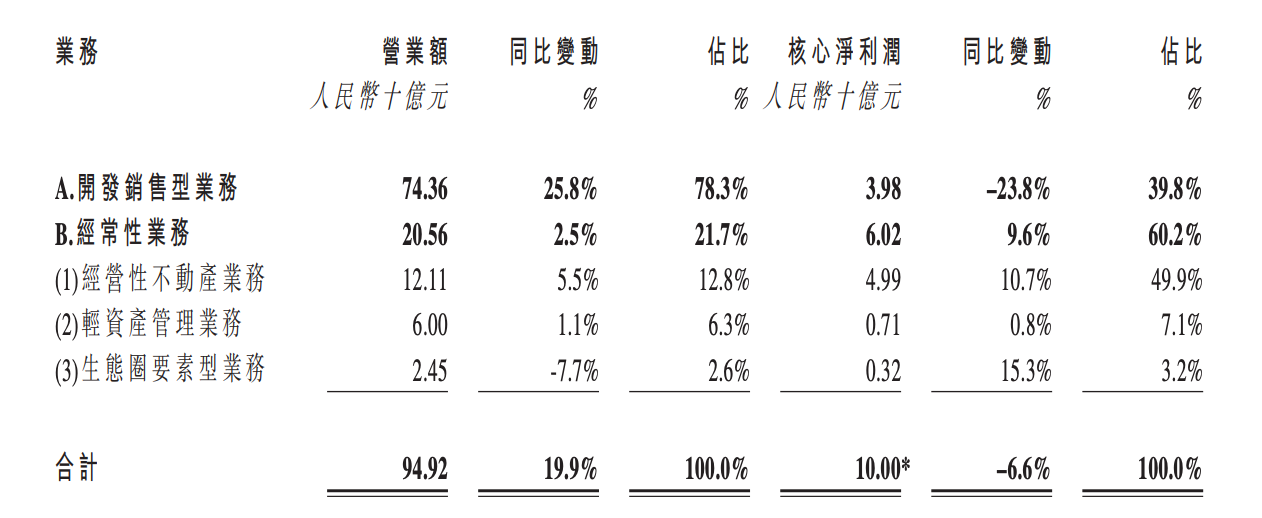
Core Viewpoint - China Resources Land's shopping center openings will slow down significantly in the next three years, with an average of 6-8 new openings per year, compared to previous years [1][10]. Financial Performance - In the first half of 2025, China Resources Land achieved a total revenue of RMB 94.92 billion, a year-on-year increase of 19.9%, while core net profit was approximately RMB 10 billion, a decrease of about 6.6% [2][8]. - The development and sales business generated a core net profit of RMB 3.98 billion, down 23.8% year-on-year, contributing 78.3% to total revenue [4][8]. - Regular business segments, including rental income from shopping centers and property services, contributed over 60% of core net profit, indicating a shift towards more stable income sources [3][9]. Development Business Insights - The development business's revenue was RMB 74.36 billion, up 25.8% year-on-year, but its core net profit fell significantly, reflecting ongoing challenges in profitability [4][8]. - The gross profit margin for the development business was approximately 15.6%, showing a slight recovery but still at a historically low level, down from 29.1% in 2020 [5][6]. Investment and Land Acquisition - In the first half of 2025, China Resources Land acquired 18 new projects, with a total construction area of 1.48 million square meters, although this represented a decrease of over 20% year-on-year [5][6]. - The company spent RMB 488 billion on land acquisitions this year, nearing the total of RMB 526 billion for the entire previous year [7]. Shopping Center Operations - The rental income from shopping centers reached approximately RMB 104.2 billion, a year-on-year increase of 9.9%, with an occupancy rate of 97.3% [10]. - The company plans to open fewer shopping centers in the coming years, with a projected average of 6-8 openings annually, down from 10 and 16 in 2023 and 2024, respectively [10][11]. Future Outlook - Management remains optimistic about the real estate development business, expecting continued support from market policies and strong sales performance in core cities [3][4]. - The company holds a significant amount of commercial land reserves, with 515 million square meters designated for commercial use, indicating potential for future growth despite concerns about market saturation in lower-tier cities [11].