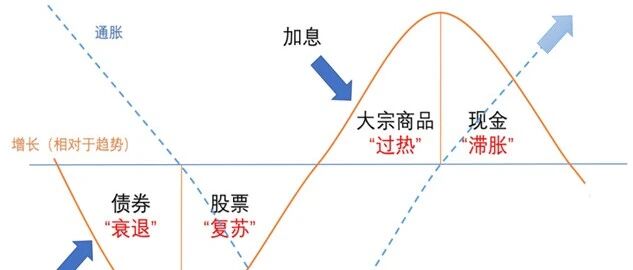
投资时钟

Search documents
投资时钟:赢在周期
泽平宏观· 2026-03-31 01:57
Core Viewpoint - The article introduces the "Investment Clock" as a classic asset allocation method that aligns with economic cycles, emphasizing its effectiveness in identifying optimal asset classes during different phases of the economic cycle [2][5]. Economic Cycle Overview - The economic cycle consists of four phases: recession, recovery, overheating, and stagflation, driven by the "animal spirits" of investors and businesses, which oscillate between greed and fear [3][4]. - Key indicators for determining the economic cycle include GDP growth and CPI inflation, which help classify the economy into the four phases [4]. Investment Clock Theory - The Investment Clock concept, initially proposed by Merrill Lynch, suggests that different asset classes perform variably across the economic cycle, with bonds leading during recession, stocks during recovery, commodities during overheating, and cash during stagflation [5][6]. - Historical data from the U.S. (1970-2020) and China (2001-2020) supports the effectiveness of the Investment Clock framework in guiding asset allocation [8][13]. Asset Allocation Strategies Recovery Phase - In the recovery phase, the recommended asset allocation is: stocks > commodities > bonds > cash, as stocks tend to outperform due to improving corporate earnings and declining interest rates [20][21]. - Key indicators of recovery include a shift to accommodative policies, improvement in leading economic indicators, and a warming market sentiment [19][20]. Overheating Phase - During the overheating phase, the optimal allocation shifts to: commodities > stocks > cash/bonds, as commodity prices rise due to strong demand and inflationary pressures [26][28]. - Characteristics of this phase include strong economic data, rising inflation, and a shift in policy towards tightening [24][25]. Stagflation Phase - In the stagflation phase, the focus should be on cash > bonds > commodities/stocks, as economic growth slows while inflation remains high, necessitating a defensive investment strategy [36][37]. - Key indicators include slowing economic growth, rising inflation, and a challenging policy environment [33][34]. Recession Phase - The recession phase favors bonds > cash > stocks > commodities, as bonds typically provide the best returns during economic downturns due to falling interest rates and increased demand for safe assets [39][44]. - Indicators of recession include declining GDP growth and inflation, rising unemployment, and a shift towards accommodative monetary policy [41][42]. Summary of Investment Clock - The Investment Clock serves as a strategic framework for asset allocation, suggesting that investors should buy bonds during recessions, stocks during recoveries, commodities during overheating, and hold cash during stagflation to achieve superior returns [49][50].

金鹰持久增利LOF: 金鹰持久增利债券型证券投资基金(LOF)2025年中期报告
Zheng Quan Zhi Xing· 2025-08-29 12:23
Fund Overview - The fund is named Jin Ying Persistent Growth Bond Fund (LOF), managed by Jin Ying Fund Management Co., Ltd. and custodied by China Postal Savings Bank [1][15] - The fund was established on March 9, 2012, and transformed into a listed open-end fund (LOF) on March 9, 2015 [15] - The total number of fund shares at the end of the reporting period was 543,783,169.59 shares [1] Financial Performance - The fund achieved a realized income of C share: 3,316,287.54 RMB and E share: 11,440,872.14 RMB during the reporting period [2] - The net asset value (NAV) for C share at the end of the reporting period was 1.3667 RMB, with a net value growth of 1.76%, while E share had an NAV of 1.4793 RMB and a growth of 1.94% [7] - The cumulative net value growth rate for C share was 51.88% and for E share was 44.57% [2] Investment Strategy - The fund aims to achieve returns exceeding its performance benchmark, which is 95% of the China Bond Composite Index (Wealth) growth rate plus 5% of the CSI 300 Index growth rate [1][3] - The investment strategy involves a balanced allocation among bond, equity, and money market assets, considering domestic and international economic conditions [1] Market Outlook - The fund's management anticipates a potential soft landing for the U.S. economy due to the "Big and Beautiful Act," with strong expectations for interest rate cuts [8] - In the domestic market, manufacturing investment is expected to benefit from subsidy policies, while infrastructure investment may become a significant variable [8] - The fund is focusing on sectors such as technology, healthcare, and new consumption trends, while also monitoring the convertible bond market for opportunities [7][8] Management and Compliance - The fund management strictly adheres to the regulations set by the China Securities Regulatory Commission and maintains a fair trading system [5][6] - The fund's management team consists of experienced professionals with diverse investment styles, ensuring a stable investment approach [4]