探月任务

Search documents
嫦娥六号月壤研究成果上新,专家讲述发现过程
Ren Min Ri Bao· 2026-02-03 03:12
Core Insights - The research team has successfully analyzed lunar soil samples from the Chang'e 6 mission, revealing the presence of naturally formed single-walled carbon nanotubes and graphite carbon, which alters the understanding of the Moon's environment and its ability to generate fine carbon nanostructures [1][2] Group 1: Research Achievements - The core research objective for the Chang'e 6 lunar soil samples was to systematically analyze the unique nanostructures of carbon within the samples [1] - The team utilized advanced microscopy and analytical techniques to capture clear images and dynamic videos of the carbon structures, marking the first international confirmation of these findings [1] - A comparison between lunar surface samples and those from the far side indicated a higher number of carbon structural defects in the far side samples, suggesting asymmetry in material composition and evolutionary processes between the two sides of the Moon [1] Group 2: Challenges and Innovations - The primary challenge faced was to present clear nanostructures under a transmission electron microscope while preventing damage from high-energy electron beams [2] - The team adopted a dual approach of optimizing instrument parameters and enhancing efficiency in sample preparation and observation to minimize observation time [2] - The successful results were attributed to collaborative efforts, theoretical research foundations, and expertise in sample testing and data analysis, highlighting the importance of teamwork in achieving these breakthroughs [2]
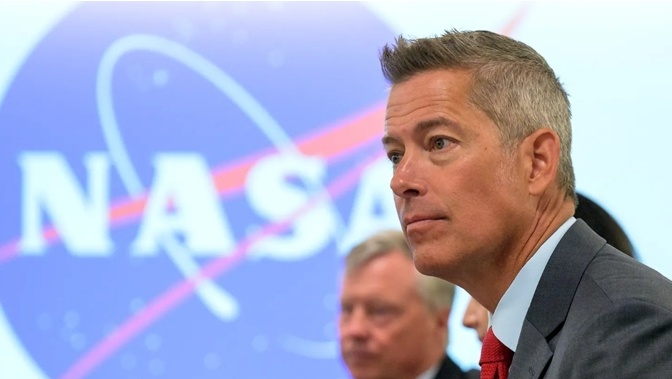
NASA代理局长放话“美国会赢”,美专家:极不可能赶超中国
Huan Qiu Wang· 2025-09-05 07:34
Core Viewpoint - The U.S. aims to return to the Moon before President Trump leaves office, with a focus on winning the "second space race" against China, despite warnings from experts about potential setbacks in the Artemis program [1][3]. Group 1: U.S. Space Ambitions - NASA's acting administrator, Sean Duffy, expressed determination to return to the Moon and establish a lasting presence there [1]. - Duffy stated that the U.S. will reach the Moon before China, emphasizing the competitive nature of the space race [3]. - The Artemis program is seen as a stepping stone for future Mars missions, although the U.S. has not sent astronauts to the Moon since 1972 [3]. Group 2: Challenges and Risks - Experts at a Senate hearing warned that the U.S. risks losing the lunar competition to China due to delays, budget uncertainties, and wavering commitments [3][4]. - The Senate committee chairman, Cruz, indicated that setbacks in the Artemis program could lead to the U.S. conceding the Moon to China [3]. - Former NASA administrator Jim Bridenstine highlighted the detrimental impact of inconsistent U.S. government policies on long-term space missions [4]. Group 3: Dependency on Private Sector - Bridenstine cautioned that the U.S. lunar mission's success heavily relies on a fragile infrastructure dependent on SpaceX, which poses risks to mission designs [6]. - He noted that the operational readiness of the Starship is still pending, requiring multiple fuel supply launches for each lunar mission [6]. - The current trajectory suggests that without significant changes, the U.S. is unlikely to meet its timeline to surpass China's advancements in lunar exploration [6].