政务金融

Search documents
长沙银行(601577):区域经济赋潜能,县域金融空间大
Caixin Securities· 2025-10-28 07:11
Investment Rating - The report maintains an "Accumulate" rating for the company [1] Core Views - The company is well-positioned in the Hunan region, with 99% of its revenue generated from this area, particularly from Changsha, which accounts for 65.76% of its income [4][14] - The bank's diversified ownership structure, primarily state-owned with participation from private enterprises, supports its strong government financial relationships [11][45] - The bank's net interest margin is among the highest in the listed city commercial banks, indicating effective asset utilization and low-cost funding [4][64] - The bank is focusing on retail transformation and expanding its presence in county-level financial services, which is expected to drive future growth [4][5] Summary by Sections Company Overview - Changsha Bank was established in 1997 and became the first regional joint-stock commercial bank in Hunan, listed in 2018 [9] - The bank's headquarters is in Changsha, with a focus on local and regional economic development [10] Regional Advantages - The economic development in Hunan is stable, with a GDP growth rate of 5.6% in the first half of 2025, outperforming the national average [17][19] - Changsha's low housing price-to-income ratio enhances consumer spending and attracts talent, contributing to a vibrant local economy [22] Business Characteristics - The bank has prioritized county-level financial services, achieving a compound annual growth rate of 18.96% in county loans from 2022 to 2024 [40] - The bank's government financial services are robust, supported by its major shareholder, the Changsha Municipal Finance Bureau [45] Financial Performance - The bank's revenue is projected to grow from 245.96 billion yuan in 2023 to 317.23 billion yuan by 2027, with net profit expected to increase from 74.63 billion yuan to 95.07 billion yuan in the same period [3] - The bank's return on equity (ROE) was 11.65% as of mid-2025, ranking it 8th among listed city commercial banks [53]

金融人·事|14年估值大逆转:从“被歧视”到“香饽饽”的城商行样本
Xin Lang Cai Jing· 2025-05-30 13:39
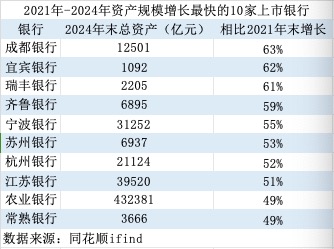
Core Viewpoint - Chengdu Bank has emerged as the fastest-growing commercial bank in China, with total assets increasing by 63% from 2021 to 2024, significantly outpacing other listed banks amid a general slowdown in credit demand in the banking sector [1][3]. Asset Growth - From 2021 to 2024, the total assets of listed banks in China (including Hong Kong) grew by 33%, while Chengdu Bank's total assets reached 1.33 trillion yuan, making it the first city commercial bank in Western China to exceed one trillion yuan in assets [2][3]. - Chengdu Bank's market capitalization nearly doubled to 82.2 billion yuan by May 30, 2024, compared to the end of 2021 [2]. Loan Composition - As of the end of 2024, Chengdu Bank's government-related loans accounted for 53.1% of its total loans, reflecting a strategic focus on public sector financing [3][8]. - The bank's corporate loans exceeded 600 billion yuan, more than doubling since the end of 2021, with corporate loans making up over 80% of total loans [3][4]. Sector Focus - The primary driver of Chengdu Bank's loan growth has been in the leasing and business services sector, which includes financing for government-related projects and infrastructure [5][10]. - By the end of 2024, loans in the leasing and business services sector reached 281.9 billion yuan, a nearly 27-fold increase since 2015 [13]. Risk Management - Chengdu Bank has maintained a low non-performing loan (NPL) ratio of 0.66% as of 2024, the lowest among listed banks, attributed to the stability of its government-related loans [15][19]. - The bank's NPL ratio has decreased by 1.7 percentage points since 2015, while its provision coverage ratio has increased significantly, providing a buffer for future profit releases [19]. Market Position - Chengdu Bank's valuation has improved, with its market capitalization growing by 90% since the end of 2021, reflecting a shift in market preference towards banks with strong government-related loan portfolios [17]. - The bank's strategy of focusing on public sector financing has positioned it favorably in a changing economic landscape, where certainty in loan performance is increasingly valued [17][18].