城投信仰

Search documents
AI“信仰”Vs城投“信仰”
Tebon Securities· 2025-11-26 10:52
Group 1: AI vs. Urban Investment Logic - The "AI faith" and "urban investment faith" share similarities in their foundational logic, emphasizing infrastructure development as a precursor to wealth generation[2] - Key leading indicators for urban investment include city planning area and total project investment, while for AI, they are the number of planned AI servers and data centers, and capital expenditure by major firms[2] - Concerns about AI giants like Nvidia stem from fears of potential overvaluation and competition from alternatives like Google's TPU[2] Group 2: Financial and Economic Implications - The "too big to fail" logic applies to both AI and urban investment, with significant interdependencies in the financial sector; as of November 25, 2025, the "Tech Seven" companies account for 33% of the S&P 500 and 48% of the Nasdaq Composite[2] - The financing logic in urban investment relies on future returns from infrastructure to repay debts, paralleling the substantial investments in AI infrastructure aimed at enhancing computational capabilities[2] - The success of AI is critical for national competitiveness, akin to the role of urban investment in China's rapid urbanization and industrialization[2] Group 3: Future Outlook and Risks - The ongoing debate on whether AI represents a bubble or a genuine faith will require time for resolution, with recent advancements like Google's Gemini 3 and TPU indicating ongoing technological evolution[2] - Risks include the potential for AI development to fall short of expectations, slower-than-anticipated penetration rates, and capital expenditures not meeting projections[2]


金融人·事|14年估值大逆转:从“被歧视”到“香饽饽”的城商行样本
Xin Lang Cai Jing· 2025-05-30 13:39
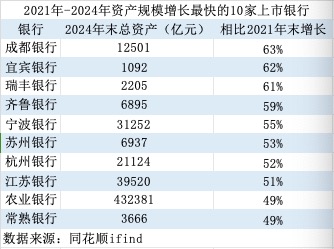
Core Viewpoint - Chengdu Bank has emerged as the fastest-growing commercial bank in China, with total assets increasing by 63% from 2021 to 2024, significantly outpacing other listed banks amid a general slowdown in credit demand in the banking sector [1][3]. Asset Growth - From 2021 to 2024, the total assets of listed banks in China (including Hong Kong) grew by 33%, while Chengdu Bank's total assets reached 1.33 trillion yuan, making it the first city commercial bank in Western China to exceed one trillion yuan in assets [2][3]. - Chengdu Bank's market capitalization nearly doubled to 82.2 billion yuan by May 30, 2024, compared to the end of 2021 [2]. Loan Composition - As of the end of 2024, Chengdu Bank's government-related loans accounted for 53.1% of its total loans, reflecting a strategic focus on public sector financing [3][8]. - The bank's corporate loans exceeded 600 billion yuan, more than doubling since the end of 2021, with corporate loans making up over 80% of total loans [3][4]. Sector Focus - The primary driver of Chengdu Bank's loan growth has been in the leasing and business services sector, which includes financing for government-related projects and infrastructure [5][10]. - By the end of 2024, loans in the leasing and business services sector reached 281.9 billion yuan, a nearly 27-fold increase since 2015 [13]. Risk Management - Chengdu Bank has maintained a low non-performing loan (NPL) ratio of 0.66% as of 2024, the lowest among listed banks, attributed to the stability of its government-related loans [15][19]. - The bank's NPL ratio has decreased by 1.7 percentage points since 2015, while its provision coverage ratio has increased significantly, providing a buffer for future profit releases [19]. Market Position - Chengdu Bank's valuation has improved, with its market capitalization growing by 90% since the end of 2021, reflecting a shift in market preference towards banks with strong government-related loan portfolios [17]. - The bank's strategy of focusing on public sector financing has positioned it favorably in a changing economic landscape, where certainty in loan performance is increasingly valued [17][18].