政府和市场的关系

Search documents
形成“放得活”“管得好”的经济秩序
Jing Ji Ri Bao· 2026-02-10 22:57
Core Viewpoint - The formation of a sound economic order is essential for building a high-level socialist market economy and is an inherent requirement for promoting high-quality economic development and social harmony [1][4]. Economic Governance Requirements - The central economic work conference emphasizes the need for a balance between "letting go" and "managing well," reflecting the organic unity of an effective market and a proactive government [2][4]. - Historical context shows that since the reform and opening-up in 1978, China has continuously adjusted production relations to ensure a dynamic balance between government and market [3][4]. Changes in Economic Conditions - The current era of economic development in China is characterized by increased economic scale and complexity, transitioning from high-speed growth to high-quality development, necessitating a new approach to government-market relations [4][5]. - The 18th National Congress of the Communist Party highlighted the importance of economic system reform, focusing on the relationship between government and market [4][5]. Governance Approach - The shift from "managing to control" to "managing well" indicates a higher requirement for economic governance, emphasizing legal governance and the establishment of a market economy foundation [5][6]. - Economic governance aims to enhance resource allocation efficiency, promote income redistribution, stabilize economic operations, and ensure security [6][7]. Balancing Key Relationships - Balancing efficiency and fairness is crucial, where "letting go" focuses on enhancing efficiency and "managing well" aims to protect fairness through regulatory measures [8][9]. - The relationship between innovation and stability must also be managed, encouraging innovation while ensuring risk prevention and social stability [8][9]. - Development and security must be coordinated, with a focus on promoting development while safeguarding against risks [9][10]. Macro and Micro Economic Governance - Macro-economic regulation should emphasize foresight, precision, and coordination, enhancing policy transparency and managing potential issues effectively [11][12]. - Industry development should focus on guiding, fair, and inclusive governance, promoting healthy industrial growth and innovation [11][12]. - Market order maintenance requires legal, standardized, and normalized governance to ensure a fair competitive environment [12][13].
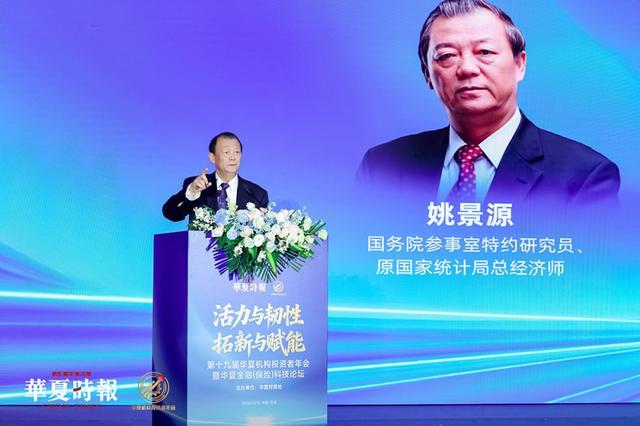
姚景源:统筹国际经贸斗争与国内经济发展,以内功应对外部变局|2025华夏机构投资者年会
Hua Xia Shi Bao· 2025-12-12 06:09
Core Viewpoint - The forum emphasizes the need for resilience and innovation in response to the changing global economic environment, highlighting the importance of expanding domestic demand and building a large domestic market as key strategies for navigating international economic challenges [2][3]. Group 1: External Environment Analysis - The "15th Five-Year Plan" faces a more turbulent international landscape compared to the "14th Five-Year Plan," with increased instability and uncertainty in global economic growth [3]. - China has approximately 600,000 import and export enterprises, employing around 100 million people, indicating a deep integration into the global economy, which makes it vulnerable to external fluctuations [3]. Group 2: Domestic Economic Strategies - The central economic work conference prioritizes expanding domestic demand and building a large domestic market as essential for solidifying responses to international changes and gaining the upper hand in economic competition [3][5]. - There is a need to shift from a supply-driven model to one that leads with new demand, creating a dynamic balance between supply and demand [5]. Group 3: Government and Market Relations - The "15th Five-Year Plan" emphasizes the need for an effective market and a proactive government, with a focus on ensuring that the market plays a decisive role in resource allocation [5]. - The government should work to eliminate barriers in the domestic market and establish a fair competitive order to facilitate orderly market competition [5]. Group 4: Safety and Development - The relationship between safety and development is crucial, with the understanding that development is essential for safety, and safety measures should ultimately serve developmental goals [5].

激活要素市场必须学会啃“硬骨头”
第一财经· 2025-09-02 00:30
Core Viewpoint - The article emphasizes the importance of deepening the market-oriented allocation of factors as a crucial measure for constructing a high-level socialist market economy and promoting the establishment of a unified national market [2][4]. Group 1: Importance of Factor Market Reform - The State Council's recent meeting highlighted the need to focus on key areas and critical links to advance reform trials, encouraging regions to innovate and explore differentiated reforms [2][3]. - The reform is essential for enhancing the efficiency of factor allocation, addressing issues such as the misallocation of traditional production factors like land, labor, and capital, and developing a market-oriented mechanism for new production factors like data [3][4]. Group 2: Challenges and Solutions - The article identifies several challenges in the ongoing factor market reform, particularly in the relationship between government and market, which requires careful balance to avoid excessive intervention or neglect [5][6]. - Key areas needing attention include improving land allocation efficiency, facilitating the smooth flow of labor, enhancing capital's service to the real economy, and promoting the transformation of technological factors into productive forces [7]. Group 3: Empowerment and Legal Framework - The article advocates for further "empowerment" to reduce obstacles in the market-oriented allocation of factors, encouraging regions to boldly explore reforms and respect grassroots innovation [8][9]. - It stresses the need to establish a legal and policy adjustment mechanism to support the comprehensive reform trials, ensuring alignment with existing laws and regulations [8][9].