
生产与消费

Search documents
姚景源谈“十五五”关键关系:发展模式向“重消费、重需求”转变
2 1 Shi Ji Jing Ji Bao Dao· 2025-12-14 04:37
Group 1 - The core viewpoint emphasizes the need for China to strengthen its domestic economy in response to external challenges, particularly in the context of the changing international landscape during the "15th Five-Year Plan" period [1] - The "15th Five-Year Plan" faces a more turbulent international environment compared to the "14th Five-Year Plan," with increased instability and uncertainty in global economic growth [1] - The relationship between international economic and trade struggles and domestic economic work is identified as a primary issue that needs to be addressed [1] Group 2 - There is a clear observation of a strong supply and weak demand imbalance, indicating a need to shift focus from production expansion to enhancing consumption and demand [2] - The adjustment in the "15th Five-Year Plan" from "allowing flexibility and maintaining control" to "allowing flexibility and ensuring good governance" reflects a deepening of the governing philosophy [2] - The concept of "effective market and proactive government" should focus on ensuring market-driven resource allocation, removing barriers to domestic market development, and establishing a competitive market order [2] Group 3 - The relationship between security and development is highlighted, stating that development is essential for security, but security must also serve development [2] - A dynamic balance between security and development is necessary, with high-quality development serving as the foundation for security [2]
姚景源:统筹国际经贸斗争与国内经济发展,以内功应对外部变局|2025华夏机构投资者年会
Hua Xia Shi Bao· 2025-12-12 06:09
Core Viewpoint - The forum emphasizes the need for resilience and innovation in response to the changing global economic environment, highlighting the importance of expanding domestic demand and building a large domestic market as key strategies for navigating international economic challenges [2][3]. Group 1: External Environment Analysis - The "15th Five-Year Plan" faces a more turbulent international landscape compared to the "14th Five-Year Plan," with increased instability and uncertainty in global economic growth [3]. - China has approximately 600,000 import and export enterprises, employing around 100 million people, indicating a deep integration into the global economy, which makes it vulnerable to external fluctuations [3]. Group 2: Domestic Economic Strategies - The central economic work conference prioritizes expanding domestic demand and building a large domestic market as essential for solidifying responses to international changes and gaining the upper hand in economic competition [3][5]. - There is a need to shift from a supply-driven model to one that leads with new demand, creating a dynamic balance between supply and demand [5]. Group 3: Government and Market Relations - The "15th Five-Year Plan" emphasizes the need for an effective market and a proactive government, with a focus on ensuring that the market plays a decisive role in resource allocation [5]. - The government should work to eliminate barriers in the domestic market and establish a fair competitive order to facilitate orderly market competition [5]. Group 4: Safety and Development - The relationship between safety and development is crucial, with the understanding that development is essential for safety, and safety measures should ultimately serve developmental goals [5].

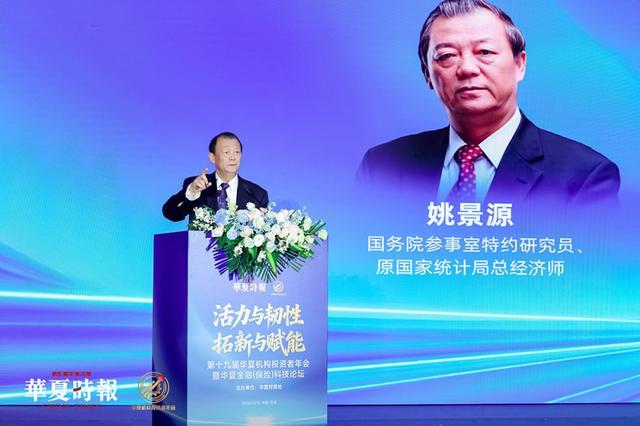
姚景源:统筹国际经贸斗争与国内经济发展,以内功应对外部变局
Xin Lang Cai Jing· 2025-12-12 06:02
Core Viewpoint - The 19th Huaxia Institutional Investor Annual Conference and Huaxia Financial (Insurance) Technology Forum was successfully held in Beijing, focusing on the theme of "Vitality and Resilience, Innovation and Empowerment" to address contemporary challenges and explore future paths [3][8]. Group 1: External Environment Analysis - During the "14th Five-Year Plan" period, the external environment was characterized by "peace and development," while the "15th Five-Year Plan" faces a more turbulent international landscape [10]. - The global economic growth momentum is weakening, with increased instability and uncertainty, making it crucial to balance international economic and trade struggles with domestic economic work [10][4]. - China has approximately 600,000 import and export enterprises, employing around 100 million people, with the economy ranking second globally and trade ranking first, indicating deep integration into the global economy [4][10]. Group 2: Domestic Economic Strategy - The recent Central Economic Work Conference prioritized "expanding domestic demand and building a large domestic market" as a key strategy to respond to international changes and maintain control in economic and trade struggles [4][10]. - Emphasis on "practicing internal skills" is highlighted as a fundamental strategy for addressing external challenges [4][10]. Group 3: Balancing Key Relationships - The need to optimize internal economic structures and improve mechanisms is essential for high-quality development [11]. - The relationship between production and consumption, as well as supply and demand, must be addressed, shifting from a model where supply automatically creates demand to one where new demand leads new supply [11]. - The relationship between government and market is crucial, with a shift in focus from "allowing flexibility and maintaining control" to "allowing flexibility and managing well," emphasizing the role of an effective market and proactive government [11]. - The relationship between safety and development must also be balanced, as development is essential for safety, and safety ultimately serves development [11].
