数据流通服务机构

Search documents
加快推进数据要素市场化
Ren Min Ri Bao Hai Wai Ban· 2026-02-14 02:54
Core Viewpoint - The recent release of the "Opinions on Cultivating Data Circulation Service Institutions and Accelerating the Marketization and Valuation of Data Elements" aims to enhance the value of data elements and promote a vibrant data market ecosystem through the establishment of three types of data circulation service institutions [2][4]. Group 1: Institutional Framework - The "Opinions" define three types of data circulation service institutions: data exchanges (centers), data circulation service platform enterprises, and data merchants, establishing a unified institutional framework [4]. - Each type of institution will have specific roles: data exchanges will enhance comprehensive service functions, platform enterprises will focus on specialized development, and data merchants will expand data product and service offerings [3][4]. Group 2: Market Activation - The document emphasizes the need for diverse data circulation transaction models and encourages institutions to explore innovative data exchange methods, such as data-for-data and data-for-services exchanges [5][6]. - It aims to support the development of high-quality data products and services, focusing on technology innovation, industrial development, and social governance [5][6]. Group 3: Collaboration and Support - The "Opinions" support collaboration between data circulation service institutions and industry leaders to address the "data scarcity" faced by many AI companies, promoting the creation of high-quality data sets [6]. - Institutions are encouraged to leverage data infrastructure for data aggregation, governance, and model training services [6]. Group 4: Future Goals - By the end of 2029, the goal is to significantly enhance the capabilities of data circulation service institutions, diversify transaction forms, and enrich data products and services, thereby improving the overall data circulation utilization level in society [7]. - The "Opinions" address the critical issue of circulation bottlenecks in the data element valuation process, marking a transition in China's data market development from framework establishment to functional enhancement [7][8].
加快推进数据要素市场化(锐财经)
Ren Min Ri Bao Hai Wai Ban· 2026-02-08 22:51
Core Viewpoint - The Chinese government has issued an opinion to cultivate three types of data circulation service institutions to accelerate the marketization and value realization of data elements, aiming to enhance the data market ecosystem [4][10]. Group 1: Types of Data Circulation Service Institutions - The three types of data circulation service institutions defined are: data exchanges (centers), data circulation service platform enterprises, and data merchants, each with specific roles to play in promoting data circulation and marketization [5][6]. - Data exchanges are encouraged to enhance comprehensive service functions, including rule exploration, compliance assurance, and service matching [5]. - Data circulation service platform enterprises are supported to develop specialized services around industry and supply chains [5]. - Data merchants are urged to expand data acquisition channels and develop diverse data products and services [5]. Group 2: Enhancing Data Market Ecology - The opinion emphasizes the need for a clear functional positioning and collaborative development among various data circulation service institutions to establish a structured framework for the data circulation service system [6][10]. - It aims to stimulate the data market by encouraging diverse data circulation transaction models and enhancing service capabilities [8][10]. - The opinion supports the exploration of innovative data circulation transaction modes, such as data exchange for services or models, to lower transaction costs and promote broader data circulation [8]. Group 3: Addressing Data Scarcity in AI - The opinion addresses the "data scarcity" issue faced by many AI companies by supporting collaboration between data circulation service institutions and industry leaders to build high-quality data sets [9]. - It encourages partnerships with AI enterprises to provide data aggregation, governance, and model training services [9]. Group 4: Future Goals and Implementation - By the end of 2029, the goal is to significantly enhance the capabilities of data circulation service institutions, diversify transaction forms, and enrich data products and services [10]. - The opinion proposes promoting the use of standardized data circulation transaction contracts to ensure compliance and efficiency in data transactions [10]. - Industry experts view this opinion as a systematic and forward-looking design to address the critical "circulation bottleneck" in the value realization of data elements, marking a transition to a more functional and vibrant data market [10][11].


释放数据要素价值 四部门发文加快培育数据流通服务机构
Bei Jing Shang Bao· 2026-02-07 08:32
Core Viewpoint - The recent policy document aims to clarify the role of data circulation service institutions, enhance transaction efficiency, and promote the marketization and valuation of data elements, ultimately fostering a vibrant data market ecosystem [1] Group 1: Policy Objectives - The document outlines the goal of significantly improving the capabilities of data circulation service institutions by the end of 2029, with a more diverse range of circulation and transaction forms [1] - It emphasizes the need for richer data products and services, as well as an increased willingness among various entities to supply and utilize data [1] Group 2: Current Landscape - Various data circulation service institutions are currently developing rapidly, playing a positive role in optimizing data resource allocation, expanding application scenarios, and stimulating market vitality [1] - However, there are challenges such as unclear functional positioning, service capability shortcomings, and the need for improved supervision and management [1]
视频丨我国首次明确培育三类数据流通服务机构 助力“人工智能+”行动
Yang Shi Xin Wen· 2026-02-07 03:01
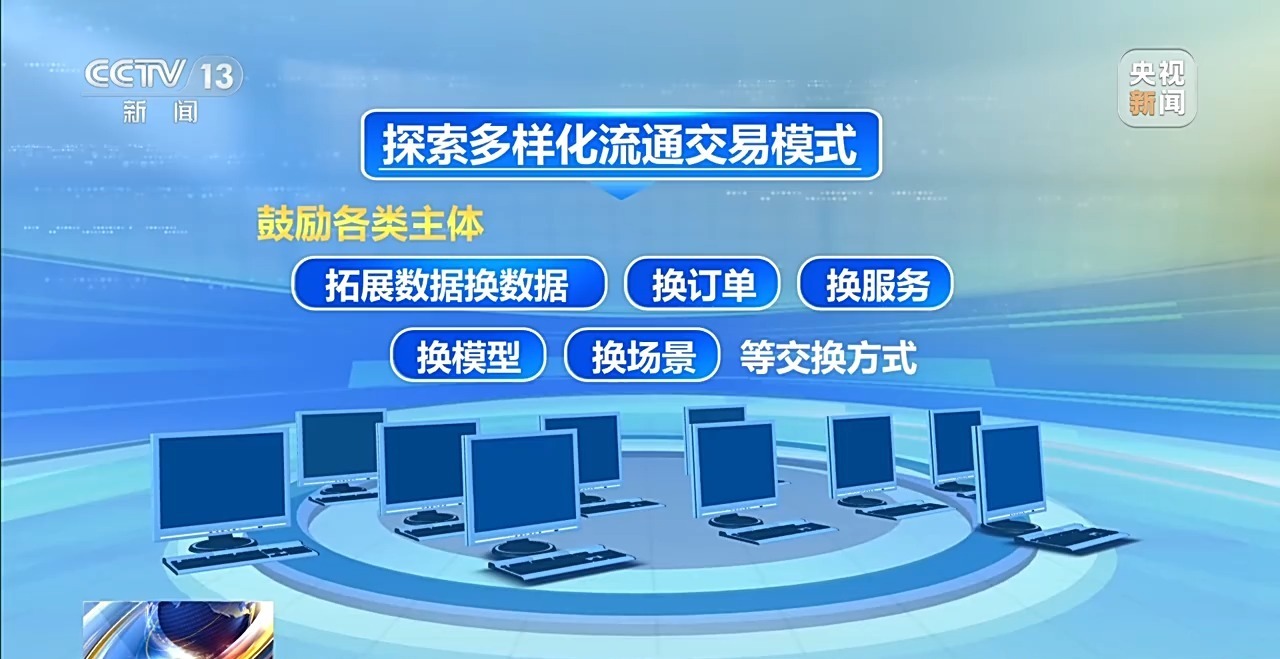
Core Viewpoint - The joint release of the "Opinions" by multiple government agencies marks a significant step towards cultivating data circulation service institutions in China, aiming to enhance the marketization and valuation of data elements. Group 1: Types of Data Circulation Service Institutions - The "Opinions" specify the establishment of three types of data circulation service institutions: data exchanges (centers), data circulation service platform enterprises, and data merchants. Each type has a distinct focus: data exchanges emphasize comprehensive service functions, data circulation service platform enterprises focus on specialized development, and data merchants aim to enhance the development of data products and services [1][3]. Group 2: Innovative Trading Models - The document encourages the exploration of diverse circulation and trading models, promoting various entities to expand data-for-data, data-for-orders, data-for-services, data-for-models, and data-for-scenarios exchange methods. This approach is expected to break traditional trading paradigms and facilitate a broader release of data element value [3]. Group 3: Support for Artificial Intelligence Development - The "Opinions" propose targeted policy measures to support the development of high-quality data sets that cater to artificial intelligence. This includes expanding circulation and trading methods for high-quality data sets that are suitable for AI applications [3][5]. Group 4: Collaboration with AI Enterprises - The document supports data circulation service institutions in strengthening collaborations with artificial intelligence companies, leveraging data infrastructure to provide services such as data aggregation, governance, and model training [5].