
数据监控

Search documents
熊节:斯诺登警告,OpenAI已卸下伪装……
Guan Cha Zhe Wang· 2025-11-26 01:16
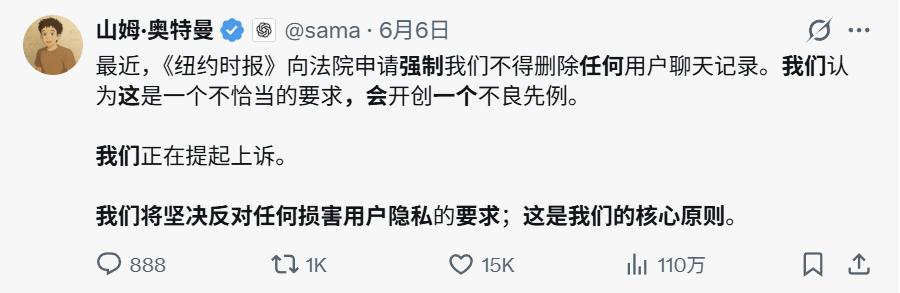
Core Viewpoint - A U.S. federal court has ordered OpenAI to "preserve and isolate all user activity records," raising significant privacy concerns as over 300 million users' conversations with ChatGPT are indefinitely stored, even if users attempt to delete them [1] Group 1: Legal and Privacy Implications - The court's ruling stems from a copyright lawsuit filed by The New York Times against OpenAI, suggesting that users who delete data may be seen as potential copyright infringers [1] - OpenAI's CEO, Sam Altman, expressed concerns that this decision undermines user privacy and sets a troubling precedent [1] - The stored conversations may contain sensitive information, including medical symptoms and personal secrets, which could be at risk of being sold, hacked, or disclosed to law enforcement [1] Group 2: Corporate Response and Data Security - Major corporations, including Samsung, Apple, Amazon, and others, are restricting employee use of ChatGPT due to fears of data leaks, with nearly 70% of companies blocking the tool to protect confidential information [1][2] - The incident involving Samsung employees leaking confidential source code through ChatGPT highlights the potential risks associated with using the platform [1] Group 3: Surveillance Concerns - Edward Snowden has warned that ChatGPT represents a more powerful surveillance tool than the NSA's PRISM program, as it collects comprehensive user data rather than just metadata [5][6] - OpenAI has acknowledged its monitoring of user conversations, claiming it is necessary to combat "malicious use," but this raises questions about the extent and nature of the surveillance [7][8] - The criteria for determining what constitutes a threat to others remain ambiguous, leading to concerns about potential misuse of the monitoring capabilities [9]

微软被曝通过UCPD.sys隐藏数据监控中国用户
Xin Lang Cai Jing· 2025-09-19 04:23
Core Viewpoint - Microsoft is accused of using UCPD.sys to secretly monitor Chinese users by hiding encrypted data and releasing unknown programs to collect user data, with automatic activation of monitoring features in China [1] Group 1: Data Monitoring Allegations - Technical experts claim that Microsoft utilizes UCPD.sys to conceal encrypted data and deploy unknown programs for user data collection [1] - The code is reported to automatically activate monitoring and upload "telemetry data" specifically for users in China [1] Group 2: Software Interception - The system reportedly includes mechanisms to intercept Chinese software, which is suggested to maintain Microsoft's market monopoly [1] Group 3: Previous Reports - Earlier in April, state media reported that the U.S. National Security Agency exploited backdoors in Windows for cyber espionage against China [1] - Microsoft has not provided an official response to these allegations [1]

