文化升维战略

Search documents
首日涨幅86.7% 八马茶业12年IPO修成正果
Bei Jing Shang Bao· 2025-10-28 16:40
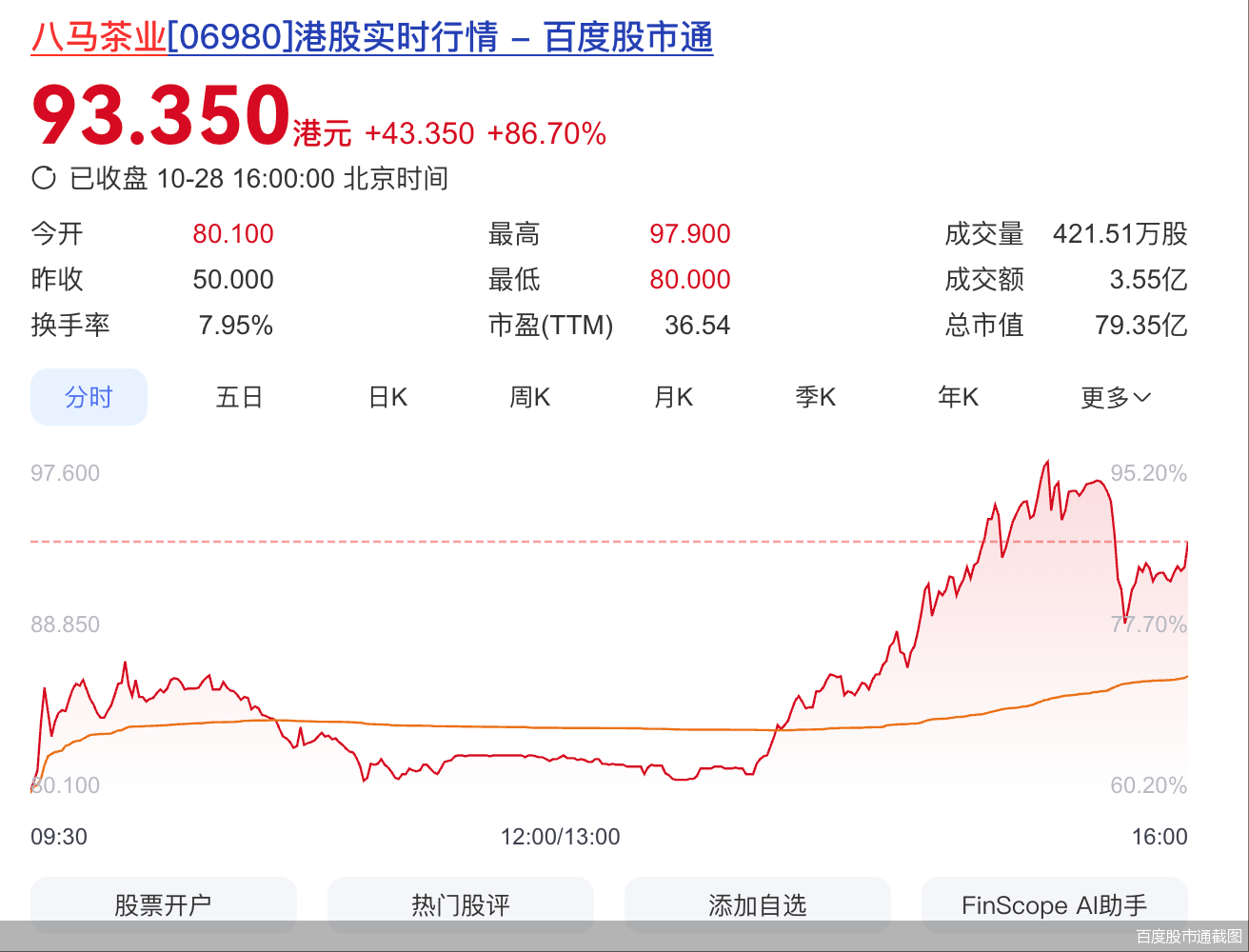
Core Viewpoint - Baima Tea's successful listing on the Hong Kong Stock Exchange marks a significant milestone for the Wang family, with shares opening at 80.1 HKD, a 60.2% increase from the issue price of 50 HKD, and closing at 93.3 HKD, reflecting an 86.7% rise, amidst challenges in the fragmented tea market [1][2]. Group 1: Company Overview - Baima Tea, established in 1997, has developed a comprehensive sales system combining direct sales, franchising, and both online and offline channels, leveraging digital tools for operational efficiency [2][4]. - The company primarily engages in the research, design, standard output, and retail of various tea products, including six major categories of Chinese tea and related products [4]. - The Wang family, as the controlling shareholders, holds a combined voting power of 55.9% in Baima Tea, indicating strong family governance [4]. Group 2: Financial Performance - Baima Tea's projected revenues for 2022 to 2025 are approximately 1.818 billion, 2.122 billion, 2.143 billion, and 1.063 billion CNY, respectively, with net profits of about 166 million, 206 million, 224 million, and 120 million CNY [2]. - The company's gross profit margins are relatively strong, with figures of 53.3%, 52.3%, 55%, and 55.3% for the same periods [2]. Group 3: Market Position and Challenges - The Chinese tea market remains highly fragmented, with over 1.6 million companies involved in tea cultivation, production, and distribution, leading to a market share of only 5.6% for the top five companies by sales revenue [6]. - Baima Tea's market share in the high-end tea segment has increased from approximately 1.1% in 2020 to 1.7% in 2024, indicating growth despite the competitive landscape [6]. - The company faces challenges such as potential franchisee attrition and the need for digital supply chain upgrades to enhance profitability [6][7]. Group 4: Strategic Initiatives - The chairman of Baima Tea has proposed a "cultural elevation" strategy to transform tea from a mere agricultural product into a cultural entity, aiming to enhance brand recognition and consumer engagement [5]. - The company is also focusing on developing sub-brands to cater to diverse consumer preferences, particularly targeting younger demographics [6]. Group 5: Market Sentiment and Future Outlook - The initial public offering (IPO) was met with overwhelming demand, achieving a subscription rate of 2680.04 times, raising 3.9 billion HKD for expansion purposes [2][3]. - The strategic choice to list on the Hong Kong Stock Exchange is attributed to its flexible listing process and higher acceptance of tea companies, which may enhance Baima Tea's international brand influence [3].
79亿港元市值,“福建商帮”跑出的八马茶业
Bei Jing Shang Bao· 2025-10-28 12:39
Core Viewpoint - Eight Horses Tea's IPO has received an overwhelming response, with a subscription rate of 2680.04 times and raised a net amount of HKD 390 million for expanding production facilities [3][4]. Company Overview - Eight Horses Tea was established in 1997 and has developed a comprehensive sales system combining direct sales, franchising, and online and offline channels [3]. - The company has a strong digital presence, empowering its retail stores through digital tools [3]. Financial Performance - Revenue projections for Eight Horses Tea from 2022 to the first half of 2025 are approximately CNY 1.818 billion, CNY 2.122 billion, CNY 2.143 billion, and CNY 1.063 billion respectively [3]. - Net profit for the same periods is expected to be around CNY 166 million, CNY 206 million, CNY 224 million, and CNY 120 million [3]. - The company's gross profit margins are relatively high, with rates of 53.3%, 52.3%, 55.0%, and 55.3% for the respective years [3]. Market Position and Strategy - Eight Horses Tea aims to address the "having categories but lacking brands" issue in the Chinese tea industry by implementing a "cultural elevation" strategy [7]. - The company has established a complete product matrix covering various tea types and related products, with its core brand "Eight Horses" leading in sales for several categories [7]. - The company has maintained a leading position in sales revenue for major tea categories, including Tieguanyin, Wuyi Rock Tea, and black tea [7]. Ownership and Governance - The controlling shareholders of Eight Horses Tea are members of the Wang family, with a combined voting power of 55.90% at shareholder meetings [5]. - The company has connections with the "Fujian business group," enhancing its market presence and credibility [6]. Industry Context - The traditional tea industry in China faces challenges in standardization, professionalization, branding, capitalization, and scaling [8]. - The choice to list on the Hong Kong Stock Exchange is attributed to its flexible listing process and higher acceptance of tea companies [4].