文明起源

Search documents
陕西2025年度六大考古新发现发布
Huan Qiu Wang· 2026-01-17 13:14
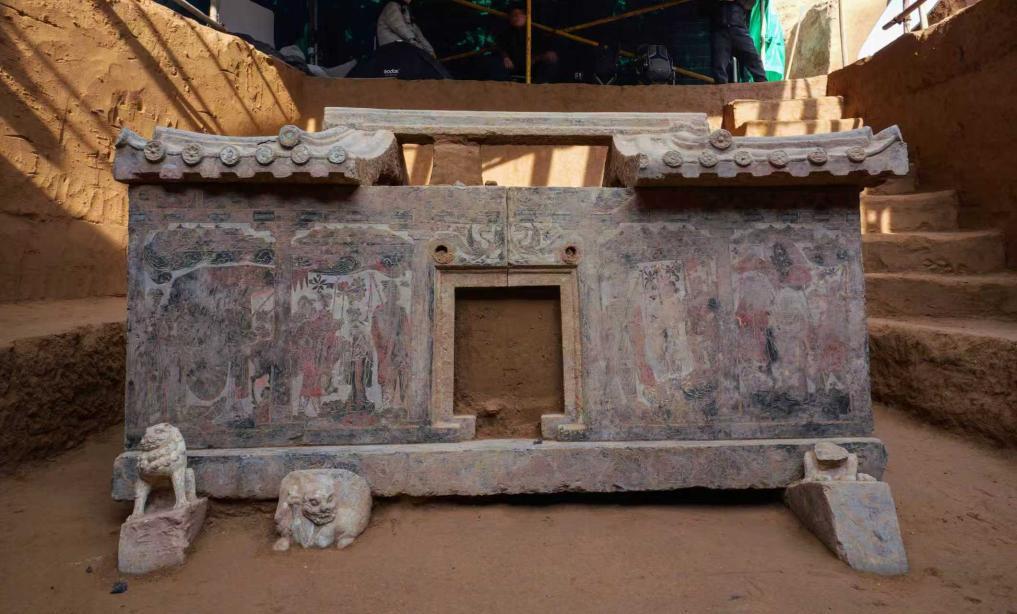
Core Insights - The Shaanxi Archaeological Society announced six major archaeological discoveries for 2025, highlighting significant sites that contribute to understanding the origins of Chinese civilization and cultural exchanges [1][3] Group 1: Archaeological Discoveries - The Weinan Jiangjia site is a large settlement from the Yangshao period, providing new evidence for the origins of the Miaodigou culture and the evolution of settlement forms in the Central Plains [1] - The Xianyang Chunchuan Luojiahe site, dating to the early Longshan period, revealed 17 granary pits, suggesting it was a prehistoric specialized storage base, crucial for studying the origins of early Chinese states and social complexity [1] - The Baoji Fengxian Liangluping site contains artifacts from various periods, demonstrating cultural exchanges between northern and southern regions, laying the foundation for the development of the Shu Road [1] - The Qin Ahfang Palace front hall site confirmed the geographical location and construction sequence of the largest ancient palace foundation in China, offering significant academic value for studying the planning concepts of the Qin Empire's capital [1] - The Yulin Jingbian Tongwan City site identified the basic structure and construction relationships of the southern city gate and the unique "interlocking rammed earth" technique, providing a special case for the study of capital construction history [1] Group 2: Cultural Significance - The Xian Baihuacun Northern Zhou Chengfu Tomb is a high-status noble burial site from the Northern Zhou period, showcasing a beautifully crafted stone coffin with imagery reflecting both Sogdian cultural traits and Central Plains cultural characteristics, exemplifying cultural exchange and integration during this period [3] - The president of the Shaanxi Archaeological Society emphasized that the six major archaeological discoveries span multiple eras, outlining a multidimensional picture of the continuous evolution of Chinese civilization, providing key data for exploring civilization origins, settlement forms, architectural techniques, and cultural exchanges [3]

中国北方万年农业考古新发现:燕山南北早期旱作农业历经三阶段
Xin Lang Cai Jing· 2026-01-14 12:27
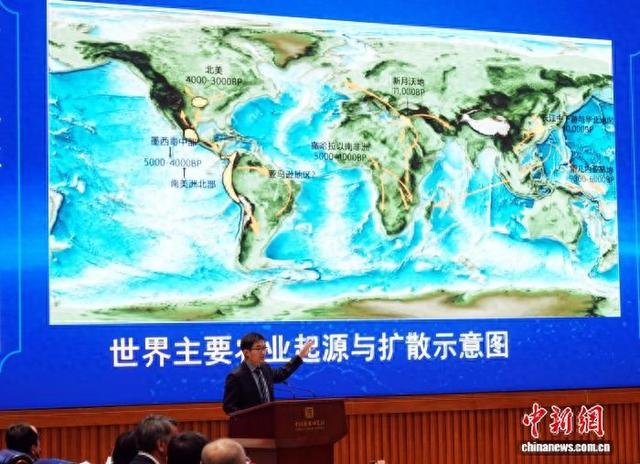
Core Insights - The Chinese Academy of Social Sciences' Key Laboratory of Technological Archaeology and Cultural Heritage Protection announced significant findings regarding the origins of dryland agriculture in northern China, revealing three key stages in its development [1][3]. Group 1: Research Findings - The research team utilized radiocarbon dating and stable isotope analysis to identify critical time nodes in the development of dryland agriculture, which is essential for understanding the origins of agriculture and civilization [1][3]. - The first stage identified at the Sitaizhi site in northern Hebei indicates a coexistence of settled life and agricultural origins around 10,000 years ago, suggesting that this region may be a center for the origins of dryland agriculture [4]. - The second stage, evidenced by findings at the Xiliao River sites, shows that by 7,800 to 7,500 years ago, dryland agriculture had formed a stable economic base, with millet comprising about 70% of the diet of early inhabitants [5]. - The third stage, from 6,200 to 5,000 years ago, indicates that millet constituted approximately 80% of the diet in the core area of the Hongshan culture, reflecting the development of agricultural economies that supported population growth and social complexity [5]. Group 2: Laboratory Contributions - The radiocarbon dating laboratory, established in 1965, is the first of its kind in China and has published over 2,700 dating results, contributing significantly to the foundational chronological framework for Chinese archaeology [7]. - The laboratory will continue to focus on important academic issues related to the cultural history of over 10,000 years and the civilization history of over 5,000 years [7].
来自现场的声音
Ren Min Ri Bao· 2025-04-28 22:36
Core Insights - The article highlights the announcement of the top ten archaeological discoveries in China for 2024, emphasizing the significance and value of various archaeological sites [1] Group 1: Archaeological Discoveries - The Xiantang site in Zhejiang is identified as China's earliest agricultural settlement, revealing a settlement structure from around 9000 years ago, showcasing various archaeological features that provide insights into early agricultural societies [2] - The Lin Tiao site in Gansu, excavated over 101 years, has uncovered a large settlement from the Majiayao culture, featuring a unique triple rectangular layout and a significant pottery production area, shedding light on the origins of civilization in the upper Yellow River region around 4800 years ago [2] - The Panlongcheng site in Hubei is recognized as a crucial stronghold of the Shang Dynasty, with evidence suggesting it remained significant during the mid-Shang period, potentially serving as a conduit for bronze technology to the Sanxingdui site [2][3] Group 2: Cultural Significance - The Wuwangdun No. 1 tomb in Anhui is highlighted as a benchmark for studying Chu culture, showcasing advanced engineering and artistic achievements, with a large burial area and unique artifacts that reflect the cultural exchange between the Central Plains and Chu [4] - The Mo'er Temple site in Xinjiang, excavated for six years, reveals the early stages of Buddhist architecture in China, illustrating the transition of Buddhist culture from India through Central Asia to the Chinese mainland [5]