新兴产业升级

Search documents
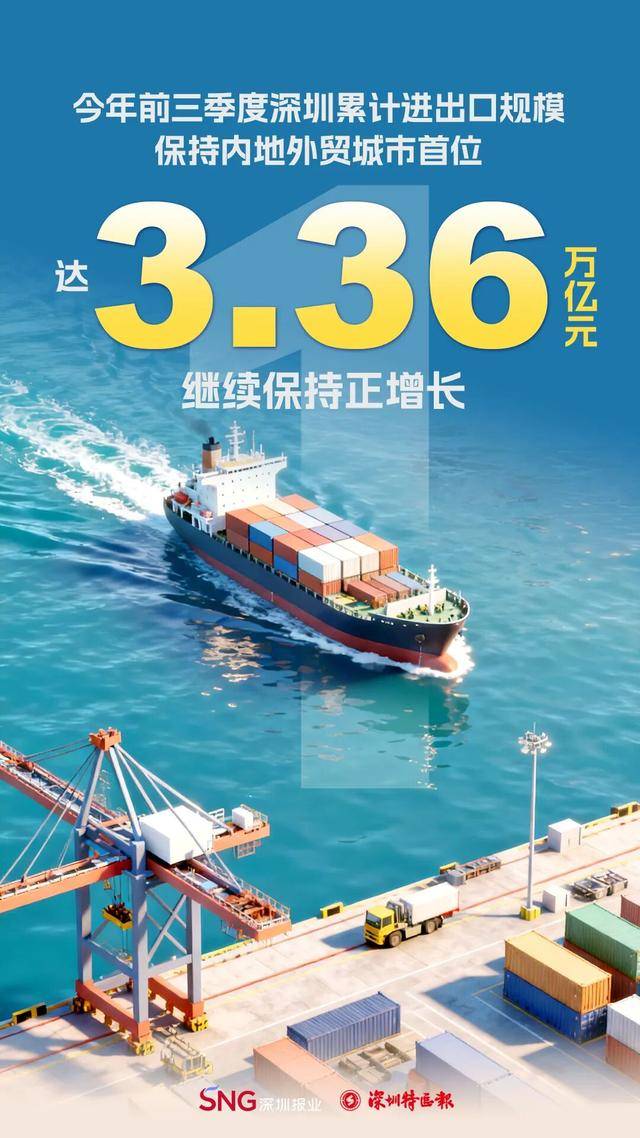
3.36万亿元,保持首位!深圳外贸韧性何来?
Sou Hu Cai Jing· 2025-10-20 05:49
Core Viewpoint - Despite a challenging external environment, Shenzhen's foreign trade continues to show resilience and maintain a steady growth momentum, with a total import and export scale of 3.36 trillion yuan in the first three quarters of the year, marking a year-on-year increase of 0.1% [1][3]. Group 1: Trade Performance - Shenzhen's total import and export volume reached 3.36 trillion yuan, maintaining its position as the leading foreign trade city in mainland China [1]. - Exports amounted to 2.04 trillion yuan, while imports reached 1.32 trillion yuan, with imports growing by 8.4% [1]. - In the first three quarters, Shenzhen's private enterprises accounted for 68.9% of total imports and exports, amounting to 2.32 trillion yuan [9]. Group 2: Role of Private Enterprises - Private enterprises, which make up 97% of the market, are the main force in stabilizing Shenzhen's foreign trade and driving market expansion [5]. - Traditional industries are actively transforming by aligning with diverse overseas demands and moving up the value chain [5]. - Innovations such as the V'mo fingerprint lock bag, which won the 2025 German iF Design Award, exemplify the technological advancements and market adaptability of Shenzhen brands [5][6]. Group 3: Product Innovation - Product innovation is identified as the core competitive advantage for brands going global, with many Shenzhen companies achieving significant breakthroughs [6]. - Shenzhen's bicycle manufacturer, Xidesheng, has developed a carbon fiber bike frame weighing only 560 grams, showcasing its technological prowess [7]. - In the first three quarters, Shenzhen exported bicycles worth 770 million yuan, reflecting a year-on-year growth of 34.5% [7]. Group 4: Export Structure and New Industries - The general trade method, characterized by longer supply chains and higher added value, accounted for 53.8% of Shenzhen's total import and export value, amounting to 1.81 trillion yuan [10]. - Emerging industries, including 3D printing and lithium batteries, are driving export growth, with lithium battery exports increasing by 36.6% [11]. - Shenzhen's traditional electronic information products, such as computers and audio-visual equipment, also maintained a competitive edge, with exports growing by 10.6% and 6.3% respectively [11]. Group 5: Expanding Trade Partnerships - Shenzhen's foreign trade partnerships are expanding, with total imports and exports to the top ten trading partners reaching 2.63 trillion yuan, a growth of 2.2% [13]. - The ASEAN region has become a significant trading partner, providing more export opportunities, especially for high-value products [13]. - The 22nd China-ASEAN Expo facilitated significant orders for Shenzhen's innovative products, further solidifying its influence in the ASEAN market [13]. Group 6: Import Trends - Imports of electromechanical products reached 1.08 trillion yuan, growing by 10.7% and accounting for 81.4% of total imports [15]. - Agricultural product imports also saw a growth of 9.3%, amounting to 752.3 million yuan [15].

南开大学金融学教授田利辉:中长期资金入市对资本市场良性发展具备重要意义
Cai Jing Wang· 2025-05-28 04:46
Core Viewpoint - The introduction of long-term capital into the capital market is essential for its healthy development, as it can stabilize the market, support quality enterprises, and shift focus from speculative trading to fundamental value investing [1][2][3]. Group 1: Characteristics and Advantages of Long-term Capital - Long-term capital and patient capital are characterized by their ability to cross cycles, create value through post-investment management, and stabilize the market by reducing speculative behavior [1][3]. - These types of capital can optimize market structure, lower retail investor proportions, and enhance institutional investor influence, thereby increasing market stability [1][2]. Group 2: Impact on Capital Market and Enterprises - The influx of medium to long-term funds can lower market volatility, optimize investor structure, and enhance market resilience, creating a stable investment environment [2][3]. - Long-term capital can directly support sectors like technology innovation and green economy through equity investments, private placements, and mergers and acquisitions [3][7]. Group 3: Recommendations for Enhancing Long-term Investment - To cultivate long-term capital, it is suggested to extend the assessment cycle for institutions, improve exit mechanisms, and allow the use of derivatives for risk hedging [4][5]. - Asset management institutions should innovate products to include "fixed income plus" offerings and educate investors on the long-term benefits of equity investments [5][6]. Group 4: Financial Institutions' Role in Supporting New Industries - Financial institutions should leverage their strengths to guide funds effectively, supporting infrastructure and manufacturing mergers, and investing in blue-chip stocks and dividend assets [7][8]. - A collaborative ecosystem involving banks, securities firms, and public funds is necessary to create a robust financial support system for the capital market [8][9]. Group 5: Balancing Innovation and Risk in Emerging Industries - Investment in emerging industries should be phased, with small-scale trials in early stages and increased funding as projects mature, while also ensuring diversified investments to mitigate risks [9]. - Attention should be given to the balance between innovation opportunities and risks, including valuation bubbles and regulatory challenges [9].