新基建金属

Search documents
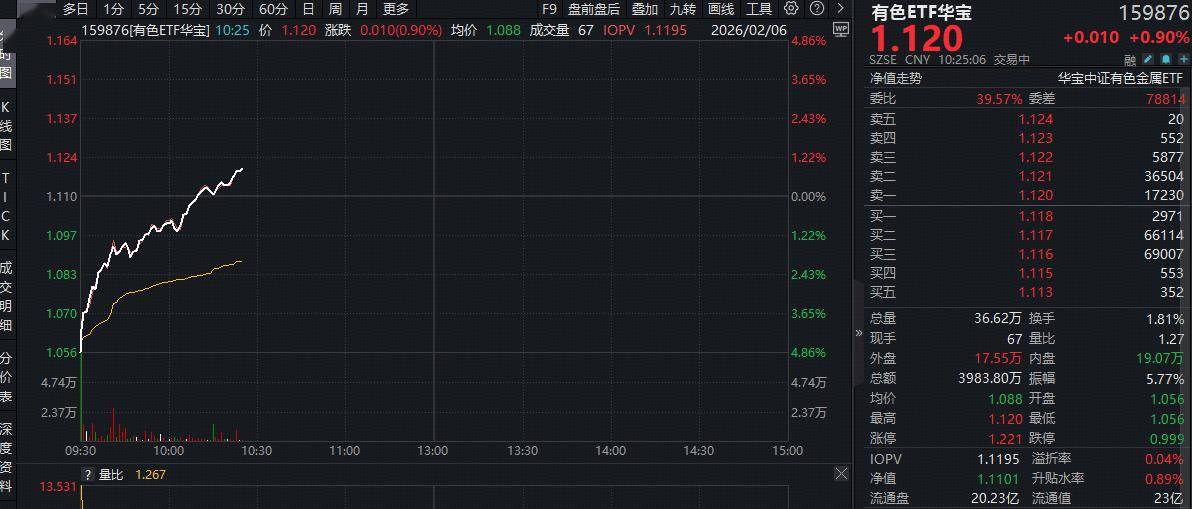
ETF盘中资讯|拔地而起!有色ETF(159876)逆市摸高0.9%,此前两日连续吸金超4000万元!中美同步推进铜资源战略储备建设
Sou Hu Cai Jing· 2026-02-06 03:08
Group 1 - The core viewpoint of the news highlights a strong performance in the non-ferrous metals sector, particularly with the Huabao ETF, which saw a 0.9% increase despite market fluctuations, indicating positive investor sentiment towards the sector [1] - Major stocks in the sector, such as Guocheng Mining and Hunan Gold, led gains of over 5%, while other companies like Shengxin Lithium Energy and Xiamen Tungsten also saw significant increases [1] - The recent influx of capital into the sector, amounting to 40.93 million yuan over two days, reflects a growing confidence in the future performance of non-ferrous metals [1] Group 2 - The strategic importance of copper is underscored by simultaneous initiatives from China and the U.S. to enhance copper resource reserves, with China exploring the inclusion of copper concentrate in its national strategic reserves to address a 75% import dependency [3] - The global copper market is facing a supply-demand imbalance, with declining ore grades and insufficient capital expenditure leading to a predicted long-term supply gap, driven by increasing demand from sectors like AI data centers and electric vehicles [3][4] - Analysts predict that copper prices will rise due to a "safety premium" as countries prioritize resource security amid geopolitical tensions, with domestic initiatives in China aimed at strengthening the copper supply chain [4] Group 3 - The domestic push for a copper resource reserve system aims to enhance the resilience and security of the copper supply chain, with expectations of an expanding global copper deficit leading to upward pressure on prices [4] - The current market conditions suggest that the "non-ferrous feast" will not be a short-term phenomenon, with high profitability expected to persist for 3-5 years due to a combination of supply-demand mismatches and macroeconomic factors [4] - Some analysts caution about potential volatility in the market due to speculative profit-taking, advising a balanced allocation of 10-20% in non-ferrous metals within investment portfolios to capture upside while managing risk [4]

拔地而起!有色ETF(159876)逆市摸高0.9%,此前两日连续吸金超4000万元!中美同步推进铜资源战略储备建设
Xin Lang Cai Jing· 2026-02-06 02:41
Core Viewpoint - The copper market is experiencing a fundamental shift, transitioning from a traditional cyclical commodity to a "new infrastructure metal" due to increasing demand from sectors like AI data centers, electric vehicle adoption, and global grid upgrades [3][11]. Group 1: Market Performance - The Huabao ETF (159876) in the non-ferrous metals sector saw a strong rebound, rising 0.9% on February 6, following a capital inflow of 40.93 million yuan over the previous two days, indicating positive market sentiment towards the sector [1][8]. - Key stocks such as Guocheng Mining and Hunan Gold led gains of over 5%, while other companies like Shengxin Lithium Energy and Xiamen Tungsten also saw increases of over 4% [1][8]. Group 2: Copper Resource Strategy - Both China and the U.S. are advancing copper resource strategic reserve initiatives, highlighting copper's critical role in manufacturing safety. China is exploring the inclusion of copper concentrate in its national strategic reserves to address a 75% import dependency [3][10]. - The U.S. has initiated a $12 billion "Project Vault" for critical mineral reserves, which includes copper among over 50 minerals [3][10]. Group 3: Supply and Demand Dynamics - Analysts predict a long-term supply deficit in the copper market due to declining ore grades and insufficient new capacity investments, coupled with rising demand from new technologies [11]. - The domestic push for a copper resource reserve system aims to enhance supply chain resilience and security, with expectations that geopolitical tensions will further widen the global copper supply gap, leading to price increases driven by a "safety premium" [4][11]. Group 4: Investment Outlook - The current market conditions suggest that high profitability in the non-ferrous metals sector will persist for 3-5 years, driven by supply-demand mismatches, macroeconomic easing, and industrial upgrades [4][12]. - Analysts recommend a balanced allocation of 10-20% in non-ferrous metals within investment portfolios to capitalize on potential price increases while managing risk [4][12].
有色狂飙!已有ETF半年涨幅翻倍!如何理解本轮“超级周期”?
Sou Hu Cai Jing· 2026-01-29 01:41
Core Viewpoint - The recent surge in prices of gold, silver, and industrial metals like copper and aluminum is driven by a combination of factors including risk aversion, industrial revolution, and macroeconomic strategic shifts, indicating a potential new resource cycle [1] Group 1: Gold Market Dynamics - Gold prices have reached multi-year highs, with global central banks maintaining a net buying position for several consecutive quarters, reflecting a strategic adjustment in global reserve asset structures [2][3] - Geopolitical tensions have spurred short-term safe-haven buying, while expectations of a shift in the Federal Reserve's monetary policy towards easing have reduced the long-term opportunity cost of holding non-yielding assets like gold [2] Group 2: Silver and Industrial Metals - Silver prices are rising alongside gold, benefiting from both its financial attributes and industrial demand from sectors like photovoltaics and electronics [3] - Copper is transitioning from a traditional cyclical commodity to a "new infrastructure metal," driven by demand from AI data centers, global grid upgrades, and electric vehicle proliferation, while facing supply challenges due to declining ore grades and insufficient new capacity investments [3] Group 3: Overall Market Trends - The overall prosperity of the non-ferrous metal sector is attributed to a combination of macroeconomic conditions, industrial trends, and strategic recognition, with a loose global monetary policy providing liquidity for commodities [3] - The transition to green energy and the digital intelligence revolution are systematically reshaping the demand landscape for industrial metals, while the strategic importance of key mineral resources like copper and rare earths has risen to a national strategic level, granting them a "strategic premium" beyond traditional commodity valuation [3]