
新技术革命优势

Search documents
专访刘世锦:打造强大的货币与资本市场,为创新和消费架桥
21世纪经济报道· 2025-12-24 14:10
Core Viewpoint - The article emphasizes that China's economy is expected to demonstrate strong resilience and vitality, with major economic indicators aligning with expectations, and the total economic output projected to reach around 140 trillion yuan by 2025 [1]. Group 1: Economic Advantages - China possesses three major economic advantages: the potential for catching up, the new technology revolution focused on digital and green technologies, and the advantage of a super-large market economy [4][5]. - The "catching up potential" indicates that China has a growth potential of at least 20,000 USD per capita GDP to reach the level of developed countries, primarily driven by the upgrading of consumption structure and the transformation of traditional industries [5][6]. - The super-large market economy advantage includes a significant consumer base, with 400 million middle-income individuals and the potential for 800-900 million individuals transitioning to middle-income status, which can significantly expand the consumer market [6][7]. Group 2: Economic Growth Drivers - The current economic growth in China is shifting from being driven by investment and exports to being driven by innovation and consumption [8][9]. - The focus on becoming a manufacturing powerhouse, a consumer powerhouse, and a financial powerhouse is essential for sustaining economic growth and enhancing the quality of development [9][10]. - A strong capital market and robust currency are crucial for bridging the gap between manufacturing and consumption, facilitating the necessary financial support for these sectors [10][11]. Group 3: Financial Market Development - The capital market is expected to play a pivotal role in selecting projects that are marketable, profitable, and have controllable risks, thereby improving resource allocation efficiency [10][11]. - The transition to a modern capital market system is necessary as China enters a phase of innovation-driven economic growth, with more funds expected to flow into capital markets rather than traditional banking [10][12]. - A strong currency is identified as a key indicator of a financial powerhouse, with the potential for the renminbi to become more internationally recognized as China's manufacturing and trade capabilities grow [12][13].


刘世锦:加强金融强国建设,用现代化金融体系为制造强国、消费强国提供服务
Xin Lang Cai Jing· 2025-12-12 05:51
Core Insights - The conference emphasized the importance of identifying, cultivating, and leveraging growth advantages in the context of profound changes in economic conditions [1][3] Group 1: Growth Advantages - The first advantage discussed is the "catch-up potential," which remains stable from both demand and technology perspectives, requiring a humble and willing attitude to learn for significant growth at lower costs and shorter timeframes [1][3] - The second advantage is the "new technological revolution," where China has a relatively small gap in digital and green technologies, allowing it to either catch up or lead in certain fields [1][3] - The third advantage is the "super-large market economy," which encompasses all categories of industries classified by the United Nations, providing a larger innovation network and more sources of innovation [1][3] Group 2: National Strengths - Based on these three advantages, the next step is to promote the construction of three national strengths: manufacturing, consumption, and financial power [2][4] - The emphasis is on building a modern financial system to support the manufacturing and consumption power of the country [2][4]
如何解决人民币“不匹配”问题?刘世锦:大幅增加离岸人民币数量,加快人民币国际化进程
Xin Lang Cai Jing· 2025-12-05 03:23
Core Insights - The "Southern Finance Forum 2025" held in Guangzhou focuses on the theme "The Power of Consensus - Innovation Surge, China's Asset Revaluation" [1][7] Economic Advantages - China has three major economic advantages: 1. Catch-up potential, which includes upgrading consumption structures and transforming traditional manufacturing and agriculture [3][9] 2. New technological revolution focused on digital and green technologies [3][9] 3. Super-large market economy, emphasizing the potential of 9 billion low-income individuals transitioning to the middle-income group, creating a larger consumer market [3][10] Strategic Goals - China aims to implement strategies to become a manufacturing powerhouse, a consumer powerhouse, and a financial powerhouse. The manufacturing goal is to cultivate leading large-scale innovative enterprises, while the consumer goal is to become the largest global consumer market. The financial goal is to support the other two objectives, as finance acts as a bridge [3][10] Financial Development - High-quality development requires a strong capital market and robust currency. Financial services should focus on selecting viable projects that enhance resource allocation efficiency [3][10] Currency and Internationalization - The importance of a strong currency is highlighted, with historical examples of the British pound and the US dollar being tied to strong economic and financial systems. Currently, China's GDP accounts for 18% of the global economy, with manufacturing at 30%, but its currency functions are below 10% [4][11] - To address the mismatch between economic strength and currency function, China aims to significantly increase the offshore RMB supply and promote its international use [4][11] Trade Strategy - China's trade strategy needs adjustment to balance imports and exports while using RMB for settlements. For instance, last year's trade surplus was nearly $1 trillion, which could be redirected towards imports paid in RMB, potentially generating over 7 trillion RMB in offshore currency [5][12] - The goal is to enhance the offshore RMB ecosystem, including bonds, stocks, and derivatives, to improve liquidity and facilitate the RMB's internationalization [5][12]
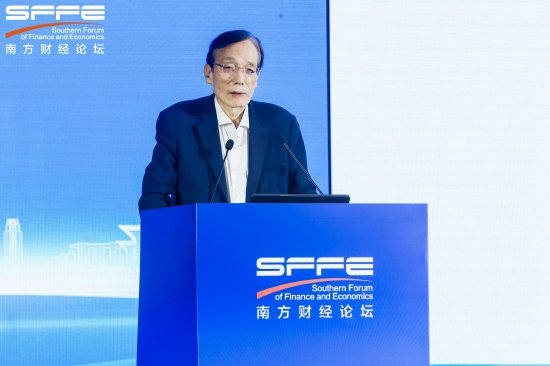
刘世锦:要更关注中低收入阶层,我国消费市场规模将实现倍增
Xin Lang Cai Jing· 2025-12-05 03:23
Core Insights - The "Southern Finance Forum 2025" held on December 5-6 in Guangzhou focuses on the theme "The Power of Consensus - Innovation Surge, China's Asset Revaluation" [1][7] - Liu Shijun, a key speaker, highlighted three major advantages of China's economy: catch-up potential, new technology revolution focusing on digital and green technologies, and the advantage of a super-large market economy [3][9][10] Economic Advantages - The first advantage is the catch-up potential, which refers to opportunities in service sector development driven by consumption structure upgrades, as well as the transformation of traditional manufacturing and agriculture [3][9] - The second advantage is the new technology revolution, emphasizing digital and green technologies [3][9] - The third advantage is the super-large market economy, with a focus on the 9 billion low-income individuals who could transition into the middle-income group, potentially creating a consumption market of 800-900 million [10] Strategic Goals - China needs to implement strategies to become a manufacturing powerhouse, a consumer powerhouse, and a financial powerhouse [10] - The goal for manufacturing is to cultivate large innovative enterprises that can lead globally, while the consumer powerhouse aims to become the largest consumption market worldwide [10] - The financial powerhouse is essential for achieving the first two goals, acting as a bridge to facilitate their realization [10] Financial Development - High-quality development requires a strong capital market and robust currency, with finance serving the real economy by selecting viable projects to enhance resource allocation efficiency [10] - Liu emphasized the importance of a strong currency, citing historical examples of strong currencies like the British pound and the US dollar, which were backed by substantial economic and financial systems [4][11] - Currently, China's GDP accounts for 18% of the global total, with manufacturing at 30%, but the currency's functional roles are below 10% [11] Currency Internationalization - Liu proposed increasing the offshore RMB supply to achieve economies of scale in its international use, addressing the mismatch between China's economic standing and its currency's global role [4][11] - He suggested a significant adjustment in China's foreign trade strategy to balance imports and exports while using RMB for settlements, potentially converting a trade surplus of nearly $1 trillion into over 7 trillion RMB for offshore use [5][12] - The expansion of offshore RMB financial products, including bonds, stocks, and derivatives, is crucial for enhancing liquidity and facilitating the RMB's internationalization [12]