
消费强国

Search documents
王文涛:加快建设消费强国|宏观经济
清华金融评论· 2026-01-03 09:47
Core Viewpoint - The article emphasizes the importance of expanding high-level opening-up as a strategic approach to promote deep reform and high-quality development in China, positioning the country as a significant player in the global market [2][8]. Group 1: Theoretical Foundations - The concept of high-level opening-up is rooted in Marxist theory, highlighting the impact of the world market and international division of labor on human society, and asserting that openness is a vital driver of human civilization and global prosperity [4]. - The importance of openness is also derived from traditional Chinese culture, which values inclusivity and mutual benefit, as exemplified by historical trade routes like the Silk Road [5]. Group 2: Practical Experience - The article discusses various local governance practices that have contributed to China's opening-up strategy, emphasizing the need for a comprehensive approach that integrates both domestic and international elements [6]. Group 3: Current Trends and Future Directions - The article outlines the current global landscape, noting the rise of unilateralism and protectionism, and stresses the necessity for China to maintain an open door policy to attract global resources and enhance its economic development [7]. - It highlights China's achievements in trade, including being the world's largest goods trader for eight consecutive years, with exports consistently around 14% of global share and imports projected to reach 10.4% by 2024 [9]. Group 4: Policy Initiatives - The article details various initiatives aimed at enhancing China's openness, such as the establishment of free trade zones, the removal of restrictions on foreign investment in manufacturing, and the promotion of cross-border e-commerce [10]. - It also emphasizes the importance of high-quality cooperation in global markets, with initiatives like the Belt and Road Initiative contributing to significant trade volumes and investments with partner countries [11]. Group 5: Security and Risk Management - The article stresses the need to balance openness with security, advocating for a robust export control system and mechanisms to address trade disputes and risks [12][17]. Group 6: Future Goals - The article concludes with a call for a more profound understanding of the requirements for high-level opening-up, aiming to create a new economic system that benefits both China and the global community [13].

十大顶级经济学家展望2026
21世纪经济报道· 2026-01-01 10:36
Core Viewpoint - The article emphasizes the need for China to build a robust monetary and capital market to bridge innovation and consumption, driving the economy into a new cycle of high-quality development [2][3]. Group 1: Economic Development Strategies - China should advance the construction of a manufacturing powerhouse, a consumption powerhouse, and a financial powerhouse characterized by a full-chain technology and industrial layout [3]. - The future growth model will rely on multiple pillars, supported by a stabilized real estate market and ongoing efforts to reduce "involution" [5]. Group 2: Innovation and Consumption - There is an expectation for consumption to reverse its trend by 2026, driven by a strengthened innovation-driven layout [4]. - The dual focus on "starry sea" innovation and "daily necessities" improvement in people's livelihoods is crucial for China's economic future [7]. Group 3: Capital Market and Investment - A capital market that supports China's technological future must establish a full-chain capital support ecosystem, including a "National Basic Research Fund" to attract long-term capital from insurance and pension funds [17]. - The article highlights the importance of stabilizing residents' income growth expectations to boost consumption and break the cycle of pessimism [21]. Group 4: Global Economic Context - The global economic growth is expected to remain between low and moderate levels by 2026, influenced by the actions and policies of the United States, such as potential sanctions or trade restrictions [13]. - As the competition between China and the U.S. in technology continues, other economies may find it increasingly difficult to navigate independently and may need to adopt a "bet on both sides" strategy [19].

专访国务院发展研究中心原副主任刘世锦:打造强大的货币与资本市场,为创新和消费架桥
2 1 Shi Ji Jing Ji Bao Dao· 2025-12-31 00:35
Economic Outlook - China's economy is expected to reach approximately 140 trillion yuan by 2025, demonstrating strong resilience and vitality despite facing challenges [1] - The central economic work conference indicates that while global economic growth is anticipated to continue moderately, uncertainties remain [1] Advantages of China's Economy - China possesses three main advantages: 1. Catch-up potential, with a GDP per capita growth potential of at least $20,000 to reach the level of developed countries [4][6] 2. New technological revolution advantages focused on digital and green technologies [4] 3. The advantage of a super-large market economy [4][5] Economic Growth Dynamics - Economic growth is transitioning from high-speed to medium-speed, with the main challenge shifting from supply constraints to demand constraints, particularly in consumption [7] - Future economic growth will increasingly be driven by innovation and consumption [7][8] Strategic Development Goals - China aims to build a manufacturing powerhouse, a consumption powerhouse, and a financial powerhouse to drive high-quality economic development [8] - The manufacturing sector will focus on enhancing its position in global value chains and increasing productivity [8] Role of Capital Markets - A strong capital market is essential for supporting the manufacturing and consumption sectors by improving resource allocation efficiency [9] - As the economy transitions to a high-quality development phase, capital markets will play a more significant role in project selection and funding [9][10] Currency Strength and Internationalization - A strong currency is a key indicator of a financial powerhouse, with China's manufacturing sector expected to contribute significantly to global growth [11] - The internationalization of the renminbi is seen as a critical area for development, with strategies to increase offshore renminbi products and enhance liquidity [12][13]

专访刘世锦:打造强大的货币与资本市场,为创新和消费架桥
21世纪经济报道· 2025-12-24 14:10
Core Viewpoint - The article emphasizes that China's economy is expected to demonstrate strong resilience and vitality, with major economic indicators aligning with expectations, and the total economic output projected to reach around 140 trillion yuan by 2025 [1]. Group 1: Economic Advantages - China possesses three major economic advantages: the potential for catching up, the new technology revolution focused on digital and green technologies, and the advantage of a super-large market economy [4][5]. - The "catching up potential" indicates that China has a growth potential of at least 20,000 USD per capita GDP to reach the level of developed countries, primarily driven by the upgrading of consumption structure and the transformation of traditional industries [5][6]. - The super-large market economy advantage includes a significant consumer base, with 400 million middle-income individuals and the potential for 800-900 million individuals transitioning to middle-income status, which can significantly expand the consumer market [6][7]. Group 2: Economic Growth Drivers - The current economic growth in China is shifting from being driven by investment and exports to being driven by innovation and consumption [8][9]. - The focus on becoming a manufacturing powerhouse, a consumer powerhouse, and a financial powerhouse is essential for sustaining economic growth and enhancing the quality of development [9][10]. - A strong capital market and robust currency are crucial for bridging the gap between manufacturing and consumption, facilitating the necessary financial support for these sectors [10][11]. Group 3: Financial Market Development - The capital market is expected to play a pivotal role in selecting projects that are marketable, profitable, and have controllable risks, thereby improving resource allocation efficiency [10][11]. - The transition to a modern capital market system is necessary as China enters a phase of innovation-driven economic growth, with more funds expected to flow into capital markets rather than traditional banking [10][12]. - A strong currency is identified as a key indicator of a financial powerhouse, with the potential for the renminbi to become more internationally recognized as China's manufacturing and trade capabilities grow [12][13].

21专访|刘世锦:打造强大的货币与资本市场,为创新和消费架桥
2 1 Shi Ji Jing Ji Bao Dao· 2025-12-24 08:22
Core Viewpoint - China's economy is expected to reach approximately 140 trillion yuan by 2025, demonstrating strong resilience and vitality despite facing challenges [1] Economic Advantages - China has three main economic advantages: 1. Catch-up potential, with a GDP per capita growth potential of at least 20,000 USD to reach the level of developed countries [5] 2. New technology revolution focused on digital and green technologies [4] 3. Super-large market economy advantage, with a significant consumer base and production capacity [4][8] Economic Growth Drivers - The current economic growth is shifting from being driven by investment and exports to being driven by innovation and consumption [2][10] - The focus on becoming a manufacturing powerhouse, a consumer powerhouse, and a financial powerhouse is essential for sustainable growth [10][11] Manufacturing and Consumption - The manufacturing sector aims to enhance its position in global value chains and increase productivity through market competition [10] - The consumer market is expected to expand significantly, particularly as a large portion of the low-income population transitions to the middle-income group [7][8] Financial Market Development - A strong capital market is crucial for supporting the manufacturing and consumption sectors, requiring an evolution from traditional banking to modern capital market systems [12] - The capital market should facilitate the emergence of large innovative enterprises and support the financial needs of a growing economy [13] Currency Strength and Internationalization - A strong currency is a key indicator of a financial powerhouse, with China's manufacturing and trade positions providing a solid foundation for the internationalization of the renminbi [14][15] - Strategies to balance imports and exports while increasing the use of renminbi in international transactions are essential for enhancing its global standing [15]
刘世锦:实现强大的货币,需大幅增加离岸人民币数量
Sou Hu Cai Jing· 2025-12-15 09:30
Group 1 - The core viewpoint is that China's economic growth is transitioning from high-speed to medium-speed, driven by a shift from supply-side constraints to demand-side issues, with a focus on innovation and consumption rather than investment and exports [1] - The next steps involve promoting the construction of a manufacturing powerhouse, a consumption powerhouse, and a financial powerhouse [3] - For the manufacturing powerhouse, the emphasis is on the transformation and upgrading of the manufacturing sector, particularly towards productive service industries [4] Group 2 - In terms of becoming a consumption powerhouse, there is a need to address the structural deviation of China's consumption as a percentage of GDP compared to the international average, aiming to become the largest consumer market globally [6] - The financial sector is seen as a bridge, requiring a modern financial system to support the manufacturing and consumption powerhouses, with a focus on selecting projects that have market potential and manageable risks [7] - During the 14th Five-Year Plan period, if China's GDP maintains a growth rate of 4% to 5%, it is expected to generate a net asset increase of no less than 30 trillion yuan annually, with new funds likely flowing into capital markets due to declining risk-free rates [7] Group 3 - A strong currency is essential for a financial powerhouse, with historical evidence suggesting that as a country's real economy grows in global share, its currency's global usage also increases [7] - To enhance the international use of the renminbi, increasing the offshore renminbi supply is crucial, which can be achieved by boosting imports and settling payments in renminbi [8] - Developing offshore renminbi financial products and improving liquidity and convenience will significantly accelerate the internationalization of the renminbi [8]
国务院发展研究中心原副主任刘世锦:建设离岸人民币金融产品生态,中国需要形成强大货币|2025华夏机构投资者年会
Hua Xia Shi Bao· 2025-12-12 06:35
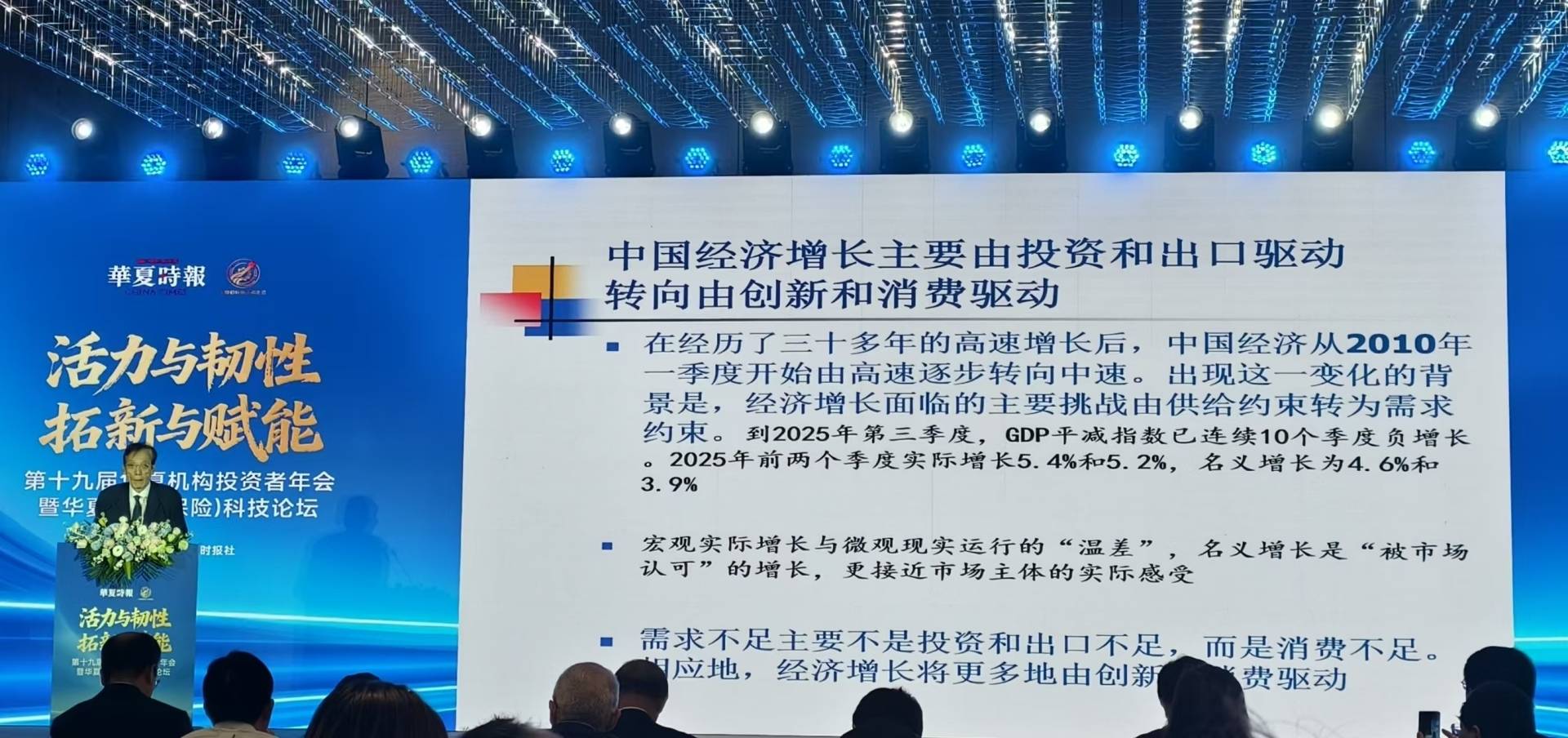
Core Insights - The conference emphasized the theme of "vitality and resilience, innovation and empowerment" to address contemporary challenges and explore future pathways [2] Economic Transition - China's economy is transitioning from high-speed to medium-speed growth, with a shift in growth drivers from investment and exports to innovation and consumption [3] - The GDP deflator index has shown negative growth for ten consecutive quarters leading up to Q3 2025, with actual growth rates of 5.4% and 5.2% in the first two quarters of 2025 [3] Long-term Growth Advantages - China possesses three long-term growth advantages: 1. Catch-up potential, with per capita income at approximately $14,000, indicating significant room for growth towards the levels of developed countries [3] 2. Advantages in new technology revolutions, particularly in digital and green technologies, where China is at the forefront of industrial engineering and commercial applications [4] 3. The scale of the market economy, highlighted by a large middle-income group and the potential for 900 million low-income individuals to transition to middle-income status, significantly expanding the consumer market [4] Financial Strength - The construction of a "manufacturing powerhouse, consumer powerhouse, and financial powerhouse" is essential for modernizing China's economy [5] - Financial systems must enhance their project selection capabilities to support the real economy, especially as the economy shifts towards innovation-driven growth [5] Currency and Internationalization - A strong currency is a key indicator of a financial powerhouse, with the need for the RMB to play a more significant role internationally [6] - Recommendations include balancing imports and exports while increasing the use of RMB for international transactions, thereby enhancing its liquidity and facilitating its internationalization [6]

刘世锦:进一步发挥“三大优势” 推动制造强国、消费强国、金融强国建设
Zhong Guo Zheng Quan Bao· 2025-12-08 00:08
Group 1 - The core advantages of China include the potential for catching up with developed economies, a new technological revolution focused on digital and green technologies, and the advantages of a super-large market economy [1][2][3] - China has a stable demand side and relatively mature supply-side technologies, which provide a strong certainty in the current uncertain environment [1] - The country has made significant progress in narrowing the gap with global leaders in key areas of technological revolution, achieving parity or local leadership in industrial engineering and commercial application scenarios [1] Group 2 - China possesses all industrial categories listed in the United Nations classification, allowing for more competition among enterprises with strong core competitiveness [2] - The country has multiple innovation hubs and abundant resources, which facilitate economies of scale and cost reduction, transforming weaknesses into strengths [2] - To further leverage these advantages, China aims to enhance its manufacturing, consumption, and financial sectors, creating a better environment for technological innovation [2] Group 3 - In manufacturing, despite accounting for over 30% of global manufacturing, China still lags in productivity and value-added metrics compared to developed countries [2] - The focus will be on improving labor productivity, industry value-added rates, and total factor productivity, while integrating productive services such as R&D, design, logistics, and human resources [2] Group 4 - In terms of consumption, China's consumer spending as a percentage of GDP still falls short of the global average, necessitating an expansion of the consumer market [3] - Enhancing human capital through education, healthcare, and social security is crucial for driving innovation and establishing a consumption powerhouse [3] Group 5 - As China transitions to a developed economy, the uncertainty in economic growth increases, necessitating an improvement in the financial system's project selection capabilities [4] - The capital market must support the cultivation of world-class technology enterprises and provide for an aging society through pension systems and increased household income [4] - To address the mismatch between China's high GDP and manufacturing share versus its low currency share, increasing the offshore RMB scale and enhancing its liquidity in international markets is essential [4]
刘世锦:进一步发挥“三大优势”
Zhong Guo Zheng Quan Bao· 2025-12-07 20:21
Group 1 - China possesses three significant advantages for future development: the potential for catching up with developed economies, a new technological revolution focused on digital and green technologies, and the advantages of a super-large market economy [1][2][3] - The potential for catching up includes stable demand and mature supply-side technology, particularly in service industry development and the transformation of traditional manufacturing and agriculture [1] - The new technological revolution sees China narrowing the gap with global leaders, achieving parity or local leadership in key areas such as industrial engineering and commercial application scenarios [1] Group 2 - The super-large market economy allows for a diverse range of industrial categories and fosters competition among enterprises, enhancing core competitiveness [2] - China aims to leverage these advantages to build a manufacturing powerhouse, a consumption powerhouse, and a financial powerhouse, thereby creating a better environment for technological innovation [2][3] - In manufacturing, despite accounting for over 30% of global manufacturing, China still lags in productivity and value-added metrics compared to developed nations, necessitating improvements in labor productivity and the integration of productive services [2] Group 3 - For consumption, China's consumer spending as a percentage of GDP still falls short of the global average, indicating a need to expand the market and enhance service consumption, including investments in human capital [3] - The financial sector must adapt to increased economic uncertainty by improving project selection capabilities, with a focus on nurturing leading technology enterprises and addressing the needs of an aging society [4] - To enhance the international status of the RMB, China should increase offshore RMB circulation and ensure a balance between exports and imports, thereby supporting the development of manufacturing and consumption powerhouses [4]
事关消费投资,黄奇帆刘世锦等建言十五五开局之路如何走
Bei Ke Cai Jing· 2025-12-07 14:00
Group 1 - China's economy is showing resilience and vitality as it approaches the end of 2025, with a focus on navigating challenges and opportunities in 2026 during the "14th Five-Year Plan" period [1] - Experts believe that China is at a critical stage of structural adjustment, where breaking through reforms will lead to both quantitative and qualitative economic growth [2] - The "14th Five-Year Plan" marks a shift in China's economic growth from being primarily driven by investment and exports to being driven by innovation and consumption [3] Group 2 - Consumption is crucial for China's economy, and there is a need to actively implement a "strong consumption country" strategy [3] - Increasing the pension levels for low-income groups is seen as a key breakthrough for expanding consumption, with a strong necessity for transferring state-owned capital to support pension funds [3] - The proposal includes reallocating state-owned capital to social security funds and capital markets to create a comprehensive pension system that meets basic living needs and reduces urban-rural disparities [3] Group 3 - China has the potential to become the world's largest consumer market, surpassing the United States, and should implement a new strategy for balanced imports and exports [4] - There is a call to expand the offshore RMB financial product ecosystem to enhance the liquidity and usability of the RMB, promoting its internationalization [4] - As the RMB appreciates, domestic consumers will be able to purchase more and better imported goods and services, thereby enhancing the scale and quality of consumption [4] Group 4 - Deepening reform and opening up is seen as a crucial path for economic breakthroughs, with macro policy optimization being an important support [5] - The focus for 2026 is on establishing a solid foundation for national policies as it will be a year where major global economies compete economically [5] Group 5 - Reform and innovation are identified as fundamental drivers of China's economic development over the past 40 years and are essential for achieving the "Chinese Dream" by 2050 [6] - Addressing issues of urban-rural integration and technological innovation is deemed critical, with a need for better integration of scientific and industrial innovation [6][7] - The "14th Five-Year Plan" period should focus on resolving challenges related to insufficient investment in basic innovation and the transformation of technological advancements [7] Group 6 - The GDP growth target for China in 2026 is expected to remain around 5%, which is considered a significant achievement in an international context [8] - Infrastructure investment is highlighted as a key method for stabilizing growth, with a strong emphasis on large-scale infrastructure projects to support economic stability [8] - Consumer spending is viewed as a slow variable, indicating that a significant rebound in consumption may be challenging in the near term [8]