新汉学计划

Search documents
2026年“新汉学计划”博士生项目等面向全球开始招生
Yang Shi Xin Wen· 2025-12-27 05:50
Core Points - The "New Sinology Program" for 2026 is officially open for global enrollment for both doctoral and master's programs in translation [1][4] - The doctoral program aims to support overseas scholars in Sinology and Chinese studies to pursue their degrees or research in China [2][3] - The master's program focuses on training skilled Chinese translation talents with a strong language foundation and international perspective [4][5] Doctoral Program Summary - The program is divided into two categories: "Sino-Foreign Cooperative Doctoral Program" and "Doctoral Degree Program in China" [3] - The duration for the cooperative program is 1 semester to 2 academic years, requiring HSK level 3 or above, and applicants must be registered doctoral students at foreign universities [3] - The degree program lasts 3 to 4 years, requiring HSK level 5 or above, and applicants must hold a master's degree or be recent graduates [3] - The program offers scholarships and academic resources, with applications open until February 28, 2026 [3] Master's Program Summary - The master's program is also divided into two categories: "Sino-Foreign Joint Training Master's Program" and "Master's Degree Program in China" [5] - The joint program lasts 1 semester to 1 academic year, while the degree program lasts 2 to 3 academic years, requiring HSK level 6 or above [5] - Applicants must have a non-Chinese native language, a background in Chinese, translation, or related fields, and be under 40 years old [5] - The program provides scholarships and opportunities for deep involvement in various translation courses and practical activities, with applications open until March 31, 2026 [5]
汉学在新时代焕发出蓬勃生命力(国际论坛)
Ren Min Ri Bao· 2025-12-20 22:22
Core Perspective - The article emphasizes the importance of Sinology as a discipline that facilitates understanding of China from an international perspective, promoting cultural exchange and mutual learning among civilizations [1][2]. Group 1: Development of Sinology - The "New Sinology Program" initiated by the Chinese Ministry of Education in 2013 has significantly contributed to the cultivation of young Sinologists, covering over 120 countries and regions [2][3]. - The program has supported the training of 1,080 PhD students and 85 master's students in translation, along with organizing training for over 1,500 young translators [2][3]. - The program has also funded the establishment of over 200 Chinese studies courses in foreign universities and published more than 70 translations of Chinese classics [2][3]. Group 2: Impact on Global Scholarship - The "New Sinology Program" has become a crucial incubator for young talent in the field of Sinology and a significant academic platform for cultural exchange [3]. - Graduates of the program are now working in various sectors, including education, culture, diplomacy, and trade, becoming key figures in cross-cultural cooperation [3]. - The program's long-term success is expected to produce a new generation of Sinologists who are proficient in Chinese and knowledgeable about China's history and culture [3].
AI遇汉学 青年汉学家“圳”当时
Nan Fang Du Shi Bao· 2025-06-08 23:16
Group 1 - The first "International Day of Civilizational Dialogue" coincides with the 9th World Sinology Conference held at Renmin University of China, focusing on the theme "Understanding China: Sinology Research in the Age of Artificial Intelligence" [1] - Nearly 200 sinologists from over 50 countries and regions gathered to discuss the innovative development of Sinology in the context of rapid advancements in artificial intelligence technology [1][2] - The conference emphasized the importance of cultivating young sinologists and included a special roundtable for young scholars to inspire sustainable development in Sinology and Chinese studies [1][2] Group 2 - The Ministry of Education of China announced the continuation of the "New Sinology Plan" to cultivate a new generation of young sinologists and enhance international exchanges [1] - Shenzhen is highlighted as a significant window for studying Sinology and understanding Chinese culture, aligning with the city's identity as a "City of Technology" and a "Great Country's Reception Hall" [2] - The launch of the "New Sinology Plan" postdoctoral program aims to establish a comprehensive support network for young sinologists, marking a significant step in talent development in this field [3] Group 3 - The World Sinology Conference has been successfully held nine times since its inception in 2007, promoting international understanding of contemporary China and enhancing cultural exchanges [3]
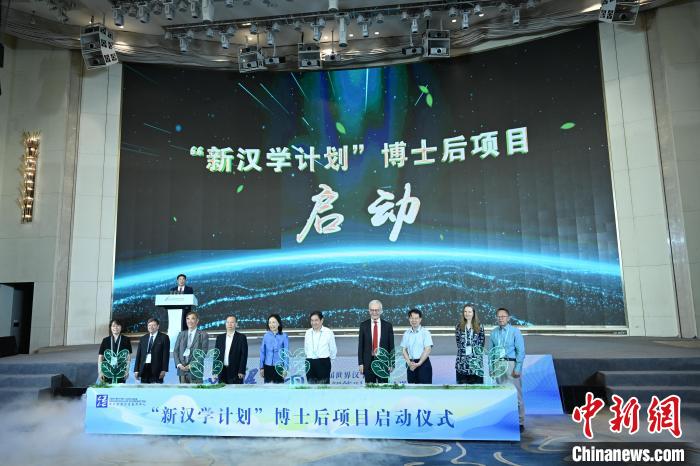
中国内地首个针对汉学人才的博士后项目正式启动
Zhong Guo Xin Wen Wang· 2025-06-06 23:59
Group 1 - The Ninth World Sinology Conference opened on June 6 in Shenzhen, marking the official launch of the "New Sinology Program" postdoctoral project, which is the first postdoctoral program in mainland China aimed at cultivating Sinology talent [1][3] - The "New Sinology Program" postdoctoral project will be piloted in 2024 in collaboration with the Ministry of Education's Center for Language Exchange and Cooperation and five universities, including Peking University and Renmin University of China [1] - The project aims to enhance the comprehensive training system and support network for young Sinology talents [1] Group 2 - The Youth Committee of the World Sinology Conference was established in 2023, creating an academic community primarily composed of young Sinologists trained under the "New Sinology Program" [2] - Certificates were awarded to newly elected representatives of the Youth Committee during the conference [2] Group 3 - The China Philosophy and Social Sciences Preprint Platform - World Sinology Platform was launched at the opening ceremony, serving as the first academic journal matrix and digital resource platform in mainland China focused on Sinology [4] - The platform aims to promote the exchange of research results in global Sinology and Chinese studies, contributing to the prosperity of global Sinology [4] - The conference, held from June 5 to 7, gathered nearly 200 Sinologists from over 50 countries and regions to discuss the innovative development of Sinology in the era of artificial intelligence [4]