
新能源汽车竞争格局

Search documents
火爆!刚刚,新能源车数据出炉
Zhong Guo Ji Jin Bao· 2025-06-01 11:43
Core Viewpoint - The competition among Chinese new energy vehicle (NEV) manufacturers is intensifying, with significant variations in monthly delivery volumes and growth rates among different companies in May 2023 [2][4][10]. Group 1: Sales Performance - BYD reported a May sales volume of 382,500 units, a year-on-year increase of 15.27%, with cumulative sales from January to May reaching 1.7634 million units, up 38.70% [2][3]. - Leap Motor achieved a record delivery of 45,067 units in May, marking a year-on-year growth of 148.10% and a month-on-month increase of 9.82% [3][4]. - Li Auto delivered 40,856 units in May, reflecting a year-on-year increase of 16.70% and a month-on-month growth of 20.38% [3][4]. - Xpeng Motors delivered 33,525 units, showing a remarkable year-on-year growth of 230.43%, although it experienced a month-on-month decline of 4.34% [3][4]. - Xiaomi's delivery volume exceeded 28,000 units in May, failing to surpass the 30,000-unit threshold for the third consecutive month [2][10]. Group 2: Competitive Landscape - The competitive landscape among NEV manufacturers is expected to become more intense in the coming months, with several companies planning product renewals or new launches [2][10]. - Leap Motor's CEO emphasized the company's focus on self-research and development of core technologies, which has established a competitive edge in cost and quality [5][6]. - Li Auto's recent upgrades to its entire model lineup, including the launch of the Li L series, aim to enhance delivery volumes and maintain competitiveness [9][13]. Group 3: Future Outlook - Xiaomi is preparing for the mass production of its first SUV model, the YU7, expected to launch in July, which may significantly impact its delivery volumes [11][13]. - NIO is set to deliver newly launched models in June, which could lead to a notable increase in its delivery figures [16][17]. - The delivery volumes of several new energy vehicle manufacturers are anticipated to change significantly in June, driven by new product launches and internal restructuring efforts [13][18].


大洗牌!刚刚,新能源车数据公布
Zhong Guo Ji Jin Bao· 2025-05-02 02:37
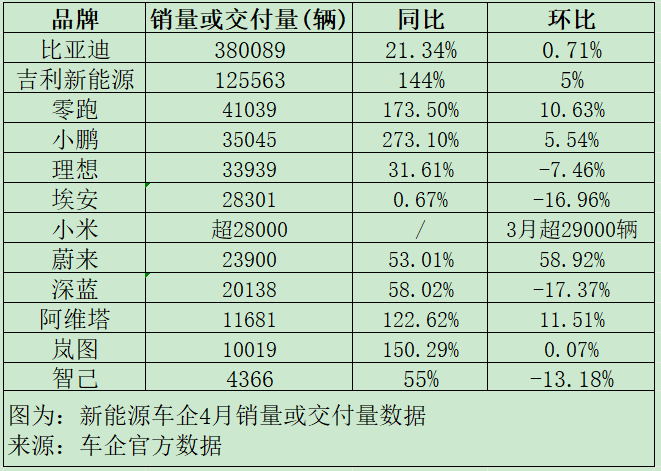
Core Insights - In April, BYD reported sales of 380,089 units, marking a year-on-year increase of 21.34% and a month-on-month increase of 0.71% [1] - The competition among new energy vehicle manufacturers has intensified, resembling a "Three Kingdoms" scenario, with key players being Leap Motor, Xpeng Motors, and Li Auto [1][9] - Leap Motor achieved a monthly delivery of 41,039 units, becoming the first new energy vehicle manufacturer to surpass the 40,000 mark in monthly deliveries [3][5] Sales Performance - BYD: 380,089 units, YoY +21.34%, MoM +0.71% [2] - Geely New Energy: 125,563 units, YoY +144%, MoM +5% [2] - Leap Motor: 41,039 units, YoY +173.50%, MoM +10.63% [2] - Xpeng Motors: 35,045 units, YoY +273.10%, MoM +5.54% [2] - Li Auto: 33,939 units, YoY +31.61%, MoM -7.46% [2] - Aion: 28,301 units, YoY +0.67%, MoM -16.96% [2] - Xiaomi: over 28,000 units, previously over 29,000 in March [2][9] - NIO: 23,900 units, YoY +53.01%, MoM +58.92% [2][15] - Avita: 11,681 units, YoY +122.62%, MoM +11.51% [2] - Lantu: 10,019 units, YoY +150.29%, MoM +0.07% [2] Competitive Landscape - The competition among new energy vehicle manufacturers is not yet stable, with opportunities for each participant to capture more market share [14] - Leap Motor and Xpeng Motors have shown significant year-on-year growth rates, with Leap Motor at 173.50% and Xpeng Motors at 273.10% [5][7] - Li Auto's performance has been inconsistent, with a decline in month-on-month growth rates observed in recent months [9][12] Strategic Developments - NIO plans to launch nine new models across its three brands in 2025, aiming to cover various market segments [18] - Leap Motor's CEO expressed confidence in maintaining a leading position in the market [5] - Li Auto is focusing on user-centric strategies to navigate the competitive landscape [12]



比亚迪超级e平台发布解读
2025-04-15 14:30
Summary of Conference Call Company and Industry - The conference call primarily discusses **BYD** and its advancements in **fast charging technology** within the **electric vehicle (EV)** industry. Key Points and Arguments 1. **Fast Charging Technology**: BYD's new fast charging technology can achieve a maximum charging power of **1 megawatt (MW)** and a charging rate of up to **10C** [1][4][5]. 2. **Battery Specifications**: The new battery design includes a **short blade battery** with dimensions ranging from **561mm to 580mm** and capacities between **134 to 188 Ah** [2][3]. 3. **Charging Process**: The charging process from **1% to 25% State of Charge (SOC)** can be completed at a rate of **1,000 kW** [2][7]. 4. **Performance Metrics**: The internal resistance of the battery has been optimized to around **0.6 ohms**, which enhances the fast charging speed [3][4]. 5. **Silicon Carbide Technology**: BYD has incorporated **silicon carbide (SiC)** technology, achieving a maximum voltage tolerance of **1,500 volts** [4][10]. 6. **Motor Specifications**: The electric motor can reach a power output of **580 kW** with a maximum speed of **30,511 RPM**, resulting in a power density of **16.4 kW/kg** [11]. 7. **Thermal Management**: Effective thermal management is crucial for fast charging, with preheating strategies being employed to reduce internal resistance [7][8]. 8. **Charging Infrastructure**: Concerns were raised about the adequacy of charging infrastructure to support the high power demands of new vehicles, as existing stations may not be equipped to handle **1,000 kW** charging [21][22][23]. 9. **Market Competition**: Other competitors, such as CATL, are expected to quickly adapt to similar fast charging technologies, but challenges remain regarding battery life and warranty [14][39]. 10. **Consumer Experience**: The actual consumer experience may lag behind the advertised capabilities if charging stations do not keep pace with vehicle technology [25][36]. Other Important but Overlooked Content 1. **Charging Station Limitations**: The current charging stations may not support the high power requirements, leading to potential consumer dissatisfaction if vehicles cannot charge as expected [22][23]. 2. **Cost Implications**: The introduction of new technologies, such as SiC and specialized fuses, may increase costs, but the overall impact on vehicle pricing remains uncertain [18][39]. 3. **Future Developments**: The industry is expected to see a shift towards more affordable electric vehicles as competition increases, potentially leading to lower prices across the board [38][39]. 4. **Technological Innovations**: The conference highlighted the importance of continuous innovation in battery technology and charging systems to maintain competitive advantages [40][41]. This summary encapsulates the critical insights from the conference call regarding BYD's advancements in fast charging technology and its implications for the electric vehicle market.
