
碳化硅芯片

Search documents
三安集团欲引入战投化解债务问题,公布三项应对措施
第一财经· 2026-03-30 03:37
Core Viewpoint - Sanan Group is seeking strategic investors to resolve its debt issues, having preliminary discussions with government-backed investors, but no specific plans have been established yet [3][5]. Group 1: Company Operations and Financial Health - Sanan Optoelectronics is operating normally, with its silicon carbide chip project in collaboration with STMicroelectronics entering mass production [3][5]. - The company has a strong cash flow, with a debt ratio of only 30%-40%, and does not face tightening of bank loans [5]. - Sanan Optoelectronics' market value has dropped from over 80 billion to over 50 billion in the past week, with a stock price decline of 4.14% to 12.04 yuan per share as of March 30 [5]. Group 2: Management Actions and Investor Confidence - The company has established a risk management task force to coordinate responses to the current challenges [3]. - To stabilize investor confidence, the chairman plans to invest 20-40 million yuan in company stock, while the general manager will invest 5-10 million yuan [4]. - Sanan Group has formed a dedicated team to address the judicial freeze on shares, actively communicating with creditors, and government intervention is underway to facilitate debt resolution [5]. Group 3: Future Projections and Challenges - The company anticipates a net loss of 200-400 million yuan for 2025, primarily due to losses in its integrated circuit business and reduced government subsidies [5]. - The judicial freeze on 29.47% of Sanan Optoelectronics' shares held by Sanan Group may not significantly impact the company's control structure immediately, but unresolved issues could lead to forced transfers or judicial auctions, posing risks to control stability [5].


1.3万亿收购案背后,日本半导体被中国打醒
汽车商业评论· 2026-03-08 23:04
Core Viewpoint - Denso Corporation, a core supplier of Toyota Group, has proposed to acquire semiconductor manufacturer Rohm for an estimated valuation of 1.3 trillion yen (approximately 8.2 billion USD) to enhance its capabilities in high-end semiconductor research and development, particularly in electric vehicles and autonomous driving technologies, aiming to compete with Chinese firms [3][4][14]. Group 1: Acquisition Proposal - Denso's acquisition proposal for Rohm has led to an 18% surge in Rohm's stock price, marking the largest single-day increase in 26 years, with shares reaching 3,243 yen (approximately 141 RMB) [4][5]. - The acquisition, if successful, would create a competitive domestic giant in the power semiconductor sector, reflecting a shift from collaboration to consolidation in Japan's semiconductor industry [3][4][7]. - Denso's offer includes an 18% premium over Rohm's closing price prior to the proposal, with the total transaction size potentially reaching 1.3 trillion yen if Denso acquires over 95% of Rohm's circulating shares [9]. Group 2: Market Dynamics - The automotive industry's increasing reliance on power semiconductors for software, motor control, and battery management is driving aggressive strategies among Japanese automotive component manufacturers to secure chip supply chains [5][10]. - Analysts suggest that Denso's direct involvement as a leading downstream customer could catalyze a market-driven restructuring of the power semiconductor industry, which has historically faced slow consolidation due to power struggles among stakeholders [7][10]. Group 3: Financial Performance - Rohm is projected to report its first loss in 12 years for the fiscal year ending March 2026, with a net loss of 50 billion yen (approximately 2.18 billion RMB), a significant decline from a profit of 53.9 billion yen in the previous fiscal year [10]. - Despite expectations of a recovery to a net profit of 10 billion yen in the current fiscal year, Rohm's profitability remains in a recovery phase [10]. Group 4: Government and Industry Strategy - The Japanese government has been promoting consolidation in the power semiconductor industry to address challenges posed by Chinese competitors and overcapacity issues [14][16]. - Japan aims to achieve semiconductor sales of 40 trillion yen (approximately 253.5 billion USD) by 2040, positioning itself to capture opportunities in artificial intelligence and data centers [18][20]. - The government has introduced substantial subsidies and regulatory reforms to support the semiconductor sector, with a focus on establishing Japan as a global hub for advanced semiconductor research and production [20][21].
董明珠接受人民日报专访:现在的年轻人要有耐心要吃得起亏
新华网财经· 2026-02-06 03:26
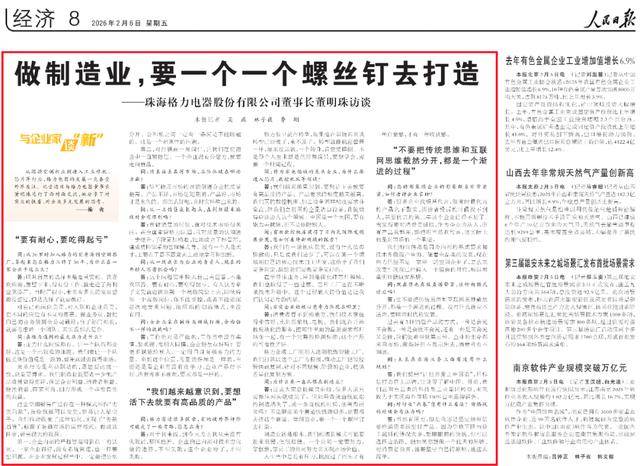
Core Viewpoint - The interview with Dong Mingzhu emphasizes the importance of dedication to manufacturing and the need for high-quality products in the industry, highlighting the company's commitment to innovation and integrity in business practices [2][3][21]. Group 1: Company Development and Strategy - Gree Electric has expanded from the air conditioning sector into industrial machinery and chip manufacturing, showcasing a commitment to diversification and innovation [3][18]. - The company has implemented a "payment before delivery" model to enhance internal management and build trust with distributors, moving away from the traditional "delivery before payment" approach [10][11]. - Gree's focus on high-quality products is evident in its investment in self-manufactured equipment, such as CNC machine tools, to reduce reliance on imports and improve precision [18][19]. Group 2: Leadership and Management Philosophy - Dong Mingzhu emphasizes the importance of responsibility and teamwork, stating that success comes from a unified vision and sincere market engagement [7][10]. - The company promotes a culture of continuous learning and innovation, with a structured quality control system to ensure product reliability [13][20]. - Dong believes that the manufacturing sector is fundamental to economic stability, advocating for a patient and steady growth model rather than chasing quick profits [21][22]. Group 3: Market Position and Future Outlook - Gree aims to establish itself as a global brand, with plans to achieve 100% self-branded sales in overseas markets, reflecting a strategic shift towards international expansion [26]. - The company is adapting to new sales models, including live streaming, to engage with consumers and showcase its products effectively [25]. - Dong acknowledges the pressures of industry competition but remains committed to delivering quality products, rejecting the notion of compromising standards for short-term gains [27].


董明珠接受人民日报专访:现在的年轻人要有耐心要吃得起亏
Sou Hu Cai Jing· 2026-02-06 01:48
Core Viewpoint - Gree Electric Appliances emphasizes the importance of quality manufacturing and the need for patience and perseverance in business development, as the company expands into new industries like industrial machinery and semiconductors while maintaining its core focus on air conditioning [1][12]. Group 1: Company Philosophy and Management - The company believes in taking responsibility for its operations and ensuring that all team members share a consistent value system to achieve long-term success [4]. - Gree has shifted its sales model from "goods first, payment later" to "payment first, goods later," which has improved internal management and built trust with distributors [5][6]. - The company prioritizes product quality based on market feedback, asserting that good products lead to lasting market presence [7]. Group 2: Industry Challenges and Opportunities - Gree recognizes the challenges of transitioning into new sectors, stating that internal choices regarding technology should not be viewed as failures but as learning experiences [11]. - The company has entered the chip and CNC machine tool industries to enhance product quality and reduce reliance on imports, reflecting a commitment to self-sufficiency [12]. - Gree's recent achievements in technology, such as winning a gold medal at the Geneva International Invention Exhibition, highlight its progress in developing core technologies [13]. Group 3: Competitive Edge and Future Directions - The company's core competitiveness lies in its technical expertise, particularly in components like compressors and motors, and it aims to standardize quality across its products [14]. - Gree's commitment to manufacturing is rooted in the belief that without a strong manufacturing base, the business cannot thrive, emphasizing a steady and innovative growth model [15]. - The company is adapting to modern sales methods, including live streaming, while maintaining a focus on product integrity and consumer trust [17].
人民日报专访董明珠
Xin Hua Ri Bao· 2026-02-06 00:01
Core Viewpoint - The company emphasizes the importance of patience and resilience in the face of challenges, advocating for a focus on quality and long-term value creation in the manufacturing sector [7][19]. Group 1: Company Philosophy and Management - The company values a natural progression in career development, highlighting the importance of responsibility and commitment to the organization [2]. - A significant challenge faced by the company is aligning the values of its team to ensure long-term success, which requires sincere efforts to build trust in the market [3]. - The company has shifted its sales model from "goods before payment" to "payment before goods," enhancing internal management and building trust with distributors [3]. Group 2: Product Quality and Innovation - The company believes that market feedback should drive improvements in product quality, asserting that only high-quality products can sustain market presence [4]. - The establishment of a quality control system and a focus on continuous learning and innovation are crucial for maintaining competitive advantage [5]. - The company has made strides in the semiconductor industry, particularly in silicon carbide chips, indicating progress in self-reliance and technological advancement [12]. Group 3: Manufacturing and Market Strategy - The company remains committed to the manufacturing sector, arguing that the foundation of success lies in robust manufacturing capabilities rather than chasing quick profits in trending markets [14]. - The company aims to transform into a technology-driven industrial group with a focus on building its own brand for global markets, aspiring for 100% self-branded sales overseas [18]. - The company is also exploring new sales channels, including live streaming, to adapt to changing market dynamics while maintaining product integrity [17]. Group 4: Challenges and Industry Perspective - The company acknowledges the pressures of industry competition and price wars but insists on delivering quality products rather than compromising standards for short-term gains [19]. - The company recognizes the need for a gradual integration of traditional and internet-based sales strategies, emphasizing the importance of showcasing products effectively to consumers [17].
做制造业 要一个一个螺丝钉去打造——珠海格力电器股份有限公司董事长董明珠访谈(与企业家谈“新”)
Ren Min Ri Bao· 2026-02-05 22:04
Core Viewpoint - Gree Electric Appliances is expanding from its core air conditioning business into industrial machinery and semiconductor industries, emphasizing the importance of high-quality products and a commitment to innovation and integrity in business practices [2][10]. Group 1: Company Development and Philosophy - Gree Electric's chairman, Dong Mingzhu, has been with the company for 36 years, highlighting the importance of commitment and responsibility in various roles within the organization [3]. - The company has shifted its sales model from "goods first, payment later" to "payment first, goods later," improving internal management and trust among distributors [4][5]. - Gree Electric emphasizes the need for a unified value system within the team to enhance product quality and ensure mutual benefits for consumers, shareholders, and partners [4]. Group 2: Quality and Innovation - The company is focused on using market feedback to drive improvements in product quality, asserting that only high-quality products can sustain market presence [6]. - Gree Electric has established a quality control system and is committed to continuous learning and innovation to enhance its technological capabilities [8]. - The company has made significant strides in the semiconductor sector, particularly in silicon carbide chips, and is continuously upgrading its technology [11]. Group 3: Market Position and Strategy - Gree Electric aims to maintain its competitive edge by investing in high-precision manufacturing equipment, moving away from reliance on imported machinery [10]. - The company is transitioning into a comprehensive technology-driven industrial group, with plans for 100% self-owned brand sales in international markets [17]. - Gree Electric is committed to delivering quality products despite market pressures and price wars, emphasizing the importance of brand integrity and consumer responsibility [18].
格力碳化硅芯片落地千万家电,驶入新能源汽车赛道
Jing Ji Wang· 2026-02-02 02:46
Core Viewpoint - The third-generation semiconductor silicon carbide (SiC) is becoming a key driver for industrial upgrades, with Gree Electronics leveraging its full-chain capabilities in SiC to achieve large-scale, high-quality applications in the home appliance sector, contributing significantly to high-end manufacturing and energy-saving efforts in China [1][11]. Group 1: Application in Home Appliances - Gree Electronics has successfully applied SiC Schottky Barrier Diodes (SBD) in millions of air conditioning units, enhancing energy efficiency for consumers [2]. - In major home appliance categories, SiC SBDs are widely used in front-end Power Factor Correction (PFC) circuits, offering significant advantages over silicon-based devices, including lower reverse leakage current and reduced junction capacitance, which improve product efficiency and reliability [2]. - For instance, the Gree SiC-based diode GCS065W020E, used in a 3-horsepower air conditioner, shows a 0.5% increase in energy efficiency and a 10°C reduction in temperature rise compared to silicon alternatives [2]. Group 2: Advancements in Semiconductor Technology - Gree's SiC MOS chips have achieved breakthroughs in low leakage current, low switching losses, and fast switching speeds, enhancing the overall efficiency of home air conditioners and optimizing internal space and heat dissipation [3]. - The hybrid SiC Integrated Power Module (IPM) solution combines Si-IGBT and SiC-SBD, balancing performance and cost, making it a preferred choice for high cost-performance applications [3]. Group 3: Support for Electric Vehicles - As the demand for electric vehicles (EVs) increases, Gree Electronics is providing core support for the industry with its full-chain capabilities in SiC technology, which is essential for the 800V high-voltage platform trend [5]. - SiC devices outperform traditional silicon IGBTs by operating stably at higher temperatures and voltages, improving heat dissipation and enabling lighter and more compact designs [5]. - The application of SiC devices in main drive inverters can enhance vehicle range by 5%-10% and significantly reduce system size and weight, offering better lifecycle costs [5]. Group 4: Quality Assurance and Certification - Gree's factory has obtained IATF16949 automotive quality management system certification, enabling the production of automotive-grade chips, and is actively pursuing AEC-Q101 certification for SiC diodes and MOSFETs [6]. - The semiconductor testing center has received CNAS laboratory accreditation, ensuring quality upgrades through standardized testing systems, which support the high-voltage and high-efficiency development of the EV industry [6]. Group 5: Comprehensive Capabilities in SiC Production - Established in July 2022, Gree Electronics has developed a comprehensive capability in SiC wafer manufacturing, power device packaging, and semiconductor testing, with over 70% of core equipment being domestically sourced [7][8]. - The company has built advanced processing capabilities for high-quality SiC Schottky diodes and MOSFETs, serving various sectors including home appliances, industrial applications, and renewable energy [8].
突发,71岁董明珠卸任!
Sou Hu Cai Jing· 2026-01-28 08:40
Core Viewpoint - Gree's leadership transition, with Dong Mingzhu stepping down and Fang Xiangjian taking over, signals a strategic shift as the company matures in its semiconductor ambitions, particularly in silicon carbide chip production [2][5][14]. Group 1: Leadership Changes - Dong Mingzhu has resigned as the legal representative and executive director of Zhuhai Gree Electronic Components Co., Ltd., with Fang Xiangjian assuming these roles [2][3]. - This leadership change is perceived as a self-adjustment and management restructuring within Gree as it accelerates its semiconductor initiatives [5][14]. Group 2: Semiconductor Business Development - Gree's semiconductor venture, particularly in silicon carbide chips, has reached a significant stage of maturity, with the establishment of a fully automated production line for third-generation semiconductor chips [4][6]. - The company has invested heavily in chip research, with Dong Mingzhu previously stating that Gree would invest 50 billion yuan to ensure success in chip development [6]. - By the end of 2025, Gree's silicon carbide chip factory is expected to achieve an annual production capacity of 240,000 six-inch wafers, with over 70% of core equipment being domestically sourced [11]. Group 3: Market Position and Future Plans - Gree aims to expand its presence in the automotive chip market, targeting partnerships with major automotive companies like BYD and Changan, as the demand for chips in electric vehicles continues to grow [11][17]. - The domestic automotive chip market is projected to exceed 95 billion yuan by 2025, presenting a significant opportunity for Gree to establish itself in this competitive landscape [17]. - Gree's strategy includes transitioning from self-sufficiency to external expansion, with plans to produce chips for solar energy storage and logistics vehicles [17]. Group 4: Organizational Evolution - The leadership transition is part of Gree's broader organizational evolution, aiming to maintain strategic coherence while empowering capable individuals like Fang Xiangjian to lead specific initiatives [22][24]. - This shift reflects a move away from reliance on individual leadership towards a more systematic approach, which is crucial for navigating the complexities of the semiconductor and renewable energy sectors [24][25].

家电龙头布局新能源四五年后谋质变,“下半场”才刚开始
Di Yi Cai Jing· 2026-01-28 07:31
Core Viewpoint - The renewable energy business, including photovoltaic and energy storage, is gradually becoming a new growth point for leading companies that originated from the home appliance industry, but its scale and profitability still need improvement [1][3]. Group 1: Company Developments - Skyworth Group plans to delist and spin off its photovoltaic business, with expectations that its photovoltaic revenue will exceed that of its traditional TV business by 2025 [4]. - Midea Group has established a new energy division and launched its electric heavy truck charging pile business, aiming to integrate photovoltaic, energy storage, and charging solutions [5]. - TCL has begun investing in a new energy project to enhance its photovoltaic and battery business, following its acquisition of TCL Zhonghuan [6]. - Haier New Energy has secured over 1 billion yuan in Series B financing and aims to create an AI-driven energy internet ecosystem [6]. - Hisense Group is expanding its energy production and storage capabilities through acquisitions [7]. Group 2: Market Context and Challenges - The home appliance market is maturing, leading companies to pivot towards renewable energy as a "second growth curve" amid declining sales in traditional sectors [8]. - The Chinese home appliance retail market is projected to decline by 6.7% in 2026, highlighting the urgency for companies to diversify into renewable energy [8]. - The renewable energy sector is highly competitive, with companies facing challenges in profitability and market saturation [10][11]. Group 3: Future Outlook - Skyworth's future growth is expected to focus on overseas markets and energy storage solutions, with ongoing projects in Thailand and Italy [4]. - Midea's new energy business is projected to reach an annual revenue of around 10 billion yuan, but it still lags behind industry leaders [5]. - The competition in the energy storage market is shifting from hardware costs to operational capabilities, indicating that the next phase for home appliance companies in the renewable sector is just beginning [11].


半导体人事变动,董明珠卸任这一职位
Sou Hu Cai Jing· 2026-01-27 06:10
Group 1: Gree Electronics Components - Dong Mingzhu has resigned as the legal representative and executive director of Zhuhai Gree Electronics Components Co., Ltd, with Fang Xiangjian taking over the key position [2] - Fang Xiangjian has a background in engineering and has held various positions within Gree Electric Appliances, including assistant president and vice president [2] - Zhuhai Gree Electronics Components was established in 2022, focusing on the manufacturing of third-generation semiconductor silicon carbide wafers and power device packaging testing [2] - The company has over 20 external cooperation clients in the chip design sector, primarily operating in wafer foundry services and providing packaging testing services across various industries, including new energy vehicles and photovoltaic storage [2] Group 2: Silicon Valley Semiconductor - Zhang Jinfang, the founder of Jichuang Beifang, has taken over as the legal representative of Silicon Valley Semiconductor (Suzhou) Co., Ltd, ending a period without a controlling entity [4] - Zhang's investment platform, Beijing Changhou Intelligent Technology Co., Ltd, has become the new major shareholder of Silicon Valley Semiconductor, while another entity he chairs holds a 13.86% stake [4] - Silicon Valley Semiconductor was founded in 2002 and specializes in high-performance mixed-signal chips, with a focus on display control chips and high-speed intelligent interconnection chips [4]