
新订单

Search documents
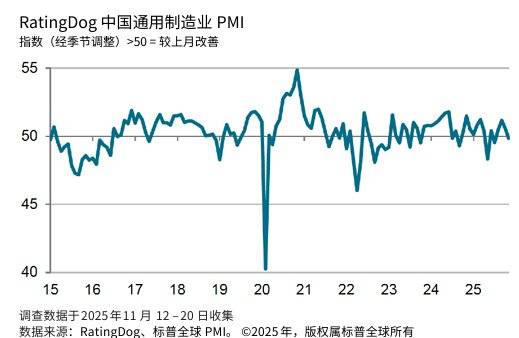
中国11月RatingDog制造业PMI降至49.9 逊预期
Sou Hu Cai Jing· 2025-12-01 03:45
Core Viewpoint - In November, China's RatingDog manufacturing PMI dropped to 49.9, indicating a weak contraction in the manufacturing sector, below the expected 50.5 and previous value of 50.6 [1] Manufacturing Sector Performance - Both production and demand indicators showed a slowdown, nearing stagnation, with new export orders rebounding but failing to improve the overall low state of manufacturing [1] - The growth of new orders has nearly stalled, leading manufacturers to reduce workforce and procurement, while becoming more cautious in inventory management [1] Inventory and Pricing Trends - Both raw material and finished goods inventories have entered a contraction phase, with readings at their lowest in nearly three years; raw material inventory saw its first decline in seven months [1] - There is a divergence in pricing, with raw material prices increasing while finished goods prices are decreasing; rising metal prices are identified as a key factor for increased costs, although the rate of increase in raw material prices and decrease in finished goods prices has narrowed, continuing to pressure corporate profit margins [1] Employment and Future Outlook - The employment index has re-entered the contraction zone due to the slowdown in new order growth [1] - Overall, the November PMI indicates a shift from expansion to contraction in China's manufacturing sector; however, there may be a potential for a temporary boost in supply and demand towards the end of the year, with expectations of a weak expansion in December PMI [1]

X @外汇交易员
外汇交易员· 2025-09-03 01:47
中国8月RatingDog服务业PMI录得53,预期52.5,前值52.6。中国8月RatingDog综合PMI录得51.9,前值50.8。其中服务业新接业务量录得2024年5月后最快增速,新订单连续第二个月加速增长,增速同样创2024年5月后最高纪录,其中部分贡献来自新出口业务,录得2月份后最高增速。https://t.co/pHLQQuONhP https://t.co/9FAoPPgz5m外汇交易员 (@myfxtrader):中国8月RatingDog制造业PMI录得50.5,预期49.7,前值49.5。数据显示,制造业景气改善率5个月来最显著,同时新增出口业务量的收缩率较7月份放缓,制造商的采购量和库存量也随之增加,当月原材料和半成品库存录得2020年11月后最大增幅。 https://t.co/I5kciLs2zr ...
X @外汇交易员
外汇交易员· 2025-08-05 01:52
Economic Indicators - China's July Caixin/S&P Global Services PMI reached 52.6, exceeding expectations of 50.4 [1] - The Composite PMI registered 50.8 [1] - China's July S&P Global Manufacturing PMI came in at 49.5, below the anticipated 50.4 [2] Service Sector Performance - Service sector new business volume experienced a notable increase, marking a one-year high [1] - The improvement was attributed to enhanced basic demand and successful business expansion [1] - Foreign demand rebounded for the first time in three months, driven by increased tourism and stable trade conditions, leading to the highest export order growth since February [1] Manufacturing Sector Performance - China's manufacturing output experienced its second decline since October 2023 [3] - Surveyed companies attributed the production decrease to a slowdown in new order growth [3] - Manufacturers reported weak foreign demand, with new export orders contracting for the fourth consecutive month and at an accelerated pace compared to June [3] Cost Pressure - Average input costs continued to rise in July due to increased raw material, fuel, and payroll expenses [1]