旅游市场遇冷

Search documents
1月中国内地访日游客减少60.7% 跌幅还在扩大 春节期间来自中国的酒店预订取消率超50%
Mei Ri Jing Ji Xin Wen· 2026-02-19 01:09
Group 1 - The number of Chinese mainland tourists visiting Japan in January decreased by 60.7% year-on-year, worsening from a 45.3% decline in December of the previous year [1] - The total number of foreign tourists visiting Japan in January fell by 4.9% year-on-year, marking the first year-on-year decline in four years [1] - The decline in Chinese tourists has negatively impacted various economic sectors in Japan, including retail, accommodation, and dining [3] Group 2 - During the Spring Festival period, the cancellation rate of hotel bookings from China in Japan reached 53.6%, an increase of 14.9 percentage points compared to the Spring Festival in 2025 [3] - Major department stores in Japan, such as Mitsukoshi Isetan, Takashimaya, and Daimaru Matsuzakaya, reported a year-on-year decline of over 10% in duty-free sales in January [3] - Concerns have been raised by industry experts regarding the ongoing severe conditions in the tourism market [3]


1月中国内地访日游客减少60.7%,跌幅还在扩大,春节期间来自中国的酒店预订取消率超50%
Mei Ri Jing Ji Xin Wen· 2026-02-19 01:00
Core Viewpoint - The number of Chinese mainland tourists visiting Japan in January decreased by 60.7% year-on-year, marking a significant decline that has impacted various sectors of the Japanese economy [1] Group 1: Tourist Data - In January, the total number of foreign tourists visiting Japan decreased by 4.9% year-on-year, marking the first year-on-year decline in four years [1] - The cancellation rate for hotel bookings from China during the Spring Festival period reached 53.6%, an increase of 14.9 percentage points compared to the Spring Festival in 2025 [1] Group 2: Economic Impact - Major department stores in Japan, including Mitsukoshi Isetan, Takashimaya, and Daimaru Matsuzakaya, reported a year-on-year decline of over 10% in duty-free sales in January [1] - Experts express concerns about the ongoing severe situation in the tourism market, indicating that the negative impact on retail, accommodation, and dining sectors is expected to persist [1]
1月中国内地访日游客减少60.7%,春节期间来自中国的酒店预订取消率超50%
Mei Ri Jing Ji Xin Wen· 2026-02-19 00:50
Group 1 - The number of Chinese mainland tourists visiting Japan in January decreased by 60.7% year-on-year, further widening from a 45.3% decline in December of the previous year [1] - The total number of foreign tourists visiting Japan in January fell by 4.9% year-on-year, marking the first year-on-year decline in four years [3] - The decline in Chinese tourists has negatively impacted various sectors in Japan, including retail, accommodation, and dining [4] Group 2 - During the Spring Festival period, the cancellation rate of hotel bookings from China in Japan reached 53.6%, an increase of 14.9 percentage points compared to the Spring Festival in 2025 [4] - Major department stores in Japan, such as Mitsukoshi Isetan, Takashimaya, and Daimaru Matsuzakaya, reported a year-on-year decline of over 10% in duty-free sales in January [4] - Concerns have been raised by industry experts regarding the ongoing severe situation in the tourism market [4]

在日中文导游:下个月要带的大陆团都取消了
Hang Zhou Ri Bao· 2025-11-25 00:53
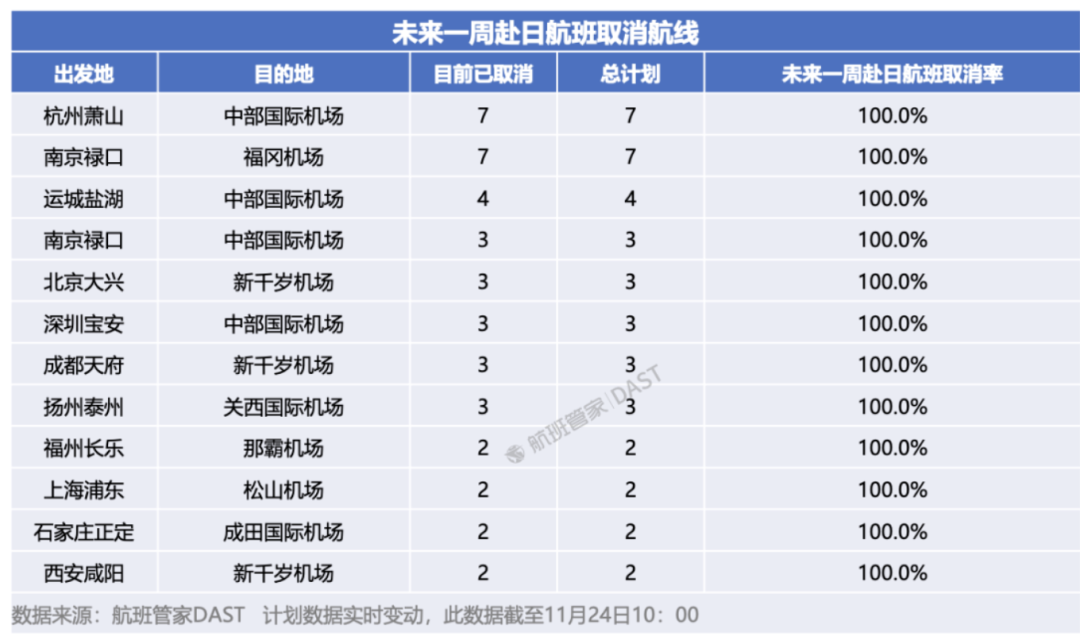
Core Insights - The cancellation of flights on the China-Japan routes has reached a significant level, with 12 routes canceling all flights as of November 24 [1][2] - The overall cancellation rate for planned flights to Japan from China has increased by approximately 56% compared to the same period last month [3][5] Flight Cancellations - Specific routes with 100% cancellation include Hangzhou to Central International Airport, Nanjing to Fukuoka Airport, and several others, indicating a complete halt in operations for these routes [2] - Major airlines such as Air China and Eastern Airlines are reducing their flight frequencies, with Air China cutting its Shanghai to Osaka route from 21 to 16 flights per week [3][5] Booking Trends - Following the announcement of a free cancellation policy for flights to Japan, there has been a notable decline in ticket bookings, with a reduction of about 29% in the next 60 days compared to the period before the policy [5] - Data indicates that as of November 18, approximately 543,000 tickets were canceled, reflecting a significant drop in demand for travel to Japan [6] Impact on Tourism - The decrease in Chinese tourists is putting pressure on Japanese tourism operators, with reports of canceled group tours during what is typically a busy season [6] - Local tour guides in Japan are expressing concerns over the reduced demand for tours, particularly from mainland China, which traditionally has a high number of elderly travelers and small high-end custom groups [6]
在日中文导游:下个月要带的大陆团都取消了
第一财经· 2025-11-24 15:08
Core Viewpoint - The article highlights a significant reduction in flights from China to Japan, with 12 routes canceling all flights and an overall increase in cancellation rates, indicating a decline in travel demand to Japan [3][4][5]. Flight Cancellations - As of November 24, 2025, 12 routes from China to Japan have canceled all flights, with a 100% cancellation rate for each of these routes [5]. - Major airlines are reducing their flight schedules, with Air China cutting its Shanghai to Osaka route from 21 to 16 flights per week, and Eastern Airlines canceling 6 out of 14 flights on its Beijing to Osaka route [6][9]. - The cancellation rate for planned flights to Japan is projected to reach 21.6% by November 27, marking the highest rate in a month [6]. Booking Trends - Following the announcement of a free cancellation policy for flights to Japan on November 15, there has been a 29% decrease in ticket bookings for the next 60 days compared to the period before the announcement [9]. - Data indicates that over 543,000 flight orders have been canceled since November 15, reflecting a significant drop in demand for travel to Japan [9]. Impact on Tourism - The decline in Chinese tourists is putting pressure on Japanese tourism operators, with reports of canceled group tours during what is typically a busy season [10]. - Tour guides and hotel operators in Japan are expressing concerns about the potential long-term impact of reduced travel demand, fearing a return to the low activity levels experienced during the pandemic [10].

国庆黄金周救不了泰国旅游
虎嗅APP· 2025-09-14 03:12
Core Viewpoint - The article discusses the significant decline in Chinese tourist arrivals in Thailand, highlighting the challenges faced by the Thai tourism industry and the potential long-term structural changes in tourist behavior following recent events [5][31]. Group 1: Current Situation of Thai Tourism - Thai hotels are experiencing a downturn, with a notable drop in bookings from Chinese tourists, leading to price reductions [6][7]. - Official data indicates a 7.2% year-on-year decrease in foreign tourists to Thailand, totaling 21.9 million visitors in the first eight months of 2025 [9]. - The decline in Chinese tourists is particularly severe, with a 46% drop in arrivals, resulting in a total revenue decrease of 12% in the second quarter of 2025 [10][11]. Group 2: Government Response - The Thai government has implemented measures to attract tourists, including allowing virtual currency exchanges for Thai baht and offering free domestic flight tickets [11][12]. - These initiatives aim to stimulate tourism despite the challenges posed by the lack of Chinese visitors [12]. Group 3: Impact of Recent Events - The "Wang Xing incident" has significantly affected Chinese tourists' confidence in traveling to Thailand, with many opting for alternative destinations [14][16]. - Predictions suggest that only 5 million Chinese tourists may visit Thailand in 2025, with most trips being business-related rather than leisure [16]. Group 4: Competitive Landscape - Other countries, such as Japan, South Korea, and Vietnam, are increasingly attracting Chinese tourists, with Vietnam seeing a 44.3% year-on-year increase in arrivals [20][24]. - Malaysia and Singapore are also gaining ground, with significant increases in Chinese tourist numbers compared to Thailand [22][23]. Group 5: Long-term Implications - The article suggests that the decline in Chinese tourists may indicate a fundamental shift in travel preferences, with Thailand potentially losing its appeal as a destination [31][36]. - The Thai tourism industry faces a critical juncture, needing to decide between lowering prices or seeking new markets to sustain tourism [35][36].