旅游概念股

Search documents
史上最长春节假期将至,出行旅游有望迎高峰期,这些股频获机构调研
Xin Lang Cai Jing· 2026-01-13 00:57
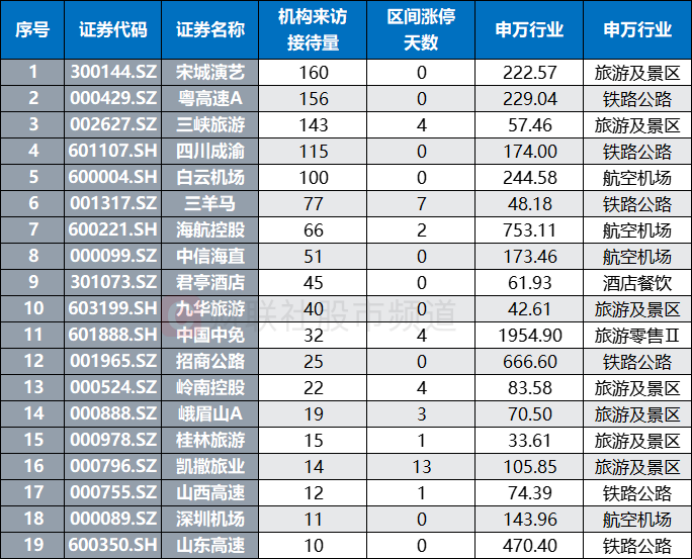
Core Insights - The 2026 Spring Festival holiday will last for 9 days from February 15 to February 23, marking the longest Spring Festival holiday in history [1] - The Spring Festival is a crucial driver of domestic tourism in China, with 5.01 billion domestic trips and a total expenditure of 677 billion yuan during the 2025 holiday, reflecting a year-on-year growth of 5.9% and 7.0% respectively [1] - The tourism market is already experiencing a surge in activity, with over 3 million flight tickets booked for the 2026 Spring Festival as of January 9, showing a 20% increase in daily bookings compared to the same period last year [1] Company and Industry Highlights - Key tourism and travel-related stocks with significant institutional interest include: - Songcheng Performance (300144.SZ) with 160 institutional visits and a price increase of 222.57% [2] - Guangdong Expressway (000429.SZ) with 156 visits and a price increase of 229.04% [2] - Three Gorges Tourism (002627.SZ) with 143 visits and a price increase of 57.46% [2] - Sichuan Chengyu (601107.SH) with 115 visits and a price increase of 174.00% [2] - Baiyun Airport (600004.SH) with 100 visits and a price increase of 244.58% [2] - Other notable stocks with high institutional visits include HNA Holding (600221.SH) with 66 visits and a price increase of 753.11%, and China Duty Free (601888.SH) with 32 visits and a price increase of 1954.90% [2][3] - Stocks with high price increase frequency over the past year include: - Caesar Travel (000796.SZ) with 13 price limit increases [3] - Tibet Travel (600749.SH) and Haikou Group (603069.SH) each with 10 price limit increases [3]





港股异动 | 旅游概念股集体走高 2026年旅游市场开门红 花旗预期春节表现将较为强劲
智通财经网· 2026-01-06 06:43
Group 1 - The tourism sector stocks have collectively risen, with notable increases in companies such as Tongcheng Travel (up 5.02% to HKD 23.86), Trip.com Group (up 4.08% to HKD 600), Huazhu Group (up 4.01% to HKD 38.36), and Meituan (up 1.42% to HKD 106.9) [1] - During the New Year's holiday, domestic travel reached 142 million trips, a 5.2% increase compared to the 2024 New Year's holiday, with total spending amounting to CNY 84.789 billion, reflecting a 6.3% growth [1] - The average spending per person during the holiday increased by 1.1% compared to the previous year, driven by a rich supply of winter-themed travel options such as ice and snow tourism, winter escapes, and New Year celebrations [1] Group 2 - The National Immigration Administration reported an average of 2.2 million inbound and outbound trips per day during the holiday, marking a 28.6% year-on-year increase and approximately 28% higher than 2019 levels, with outbound trips by mainland residents rising by 39.1% [1] - Citigroup's research indicates that while domestic travel performance is expected to remain stable for the upcoming 2026 New Year, cross-border travel is anticipated to show robust growth [1] - The upcoming Spring Festival is projected to be more significant, with expectations for strong performance due to a 9-day holiday in 2026, one day longer than in 2025 [1]


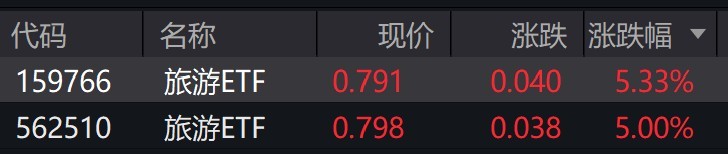
旅游概念股持续走强,旅游ETF涨约5%
Mei Ri Jing Ji Xin Wen· 2025-11-10 05:46
Core Viewpoint - The tourism sector is experiencing a strong rally, with significant gains in stocks such as China Duty Free Group, Overseas Chinese Town A, and Jin Jiang Hotels, leading to a rise in the tourism ETF by approximately 5% [1][2]. Group 1: Market Performance - China Duty Free Group, Overseas Chinese Town A, and Jin Jiang Hotels have reached their daily limit up [1]. - The tourism ETF, which tracks the CSI Tourism Theme Index, has increased by about 5% [1]. Group 2: Industry Recovery - The CSI Tourism Theme Index includes up to 50 listed companies involved in various aspects of the tourism industry, reflecting the overall performance of tourism-related stocks [2]. - All segments of the tourism industry, including scenic spots, hotels, travel agencies, and retail, are showing signs of comprehensive recovery [2]. Group 3: Policy Support - The government is actively promoting high-quality development in the tourism sector through various policies aimed at regulating industry growth, enhancing quality tourism products and services, improving infrastructure, and expanding financing channels [2]. - Upcoming holidays, such as the New Year and extended Spring Festival, along with the rising popularity of ice and snow tourism and the introduction of duty-free and visa-free policies, are contributing to the increased activity in the tourism sector [2].


“人造古城”模式陷困局
Shen Zhen Shang Bao· 2025-06-30 22:44
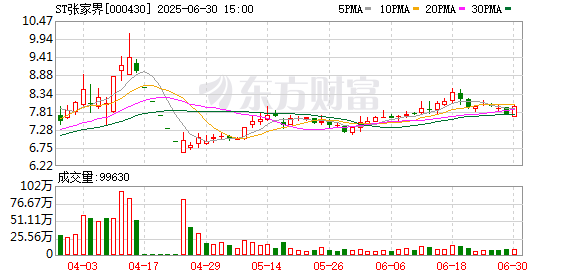
Group 1 - ST Zhangjiajie experienced a stock price increase of 2.97% by the end of trading on June 30, following exposure of the Da Yong Ancient City project, which has incurred a cumulative loss of 1.08 billion yuan over four years and is now on the brink of bankruptcy [2] - The company has been under other risk warnings from the Shenzhen Stock Exchange since April 17, 2023, due to negative net profits for three consecutive accounting years, raising concerns about its ability to continue as a going concern [2] - The Da Yong Ancient City project, with an investment scale of 2.443 billion yuan, has been a significant financial burden, with total assets of 1.395 billion yuan and total liabilities of 1.697 billion yuan, resulting in a negative net asset of 302 million yuan [3] Group 2 - ST Zhangjiajie, established in December 1992 and listed in 1996, is recognized as the first listed company in China's tourism sector, but unlike other tourism companies, it does not derive ticket revenue from the Zhangjiajie scenic area [3] - The company's revenue is primarily generated from environmental passenger transport, Baofeng Lake, and Yangjiajie cableway, with the Da Yong Ancient City project being classified as a heavy "liability" [3] - The tourism industry is facing challenges with the "artificial ancient city" model, which highlights the difficulties of relying on heavy asset expansion, long recovery periods, and the risk of becoming "ghost towns" due to excessive dependence on government subsidies [3]