
旅游ETF

Search documents
量化择时周报:耐心防御等缩量-20260322
ZHONGTAI SECURITIES· 2026-03-22 11:42
Core Insights - The report indicates that the market is currently in a consolidation phase, with a potential for further short-term adjustments as trading volume continues to decrease, but remains above critical thresholds [2][5][6] - The overall market (wind All A index) experienced a decline of 4.13% last week, with small-cap stocks (CSI 1000) dropping by 5.25% and mid-cap stocks (CSI 500) falling by 5.82% [6][7] - Key sectors showing resilience include telecommunications and banking, while materials such as non-ferrous metals and steel have underperformed significantly [6][7] Market Dynamics - The distance between the short-term (20-day) and long-term (120-day) moving averages has narrowed to 4.33%, indicating a bearish market sentiment with a negative profit effect of -4.35% [5][6][9] - The report highlights that the core variable to observe is the change in risk appetite, influenced by factors such as shifts in Federal Reserve interest rate expectations and ongoing geopolitical tensions in the Middle East [7][9] - A trading volume below 17 trillion is anticipated to signal a potential rebound in the market [5][7] Sector Allocation - The mid-term industry allocation model suggests focusing on sectors related to computing power, such as semiconductor equipment (ETF code 159516.SZ) and telecommunications (ETF code 515880.SH), as well as cyclical sectors like oil and gas (ETF code 159309.SZ) and energy chemicals (ETF code 159981.SH) [5][12] - In a defensive strategy, short-term attention should be given to banking ETFs and tourism ETFs [5][12] Valuation Metrics - The wind All A index's PE ratio is positioned around the 85th percentile, indicating a moderately high valuation level, while the PB ratio is at the 50th percentile, reflecting a medium valuation level [7][9] - Based on the current market conditions, a 50% allocation in absolute return products based on the wind All A index is recommended [5][7]
量化择时周报:缩量之前防御为主-20260315
ZHONGTAI SECURITIES· 2026-03-15 07:43
Quantitative Models and Construction Methods 1. Model Name: Timing System Model - **Model Construction Idea**: The model uses the distance between the short-term moving average (20-day) and the long-term moving average (120-day) of the Wind All A Index to identify market trends and timing signals[2][7][12] - **Model Construction Process**: 1. Calculate the 20-day moving average and 120-day moving average of the Wind All A Index 2. Compute the distance between the two moving averages: $ Distance = \frac{MA_{20} - MA_{120}}{MA_{120}} $ 3. Define thresholds: If the absolute value of the distance is greater than 3%, it indicates a significant trend signal[7][12] 4. Incorporate additional metrics such as market trend line (6796 points) and profitability effect (-0.02%) to refine the signal[7][12] - **Model Evaluation**: The model effectively captures market oscillations and provides actionable timing signals during periods of market uncertainty[7][12] 2. Model Name: Mid-term Industry Allocation Model - **Model Construction Idea**: This model identifies industries with strong performance potential based on earnings trends and macroeconomic factors[6][8][13] - **Model Construction Process**: 1. Analyze earnings trends across industries to identify sectors with upward momentum 2. Incorporate macroeconomic indicators and policy drivers to refine sector selection 3. Highlight key sectors such as computing power (e.g., semiconductor equipment, communication), cyclical industries (e.g., oil and gas, energy chemicals), and agriculture[6][8][13] - **Model Evaluation**: The model provides a robust framework for sector rotation and aligns with defensive strategies during market uncertainty[6][8][13] --- Model Backtesting Results 1. Timing System Model - Moving average distance: 5.28% (greater than the 3% threshold)[7][12] - Market trend line: 6796 points[7][12] - Profitability effect: -0.02% (not yet positive)[7][12] 2. Mid-term Industry Allocation Model - Key sectors identified: - Computing power: Semiconductor equipment ETF (159516.SZ), Communication ETF (515880.SH) - Cyclical industries: Oil and gas ETF (159309.SZ), Energy chemicals ETF (159981.SH) - Agriculture: Agriculture ETF (562900.SH)[6][8][13] --- Quantitative Factors and Construction Methods 1. Factor Name: Moving Average Distance - **Factor Construction Idea**: Measures the relative distance between short-term and long-term moving averages to capture market momentum[7][12] - **Factor Construction Process**: 1. Calculate the 20-day and 120-day moving averages of the Wind All A Index 2. Compute the relative distance using the formula: $ Distance = \frac{MA_{20} - MA_{120}}{MA_{120}} $ 3. Use a threshold of 3% to determine significant signals[7][12] - **Factor Evaluation**: The factor is effective in identifying market trends and oscillations, providing a clear signal for timing decisions[7][12] --- Factor Backtesting Results 1. Moving Average Distance Factor - Current value: 5.28% (above the 3% threshold)[7][12]
“北向+游资+机构” 疯狂抢筹岩山科技,多家机构集体出逃油气股
摩尔投研精选· 2026-03-05 10:29
Core Viewpoint - The article highlights the trading activities in the Shanghai and Shenzhen stock markets, focusing on the top traded stocks, sector performances, and significant fund flows, indicating potential investment opportunities and market trends [1][2][5]. Group 1: Trading Volume and Top Stocks - The total trading volume for the Shanghai and Shenzhen Stock Connect reached 316.35 billion, with Zijin Mining and Xinyi Technology leading in trading volume for the Shanghai and Shenzhen markets respectively [1]. - The top traded stocks in the Shanghai Stock Connect included Zijin Mining (24.63 billion), Baiwei Storage (23.70 billion), and Tebian Electric (18.99 billion) [3]. - In the Shenzhen Stock Connect, the leading stocks were Xinyi Technology (43.34 billion), Ningde Times (39.52 billion), and Zhongji Xuchuang (36.06 billion) [4]. Group 2: Sector Performance - The electronic sector saw the highest net inflow of funds, while sectors such as agriculture, oil and gas, and precious metals experienced significant outflows [5][6]. - The top sectors with net inflows included optical electronics (56.63 billion, 9.10%) and electric power equipment (55.59 billion, 3.81%) [6]. - Conversely, the non-ferrous metals sector had the largest net outflow at -84.28 billion (-4.63%) [7]. Group 3: ETF Trading - The A500 ETF Fund (512050) had the highest trading volume at 104.93 billion, with a 3.06% increase from the previous trading day [13]. - The tourism ETF (159766) saw a remarkable 179% increase in trading volume compared to the previous day, indicating strong investor interest [14]. Group 4: Institutional and Retail Activity - Institutional activity was notable, with the brain-computer interface stock, Yanshan Technology, hitting a strong limit up and attracting 1.9 billion from two institutions [16]. - Significant sell-offs were observed in oil and gas stocks, with Tongyuan Petroleum and Intercontinental Oil & Gas facing substantial institutional sell-offs of 1.15 billion and 7.42 billion respectively [17]. - Retail investors showed interest in Yanshan Technology, with a total of 4.86 billion bought by leading retail funds [19].




ETF及指数产品网格策略周报-20260303
HWABAO SECURITIES· 2026-03-03 11:08
Group 1: Grid Trading Strategy Overview - The essence of "grid trading" is a high buy low sell strategy, which does not predict market trends but utilizes natural price fluctuations within a certain range to generate profits, making it suitable for frequently fluctuating markets [3][11] - Characteristics of suitable grid trading targets include: selecting on-market targets, stable long-term trends, low trading costs, good liquidity, and high volatility. Equity ETFs are considered relatively suitable for grid trading [3][11] Group 2: ETF Grid Strategy Target Analysis - The Hong Kong Stock Connect Non-Bank ETF (513750.SH) benefits from an increase in the sales proportion of participating insurance products, which helps optimize the liability cost for insurance funds. In Q3 2025, the net profit of the top five listed insurance companies in A-shares reached CNY 426.04 billion, a year-on-year increase of 33.54%, driven by improved investment returns in stocks and equity funds [3][12] - The Robot ETF (159530.SZ) reflects the maturity of China's robotics industry and the arrival of a commercialization threshold, with significant advancements in AI technology expanding the commercial boundaries of robots in various sectors such as service, healthcare, and companionship [4][15] - The Tourism ETF (159766.SZ) saw record-breaking data during the Spring Festival, with 596 million domestic trips taken, an increase of 95 million from 2025, and total spending of CNY 803.48 billion, up CNY 126.48 billion year-on-year. This indicates a strong recovery in consumer spending in tourism, positioning it as a key driver for economic growth [5][6][17]
ETF 及指数产品网格策略周报(2026/3/3)
华宝财富魔方· 2026-03-03 09:18
Core Viewpoint - The article discusses the performance and potential of specific ETFs, particularly focusing on the non-bank insurance ETF and tourism ETF, highlighting their growth prospects driven by market conditions and consumer behavior. Group 1: Non-Bank Insurance ETF (513750.SH) - As of Q3 2025, the total net profit attributable to shareholders of the five major listed insurance companies in A-shares reached 426.04 billion yuan, a year-on-year increase of 33.54%, primarily driven by improved equity investment returns in a low-interest-rate environment [3][4]. - The active market trading and regulatory guidance are expected to enhance the proportion of equity investments by insurance funds, providing upward elasticity for their investment side [3]. - The sales of participating insurance products have significantly increased, helping insurance companies optimize their liability costs and alleviate pressure from interest rate spreads [3]. Group 2: Tourism ETF (159766.SZ) - During the 2026 Spring Festival holiday, domestic travel reached 596 million trips, an increase of 95 million trips compared to 2025, with total spending amounting to 803.48 billion yuan, up by 126.48 billion yuan, marking record highs in both visitor numbers and spending [6][7]. - The People's Bank of China reported that during the same period, transaction volumes processed by UnionPay and NetUnion reached 39.302 billion transactions, amounting to 13.12 trillion yuan, reflecting a year-on-year increase of 37.45% in transaction counts and 19.26% in transaction amounts [6]. - The "14th Five-Year Plan" emphasizes the construction of a strong tourism nation, aiming to enhance the supply of high-quality tourism products and services, positioning tourism as a key driver for consumption upgrades and economic growth [6][7].

行业轮动ETF策略周报-20260302
金融街证券· 2026-03-02 07:15
1. Report Industry Investment Rating - No relevant information provided 2. Core Viewpoints of the Report - The strategy is based on the reports "Strategy Portfolio Report under Industry Rotation: Quantitative Analysis from the Perspective of Industry Style Continuity and Switching" (20241007) and "Research on the Overview and Allocation Methods of the Stock - type ETF Market: Taking the ETF Portfolio Based on the Industry Rotation Strategy as an Example" (20241013), constructing a strategy portfolio based on industry and theme ETFs [2] - From 20260224 - 20260227, the cumulative net return of the strategy was about 0.44%, and the excess return relative to the CSI 300 ETF was about - 0.71%. From October 14, 2024 to now, the cumulative out - of - sample return of the strategy was about 38.54%, and the cumulative excess return relative to the CSI 300 ETF was about 13.71% [5] - In the week of 20260302, the model recommends allocating sectors such as real estate development, cement, and batteries. In the next week, the strategy will newly hold products such as Building Materials ETF, Battery ETF Huitianfu, Bank ETF, and Game ETF, and continue to hold products such as Real Estate ETF and Tourism ETF [13] 3. Summary by Relevant Catalogs 3.1 Strategy Update - The strategy constructs a portfolio based on industry and theme ETFs, with reference to two previous research reports [2] 3.2 ETF Portfolio Information | Fund Code | ETF Name | ETF Market Value (billion yuan) | Holding Status | Heavy - held SW Industry and Weights | Weekly Timing Signal | Daily Timing Signal | | --- | --- | --- | --- | --- | --- | --- | | 159707 | Real Estate ETF | 6.65 | Continue to hold | Real estate development (100%) | - 1 | - 1 | | 159745 | Building Materials ETF | 26.61 | Add | Cement (45.24%) | 1 | 1 | | 159796 | Battery ETF Huitianfu | 84.32 | Add | Batteries (64.18%) | - 1 | - 1 | | 512800 | Bank ETF | 114.46 | Add | Joint - stock banks (42.01%) | - 1 | - 1 | | 159869 | Game ETF | 122.27 | Add | Games (83.85%) | 1 | - 1 | | 159766 | Tourism ETF | 78.92 | Continue to hold | Aviation and airports (33.21%) | 0 | 0 | | 515220 | Coal ETF | 94.06 | Add | Coal mining (88.96%) | 1 | 1 | | 159328 | Home Appliance ETF E Fund | 1.21 | Add | White goods (43.01%) | - 1 | - 1 | | 515650 | Consumption 50 ETF | 36.27 | Add | Baijiu (28%) | - 1 | 0 | | 515760 | Zhejiang State - owned Assets ETF Huaxia | 1.44 | Add | City commercial banks (20.13%) | 0 | 0 | [3] 3.3 Performance Tracking - From 20260224 - 20260227, the cumulative net return of the strategy was about 0.44%, and the excess return relative to the CSI 300 ETF was about - 0.71% - From October 14, 2024 to now, the cumulative out - of - sample return of the strategy was about 38.54%, and the cumulative excess return relative to the CSI 300 ETF was about 13.71% [5] 3.4 Portfolio Adjustment and Recommendations - In the week of 20260302, the model recommends allocating sectors such as real estate development, cement, and batteries - In the next week, the strategy will newly hold products such as Building Materials ETF, Battery ETF Huitianfu, Bank ETF, and Game ETF, and continue to hold products such as Real Estate ETF and Tourism ETF [13]
航天彩虹、中无人机等成立动力科技公司,注册资本35亿
Qi Cha Cha· 2026-02-27 01:54
Group 1 - The core point of the news is the establishment of a new company,航发通航动力科技(上海)有限公司, with a registered capital of 3.5 billion yuan, focusing on the manufacturing and sales of intelligent unmanned aerial vehicles and components for civil aviation [1] Group 2 - The new company is jointly held by航天彩虹 (002389) and中无人机 (688297), indicating collaboration between these firms in the aerospace sector [1]


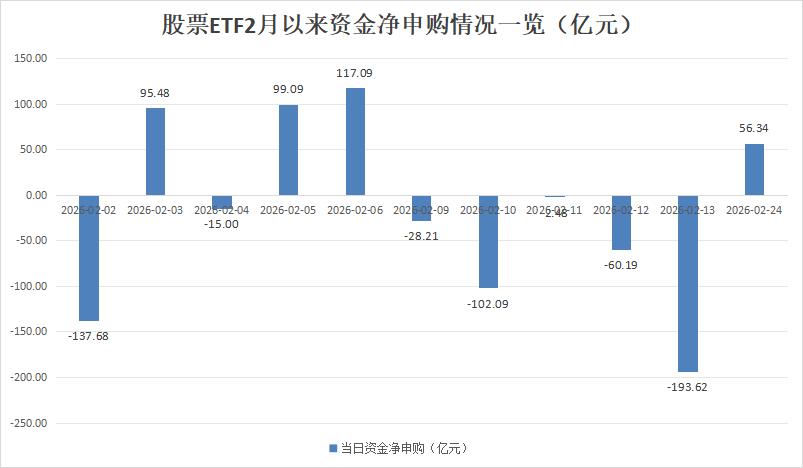
56亿,加仓
3 6 Ke· 2026-02-25 09:42
Group 1 - The stock ETF market experienced a significant net inflow of 56.34 billion yuan on February 24, reversing the trend of net outflows observed in the first five trading days of the year [1][2] - The A-share market opened higher and closed with the Shanghai Composite Index up by 0.87%, while the ChiNext Index saw a peak increase of over 2% [2] - The total scale of all stock ETFs reached 3.92 trillion yuan, with 1,339 stock ETFs in the market [2] Group 2 - The Hong Kong stock market ETFs led the net inflow, with 84.72 billion yuan, while broad-based ETFs saw a net outflow of 50.11 billion yuan [4] - ETFs tracking the Hang Seng Technology Index had the highest single-day net inflow of 46.59 billion yuan, while those tracking the CSI A500 Index faced a net outflow of 17.18 billion yuan [4] - Major fund companies like E Fund and Huaxia Fund reported significant net inflows in their ETFs, with E Fund's total ETF scale reaching 659.7 billion yuan [4][5] Group 3 - Specific ETFs such as the Hang Seng Technology Index ETF and the China Internet ETF saw net inflows of 16.53 billion yuan and 13.41 billion yuan, respectively [5][6] - The performance of the robotics and power grid equipment ETFs also attracted over 4 billion yuan in net inflows, indicating growing interest in these sectors [8] Group 4 - The market saw notable net outflows from broad-based ETFs, including the CSI 500 ETF and the media ETF, with the latter experiencing a net outflow of 4.46 billion yuan [9] - The short-term bond ETF faced the largest single-day net outflow of 11.54 billion yuan, reflecting a shift in investor sentiment towards riskier assets [9]
廖市无双-节后开盘-A股是否有机会进攻
2026-02-24 14:16
Summary of Conference Call Records Industry Overview - The conference call primarily discusses the A-share market in China, focusing on market trends, sector performance, and investment opportunities post-Chinese New Year [1][2][3]. Key Points and Arguments Market Performance and Trends - The A-share market exhibited a strong oscillation pattern before the Chinese New Year, with the Shanghai Composite Index peaking at 4,142 points, aligning with the expected range of 4,000 to 4,150 points [2][3]. - Major indices failed to break above the 5-week moving average due to large funds suppressing market movements, indicating a preference for maintaining a range-bound market rather than a rapid upward trend [3][5]. - The market is currently in an ABC adjustment structure, with the B phase ongoing, suggesting that a clear upward movement is unlikely until the C phase is completed [9][14]. Sector Performance - Sectors that performed well before the holiday include technology growth, computing, electronics, media, and telecommunications, which are closely related to the mainstream market trends since September 24, 2022 [4]. - The consumer sector, particularly retail and general consumption, saw significant capital outflows, reflecting a lack of investor confidence in economic recovery [7]. - The food and beverage sector is not expected to experience a major upward trend, with a clear bearish pattern observed [8]. Investment Opportunities - Short-term investment strategies are recommended, focusing on sectors with lower price levels and potential for quick gains, such as brokers, building materials, and banks [20]. - The technology growth sector, including AI applications and robotics, may present localized investment opportunities, but significant upward trends are not anticipated [18]. - The first quarter of 2026 may see the non-ferrous metals sector forming a significant bottom, with a notable increase in the index by 97.5 points in 2025 [21]. Market Sentiment and Future Outlook - The market is expected to maintain a high-risk preference in the short term, with potential for continued focus on technology growth sectors, although caution is advised due to the last trading day before the holiday [6][15]. - New funds are advised to wait for clearer investment opportunities post-March, as the current environment does not favor long-term investments [19][16]. - The overall market structure is likely to remain balanced, with a mix of growth and value styles emerging [30]. Other Important Insights - The recent appreciation of the RMB, surpassing 6.89, is seen as beneficial for the A-share market, supporting a positive outlook for capital markets [11]. - The upcoming political events, such as the two sessions in March, are anticipated to provide clearer investment signals [16]. - The historical context of spring market movements suggests a potential for short-term volatility, but with a cautious approach to avoid chasing high prices [28][31]. This summary encapsulates the key insights from the conference call, providing a comprehensive overview of the current state and future outlook of the A-share market and relevant sectors.
行业轮动ETF策略周报-20260224
金融街证券· 2026-02-24 12:53
Core Insights - The report emphasizes the construction of a strategy portfolio based on industry and thematic ETFs, leveraging insights from previous strategy reports on industry rotation and ETF market overview [2]. Strategy Update - The strategy portfolio includes various ETFs with specific holdings and weightings, such as: - Wine ETF with a market value of 184.16 billion, holding a significant position in the liquor industry (84.84%) [3]. - Real Estate ETF valued at 6.61 billion, fully invested in real estate development (100%) [3]. - Tourism ETF at 88.57 billion, primarily focused on the aviation and airport sector (33.21%) [3]. - New additions include Agriculture and Fishery ETF and Grain ETF, with respective holdings in aquaculture (46.89%) and planting (49.63%) [3]. - The strategy's performance for the period from February 9 to February 13, 2026, showed a cumulative net return of approximately -0.38%, underperforming the CSI 300 ETF by about -0.85% [3]. Performance Tracking - Since October 14, 2024, the strategy has achieved a cumulative return of approximately 37.93%, outperforming the CSI 300 ETF by about 14.43% [3][4]. - The report includes a performance chart illustrating the cumulative return of the industry rotation ETF strategy since its inception [4]. Weekly Holdings and Performance - The report details the weekly performance of various ETFs, indicating that the strategy will continue to hold Wine, Real Estate, Tourism, and Traditional Chinese Medicine ETFs while adding Agriculture and Grain ETFs [11]. - The average return of the ETF portfolio for the week was -0.38%, with a notable underperformance compared to the CSI 300 ETF [11].