无尺码

Search documents
为什么现在的内衣,长得都差不多?
3 6 Ke· 2025-12-23 11:46
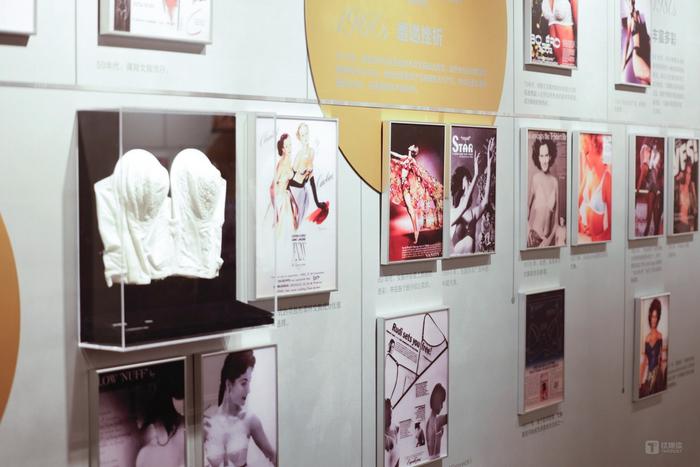
Core Insights - Triumph Group's withdrawal from the Chinese market marks a significant shift in the lingerie industry, indicating the end of the traditional underwire era and reflecting changing consumer preferences [1][2]. Market Overview - Triumph's peak sales in 2015-2016 reached 3.5 billion yuan with over 900 offline stores, but the brand is now exiting the market as consumer demand has evolved away from traditional underwire models [2]. - The overall lingerie market in China is experiencing stagnation, with online sales projected to reach over 20 billion yuan in 2025, but with only a 2.6% year-on-year growth, indicating a shift to a mature market with no structural growth [2]. Consumer Behavior - There has been a significant shift in consumer preferences from underwire to wireless and size-free lingerie, leading to a market characterized by intense competition and homogenization [2][6]. - The traditional model of detailed sizing and professional in-store guidance is becoming obsolete as consumers increasingly prefer online shopping, with 81.9% purchasing lingerie online [5]. Competitive Landscape - New brands like Ubras and蕉内 are rising, focusing on size-free designs that simplify the purchasing process and align with modern consumer values of comfort and self-acceptance [6][9]. - The market is witnessing a shift where brands are expanding into adjacent categories like loungewear and activewear as single-category growth becomes challenging [15][17]. Innovation and Challenges - The lingerie market is facing a lack of innovation, with many brands relying on marketing rather than product development, leading to a homogenized product offering [18][21]. - Future opportunities for innovation may lie in functional materials and fashion-forward designs, moving beyond the current size-free trend to cater to specific consumer needs [22][24].

新老内衣品牌鏖战 黛安芬竞争失利
Zhong Guo Jing Ying Bao· 2025-11-28 21:10
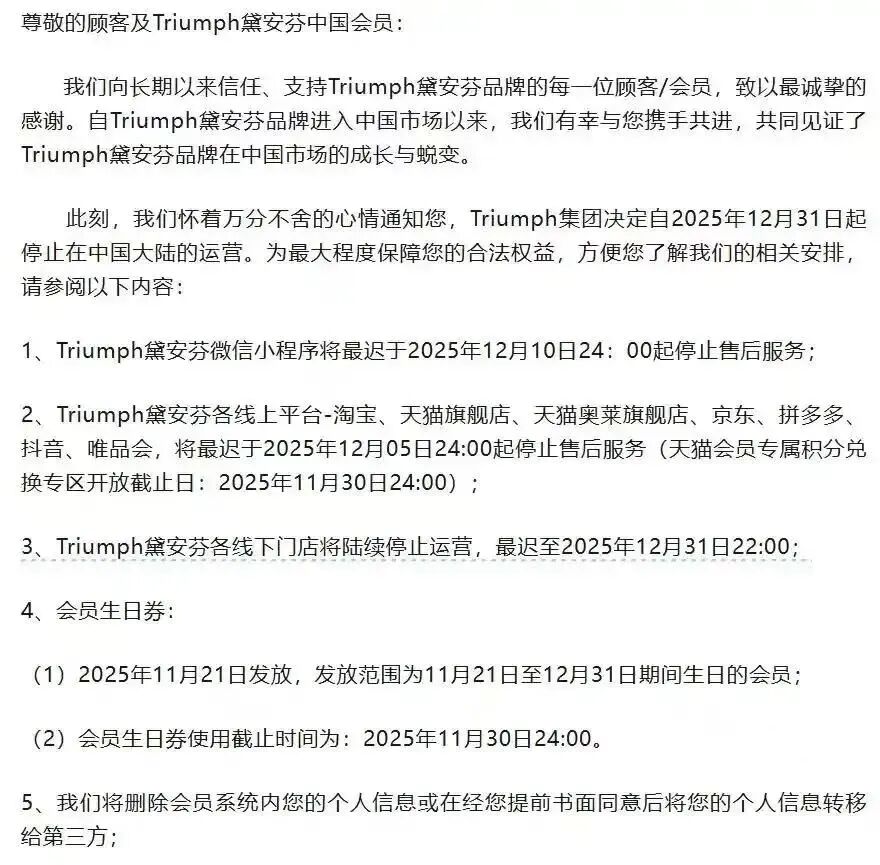
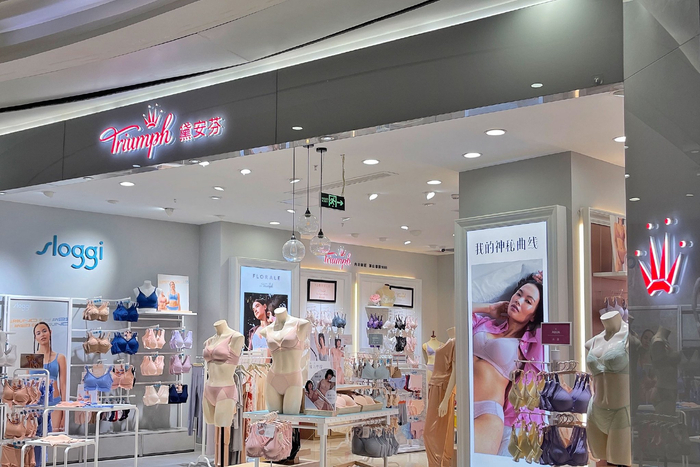
Core Viewpoint - Triumph Group, the parent company of the well-known lingerie brand Triumph, announced its decision to cease operations in mainland China by December 31, 2025, due to an inability to adapt to changing consumer demands and competitive dynamics in the market [2][4][5]. Company Summary - Triumph, founded in 1886, was one of the first foreign brands to introduce underwire bras to the Chinese market and had established over a thousand stores at its peak [4][5]. - The brand has begun closing its physical stores, with some locations already offering clearance sales and discounts ranging from 4.5% to 8.5% off [3][4]. - Online sales channels will also be phased out, with the last day for after-sales service on various platforms set for December 5, 2025 [2][3]. Industry Summary - The lingerie market in China has shifted from a focus on underwire bras to a preference for comfort, with over 70% of the market now favoring wireless bras [4][5]. - New emerging brands that emphasize comfort, such as Ubras and Neiwai, have gained significant market traction, often outperforming traditional brands like Triumph in online sales [6][7]. - The competitive landscape is characterized by a fragmented market, with Triumph holding less than 1% market share, while local brands are rapidly gaining ground [5][9]. - Traditional brands are facing challenges due to slow product innovation and reliance on outdated sales channels, while new brands leverage online marketing and innovative product designs to attract younger consumers [6][8][9].
对话爱慕创始人张荣明:内衣混战,消费分化,但价格战不是出路|独家
Tai Mei Ti A P P· 2025-08-05 10:16
Core Viewpoint - The article discusses the evolution of the lingerie industry in China, focusing on the brand Aimer, founded by Zhang Rongming, and its adaptation to changing consumer preferences and market dynamics [2][5][26]. Company Overview - Aimer was founded in 1993 by Zhang Rongming, who initially developed a high-performance memory alloy bra under the brand [5][6]. - The company has grown to become a leading player in the domestic lingerie market, with a diverse product line that includes various sub-brands [5][6][10]. Market Trends - The lingerie market is experiencing a shift in consumer preferences, with a growing emphasis on comfort and practicality over traditional notions of beauty and allure [6][8][10]. - New brands are emerging with innovative concepts such as "wireless" and "size-free" designs, challenging established players like Aimer [6][12][17]. Competitive Landscape - Aimer has historically been a pioneer in the use of memory alloy materials for bras, but it faces increasing competition from new entrants that leverage modern marketing strategies and consumer trends [6][12][17]. - The brand has maintained its market position despite the entry of global competitors like Victoria's Secret, which struggled in the Chinese market due to cultural differences [8][9][12]. Consumer Behavior - The new generation of Chinese female consumers is shifting from a desire to please others to a focus on self-expression and comfort in their lingerie choices [6][10][12]. - Aimer recognizes the importance of adapting to these changing consumer values while maintaining its brand identity [17][25]. Production and Supply Chain - The lingerie industry is moving towards more efficient production methods, such as bonding technology, which reduces labor costs and increases production capacity [12][24]. - Aimer is exploring new manufacturing techniques while balancing the need for quality and brand integrity [12][24]. Strategic Direction - Aimer's strategy emphasizes maintaining brand consistency across online and offline channels, resisting the urge to engage in price wars [19][21][26]. - The company is focused on building a strong brand presence and adapting to market changes without compromising its core values [17][26].