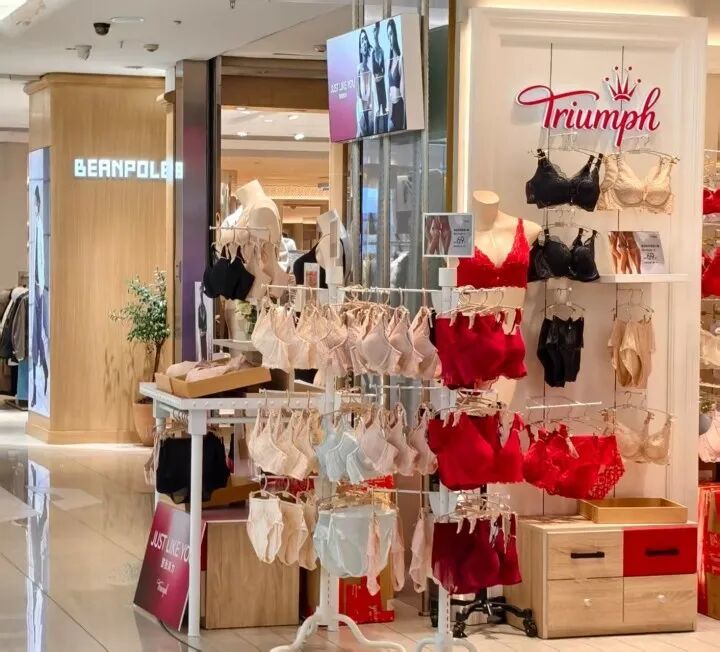
无钢圈内衣

Search documents
县城贵妇的「美丽刑具」,终于被抛弃了
3 6 Ke· 2026-01-21 03:58
Core Insights - The article discusses the significant shift in the lingerie market, particularly the decline of traditional underwire bras and the rise of comfortable, wire-free options, reflecting changing consumer preferences towards comfort over traditional notions of sexiness [1][6][27]. Group 1: Market Trends - The lingerie market has seen a transformation where brands like Triumph, once dominant, are now struggling as consumers move away from underwire bras towards softer, more comfortable options [5][6][25]. - The shift in consumer preferences is evident as traditional lingerie stores have changed their offerings to focus on lighter, more comfortable materials, moving away from the structured, underwire designs [7][9]. - The rise of brands emphasizing comfort, such as Ubras and Bananain, highlights a broader trend where consumers prioritize comfort and personal expression over traditional sexy aesthetics [14][19]. Group 2: Brand Evolution - Victoria's Secret, once a leader in the lingerie market, has experienced a significant decline in sales, dropping from $7.5 billion in 2019 to around $2 billion in 2023, prompting a shift towards wire-free and sports lingerie [23][25]. - The marketing strategies of lingerie brands have evolved, with a focus on promoting health, comfort, and self-acceptance rather than traditional sexy imagery [32][40]. - The article notes that the concept of "sexy" in lingerie advertising has shifted, with modern campaigns focusing on empowerment and self-definition rather than conforming to past ideals [36][42]. Group 3: Consumer Behavior - Consumers are increasingly rejecting the discomfort associated with traditional bras, leading to a rise in the popularity of wire-free options that prioritize comfort and fit [11][14]. - The article emphasizes that the modern consumer is more aware of their body and comfort needs, leading to a rejection of the restrictive designs of the past [13][19]. - The trend towards "no bra" or alternative options like breast stickers indicates a significant cultural shift in how women view lingerie and their bodies [44][52].

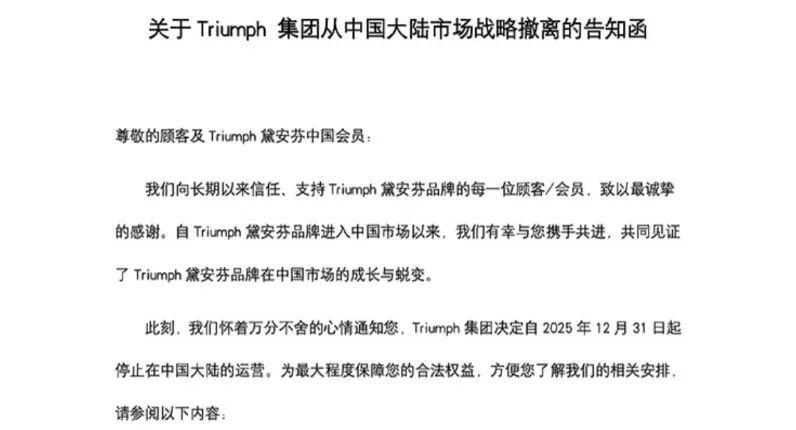
新老内衣品牌鏖战 黛安芬竞争失利
Zhong Guo Jing Ying Bao· 2025-11-28 21:10
Core Viewpoint - Triumph Group, the parent company of the well-known lingerie brand Triumph, announced its decision to cease operations in mainland China by December 31, 2025, due to an inability to adapt to changing consumer demands and competitive dynamics in the market [2][4][5]. Company Summary - Triumph, founded in 1886, was one of the first foreign brands to introduce underwire bras to the Chinese market and had established over a thousand stores at its peak [4][5]. - The brand has begun closing its physical stores, with some locations already offering clearance sales and discounts ranging from 4.5% to 8.5% off [3][4]. - Online sales channels will also be phased out, with the last day for after-sales service on various platforms set for December 5, 2025 [2][3]. Industry Summary - The lingerie market in China has shifted from a focus on underwire bras to a preference for comfort, with over 70% of the market now favoring wireless bras [4][5]. - New emerging brands that emphasize comfort, such as Ubras and Neiwai, have gained significant market traction, often outperforming traditional brands like Triumph in online sales [6][7]. - The competitive landscape is characterized by a fragmented market, with Triumph holding less than 1% market share, while local brands are rapidly gaining ground [5][9]. - Traditional brands are facing challenges due to slow product innovation and reliance on outdated sales channels, while new brands leverage online marketing and innovative product designs to attract younger consumers [6][8][9].
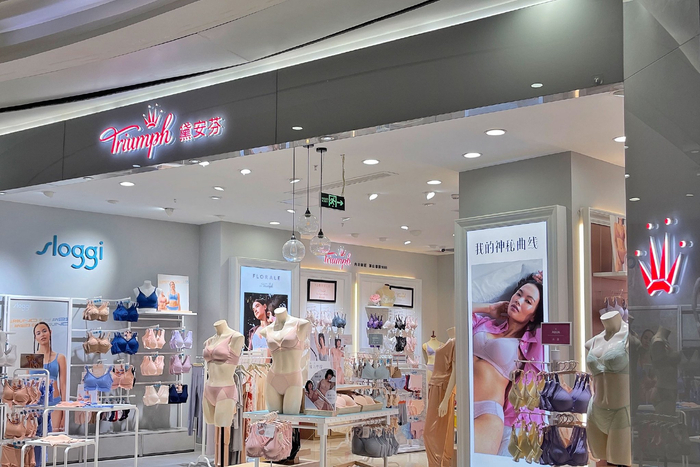
昔日巨头黛安芬退场,本土内衣品牌“接棒”主舞台
Xin Jing Bao· 2025-11-28 13:39
Core Insights - Triumph, a German lingerie brand, announced its exit from the Chinese mainland market by the end of 2025, marking the end of the "underwire era" in the country [5][6][11] - The shift in consumer preferences towards comfort and local brands has led to a decline in Triumph's market presence, with 78.4% of consumers now opting for wire-free bras [6][10] - The rise of domestic brands like Ubras and Jiao Nai has capitalized on the changing consumer trends, achieving significant market share and sales growth [10][12] Company Overview - Triumph International Group, established in 1886, was one of the first international lingerie brands to localize production in China, with a peak of over 1,000 stores [7][11] - The brand was once perceived as a luxury in the Chinese market, but its relevance has diminished as consumer preferences shifted towards comfort and affordability [8][9] Market Dynamics - The lingerie market in China is undergoing a transformation, with local brands capturing 90% of the top 20 sales during the recent Double 11 shopping festival [10][12] - The market is characterized by a fragmented landscape, with the top five brands holding only 6% market concentration, indicating a highly competitive environment [15] Consumer Behavior - Younger consumers are increasingly favoring local brands over international ones, driven by a desire for comfort and affordability [8][9] - The traditional focus on shaping and underwire has been replaced by a demand for comfort, with many consumers now preferring wire-free and sports-style lingerie [6][10] Industry Trends - The lingerie industry is witnessing a bifurcation, with new brands rapidly emerging while traditional brands like Triumph face declining sales and market share [11][12] - The rise of "white label" products poses a significant challenge to both established and new brands, as price competition intensifies in the fragmented market [15]
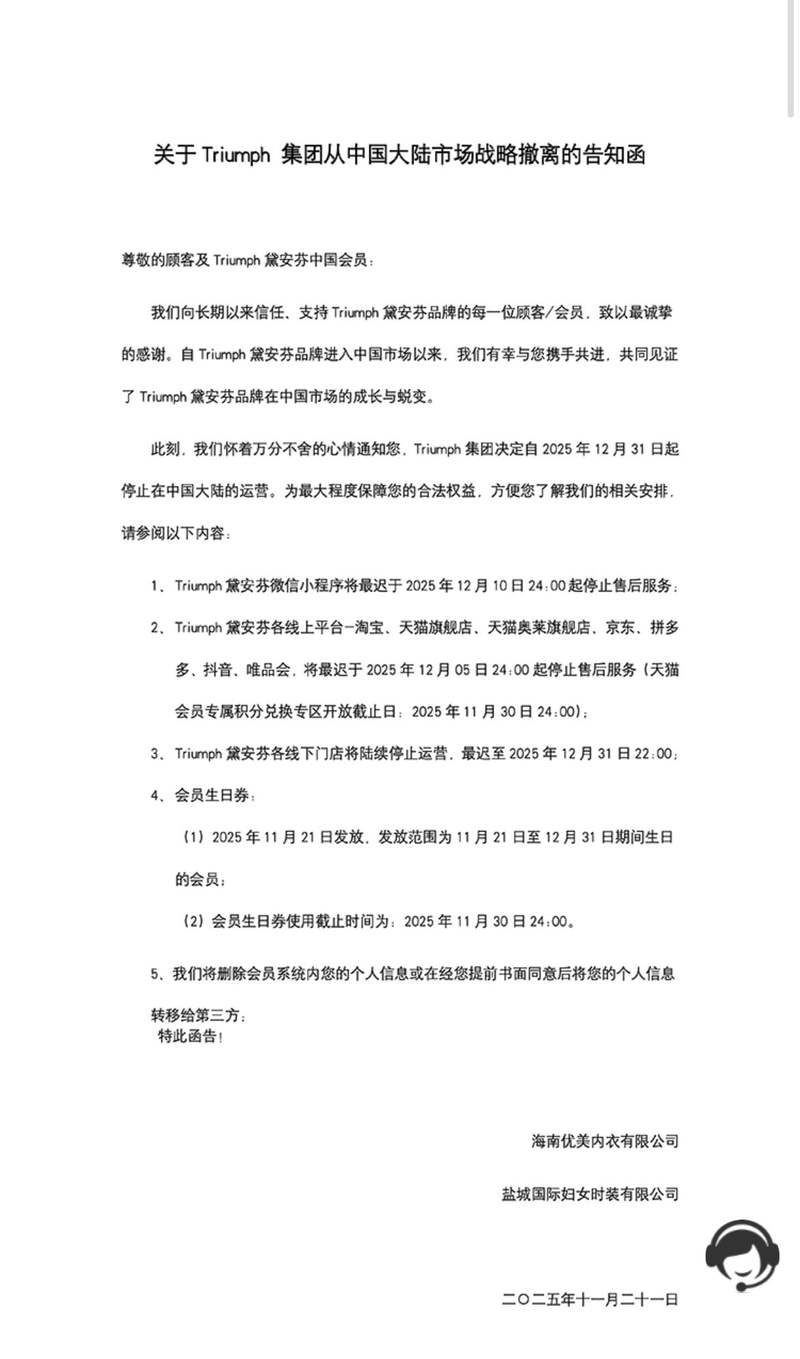
突然退市!记者走访知名内衣品牌深圳门店
Shen Zhen Shang Bao· 2025-11-25 13:59
Core Insights - The German lingerie brand Triumph, known for introducing underwire bras to the Chinese market, is set to exit mainland China after over 40 years of operation, with its last stores expected to close by December 20, 2023 [1][3] - The brand's decline is attributed to a significant market shift towards wireless bras, which now account for 68% of the online lingerie market in China, reflecting a broader trend in consumer preferences for comfort over shaping [2][4] Company Overview - Triumph entered the Chinese market in 1979, becoming one of the first international lingerie brands to establish a presence post-reform [3] - The brand peaked between 2015 and 2016, achieving annual sales of 3.5 billion yuan and operating over 900 stores, capturing a market share of 5.2% [3] - Despite attempts to adapt by launching wireless products post-2020, Triumph's market share has dwindled to less than 1% as of Q3 2024 [3] Industry Trends - The Chinese wireless lingerie market has seen explosive growth, with a market size reaching 152.1 billion yuan in 2024, a threefold increase from 38 billion yuan in 2018 [4] - Local brands such as Ubras and Jiao Nai have emerged as market leaders, dominating sales on platforms like Tmall, where they occupy the top two spots in the lingerie category [4] - The industry is evolving towards diversification and technological innovation, with new product categories like sports and sleepwear gaining traction, and the integration of advanced materials enhancing product value [4]
黛安芬关闭中国内地门店,千亿内衣市场有人吃肉有人喝汤
Sou Hu Cai Jing· 2025-11-24 15:13
Core Viewpoint - The German lingerie brand Triumph, with over 130 years of history, announced the closure of all offline stores in mainland China by December 31, 2025, along with the shutdown of all online stores by December 5, 2025, signaling a strategic retreat due to significant market changes [2][4]. Company Summary - Triumph was founded in 1886 in southern Germany and entered the Chinese market in 2008, being one of the first brands to introduce "underwire bras" to China [4]. - The company has previously closed stores in the UK in 2017 and is now facing rising operational costs in China, which necessitate high inventory turnover and intense promotions, compressing profit margins [7]. - As of 2024, Triumph's associated company in China, Yancheng International Women's Fashion Co., Ltd., has a registered capital of 15 million USD and employs 75 people [4]. Industry Summary - The Chinese lingerie market has undergone significant changes over the past decade, shifting from a focus on "underwire shaping" to a preference for "wireless comfort" [7]. - The market size for women's lingerie in China reached 223.7 billion CNY in 2024, with domestic brands surpassing foreign brands for the first time in market concentration [7][11]. - The market share of wireless bras increased to 68% in 2024, a 42 percentage point rise since 2018, indicating rapid growth in this segment [7][11]. - Local brands like Ubras, Neiwai, and Jiao Nai have gained prominence with their "wireless, zero-burden" philosophy, leading to a shift in consumer preferences [10][12]. - The competitive landscape is characterized by a fragmented market, with the top 10 brands holding only 8.9% market concentration in 2024 [11]. - Traditional brands are adapting through various strategies, with Urban Beauty focusing on core categories and Aimer pursuing a multi-brand and globalization approach [11]. - Emerging brands are rapidly gaining market share, with Ubras achieving sales of 3.5 billion CNY in 2024, and Jiao Nai's GMV surpassing 7 billion CNY, highlighting the shift towards comfort and segmentation in the market [12].

太突然!知名品牌退出中国大陆市场,很多人买过→
Sou Hu Cai Jing· 2025-11-22 06:04
Core Viewpoint - Triumph Group, a well-known German lingerie brand, announced its strategic withdrawal from the Chinese mainland market, effective December 31, 2025, due to significant market changes and competition from local brands [1][4]. Company Summary - Triumph Group has been operating in the Chinese market since 2008, being one of the first foreign brands to introduce underwire bras [4]. - The company has struggled to adapt to the evolving consumer preferences in China, where demand has shifted from "shaping" to "comfort" [4]. - Despite launching a comfort line, Triumph's core product line has remained focused on underwire bras, which has hindered its ability to capture the growing market for wireless bras [4]. Industry Summary - The Chinese lingerie market has undergone significant transformation, with the wireless bra segment expected to account for 68% of the market by 2024, a 42 percentage point increase since 2018 [4]. - The overall market size is projected to reach 223.7 billion yuan in 2024, growing at 8.3% year-on-year, but market share is increasingly concentrated among local brands [4]. - International lingerie brands, including Triumph, have seen their market share decline to less than 1% by 2024 due to lagging in channel adaptation, pricing strategies, and localized design [4][5].
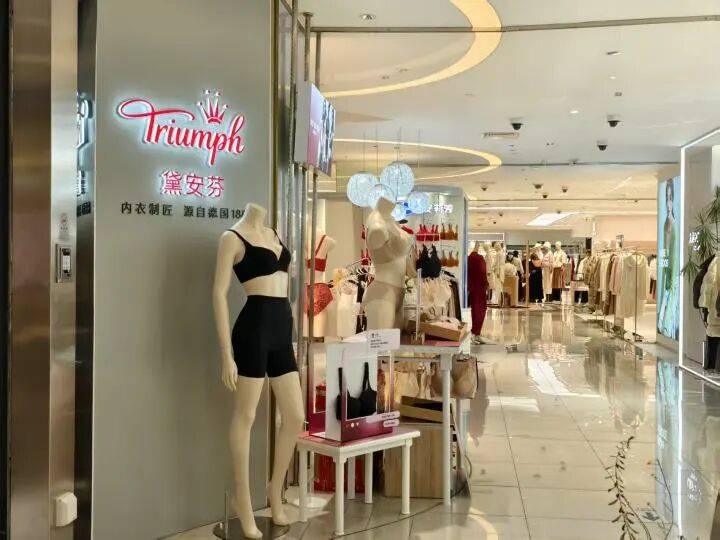
黛安芬2025年底关闭中国内地线下门店
Sou Hu Cai Jing· 2025-11-21 10:24
Group 1: Exit Plan and Timeline - Triumph will close all offline counters in mainland China by December 31, 2025, as confirmed by multiple store employees [1] - Some stores have already indicated they will cease operations by the end of this month [1] Group 2: Official Stance - As of November 20, 2025, Triumph's official website in China has not released any public statements, although internal notifications have been sent to some stores [2] - The status of online channels remains unclear, with customer service indicating no relevant information available [2] Group 3: Clearance Progress - Most stores are currently offering regular discounts (5-30%), with some locations like Shanghai Jiu Guang Department Store advertising promotions as low as 30% [3] Group 4: Brand History and Market Position - Triumph entered the Chinese market in 1979 and established factories in 1992, officially entering the retail market in 2008, reaching peak sales of 3.5 billion yuan with over 900 stores [5] - The brand is known for its underwire bras, priced between 200-500 yuan, and is considered a "first bra" brand for many consumers [7] Group 5: Reasons for Exit - The shift in consumer demand towards wireless bras, which are projected to capture 68% of the market share by 2024, has negatively impacted Triumph, which has struggled to change its "underwire specialist" image [7] - Local brands like Ubras and NEIWAI have gained market share with innovative products and strong online sales, while Triumph's online sales account for only 14% [7] - Triumph's market share has plummeted from 5.2% in 2015 to less than 1% in 2024, with a significant drop in sales during the 2023 618 shopping festival due to a product safety issue [8] Group 6: Consumer Reactions and Industry Impact - Consumer sentiment is divided, with nostalgic customers reminiscing about their first bras while practical consumers criticize the brand for high prices and poor fit for Asian body types [9] - Local brands are quickly filling the void left by Triumph, with companies like Victoria's Secret planning to open new stores and others like Bananain and NEIWAI taking over Triumph's former locations [10] Group 7: Summary and Industry Insights - Triumph's exit signifies a shift in the Chinese lingerie market from foreign dominance to local innovation, highlighting failures in product strategy, channel adaptation, and cost competitiveness [11] - Future competition will focus on agile responses to consumer needs, integrated multi-channel strategies, and personalized experiences, indicating ongoing industry reshuffling [12]
年底全面撤出内地市场,老牌内衣黛安芬败在哪
Bei Jing Shang Bao· 2025-11-20 12:58
Core Viewpoint - The mid-to-high-end lingerie brand, Triumph, is set to withdraw from the mainland China market by December 31, 2025, as consumer preferences shift away from traditional underwire bras towards more comfortable, wire-free, and sports-oriented lingerie options [1][5][10] Company Summary - Triumph, a well-known lingerie brand from Germany, was one of the first foreign brands to enter the Chinese market, establishing a local production system in the early 1990s [5] - At its peak, Triumph operated over a thousand stores in mainland China, becoming a significant player in the lingerie market [5] - The brand's long-standing focus on underwire bras has led to a failure to adapt to changing consumer demands for comfort and functionality, resulting in its decision to exit the market [5][10] Industry Summary - The lingerie market is experiencing a transformation, with emerging brands focusing on comfort and functionality gaining popularity over traditional brands like Triumph [8][9] - New brands such as ubras and NEIWAI have successfully captured market share by offering wire-free products and innovative designs that resonate with younger consumers [9][10] - Established brands are facing declining sales and profitability, with companies like Wacoal and Aimer reporting significant revenue drops [6][7] - The shift in consumer preferences from "beauty for others" to "comfort for oneself" has created challenges for traditional brands that have not kept pace with market changes [10]

太突然!知名品牌被曝年底撤柜,有门店已证实
新浪财经· 2025-11-20 09:24
Core Insights - The high-end lingerie brand, Triumph, is set to completely withdraw from the Chinese mainland market by December 31, 2025, as confirmed by multiple store employees [2] - The brand has a long history in China, starting its operations in 1979 and establishing a local production system by the early 2000s [4] Market Dynamics - The withdrawal of Triumph reflects significant changes in the Chinese lingerie market over the past decade, with consumer demand shifting from "shaping" to "comfort" [5] - The market share of non-underwire bras is projected to reach 68% by 2024, a 42 percentage point increase since 2018, while Triumph has primarily focused on underwire products [5] - Local brands like ubras and NEIWAI have rapidly gained market share by emphasizing "non-underwire" and "zero constriction" products, with ubras achieving over 2 billion yuan in annual sales within five years [5] Sales Channels - The online sales channel has become crucial for brands to reach consumers effectively, with e-commerce platforms providing the ability to target specific customer groups and meet diverse consumer needs [5] - The Chinese women's lingerie market is expected to see a growth rate of 7%-8% in 2025, with e-commerce sales experiencing a year-on-year increase of 44.75% [5]
在华已运营超30年,黛安芬将全面撤柜,门店:已收到通知
Mei Ri Jing Ji Xin Wen· 2025-11-19 22:49
Core Viewpoint - The German mid-to-high-end lingerie brand Triumph is set to exit the mainland China market by December 31, 2025, sparking discussions among consumers about the brand's significance in their lives [1][7]. Company Overview - Triumph, founded in 1886 in Germany, is one of the largest lingerie manufacturers globally, with annual sales of $1.6 billion and production exceeding 200 million lingerie items [3]. - The brand entered the Chinese market in 1979, initially engaging in processing operations, and established local production companies in 1992 [3]. Market Dynamics - The Chinese lingerie market has undergone significant changes over the past decade, shifting consumer demand from "shaping" to "comfort," with the no-wire lingerie segment expected to account for 68% of the market by 2024, a 42 percentage point increase since 2018 [4]. - Local brands like ubras and NEIWAI have rapidly gained market share by focusing on "no-wire, zero constriction" products, with ubras achieving annual sales exceeding 2 billion yuan within five years [4]. Competitive Landscape - The Chinese lingerie market is projected to reach 223.7 billion yuan in 2024, growing at 8.3% year-on-year, with market share increasingly concentrated among local brands [5]. - Established local brands like Aimer and Maniform hold nearly 30% of the mid-to-high-end market due to their multi-channel strategies and competitive pricing [5]. - Triumph and other foreign brands have seen their market share decline to less than 1% by 2024, hindered by slow online channel adaptation, higher price points, and inadequate local design [5]. Industry Trends - Triumph's exit reflects broader challenges faced by international lingerie brands in adapting to evolving consumer preferences and competitive dynamics in China [7]. - The rise of local brands and market diversification offers consumers more choices, with a focus on sustainability, comfort, and personalization becoming central to lingerie consumption [7].