无汞体温计替代

Search documents
水银体温计今日起停产 替代产品怎么选?
Xin Hua Wang· 2026-01-01 01:57
Core Viewpoint - The National Medical Products Administration (NMPA) has announced a ban on the production of mercury thermometers and sphygmomanometers starting January 1, 2026, marking the end of mercury thermometers in the market. The accuracy of alternative electronic and infrared thermometers is a major concern for the public [3][20]. Group 1: Regulations and Transition - The new regulation will phase out mercury thermometers, with existing compliant products allowed to be sold until their expiration dates [20]. - Hospitals are expected to stop purchasing mercury thermometers, with a complete phase-out planned between 2025 and 2027, particularly in pediatric and maternal-child health institutions [20]. Group 2: Accuracy and Consumer Concerns - Many consumers express skepticism about the accuracy of electronic thermometers compared to mercury ones, fearing misdiagnosis due to perceived inaccuracies [4]. - Medical professionals assert that qualified electronic thermometers have no significant difference in accuracy compared to mercury thermometers, with an acceptable error range of ±0.1-±0.2°C [4][3]. Group 3: Market Dynamics and Pricing - The market for thermometers is diverse, with prices ranging from 8-15 yuan for mercury thermometers to over 300 yuan for high-end infrared models [8][15]. - The cost difference in thermometers is influenced by materials used, brand value, and technological features, with non-mercury thermometers expected to drop below 10 yuan as production scales up [15]. Group 4: Disposal and Environmental Concerns - There is a lack of comprehensive recycling channels for mercury thermometers for ordinary residents, and proper disposal is crucial to prevent environmental hazards [21]. - Some pharmacies are willing to participate in the collection of expired mercury thermometers, but emphasize the need for support and infrastructure to ensure safe disposal [21].

水银温度计停产在即,替代产品早已布局
Qi Lu Wan Bao· 2025-12-17 09:30
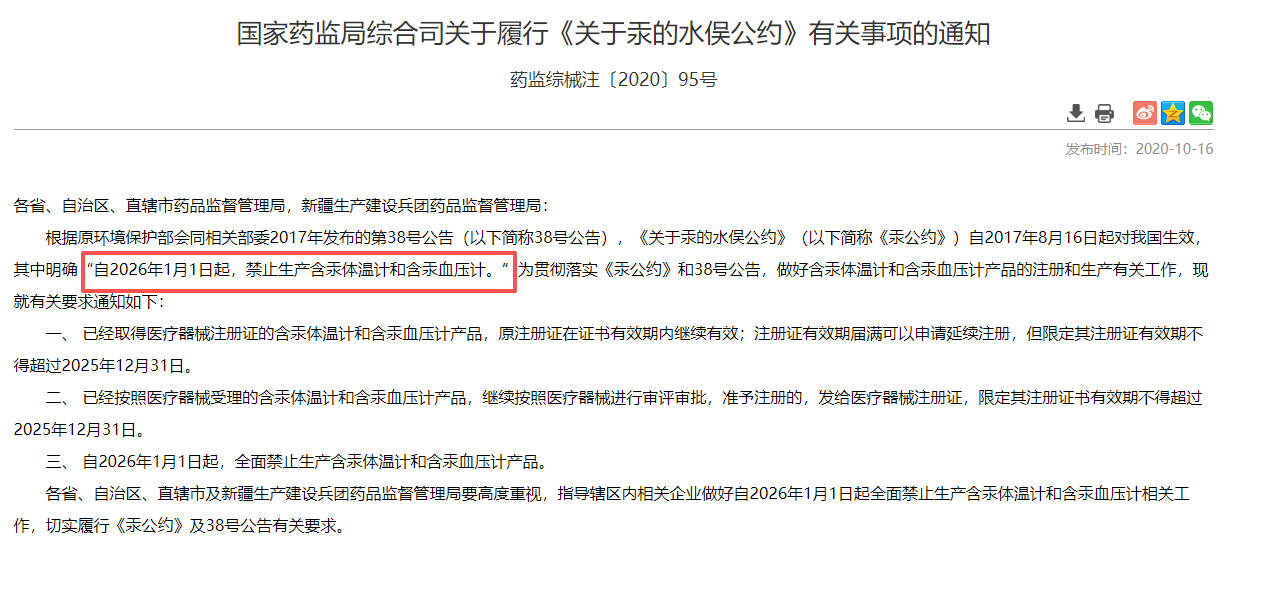
Core Viewpoint - Starting from 2026, China will prohibit the production of mercury thermometers and blood pressure monitors, leading to a surge in sales of existing mercury thermometers as consumers rush to stock up before the ban takes effect [1] Group 1: Market Response - The sales of mercury thermometers have increased significantly, with reports of some stores running out of stock and consumers purchasing multiple units [1][2] - Online prices for mercury thermometers have risen, with most now priced above 12 yuan, and some stores reporting a tenfold increase in weekly sales [2] - The market for non-mercury glass thermometers and electronic thermometers is also seeing increased demand, with some products already sold out [2] Group 2: Consumer Preferences - Many consumers express a preference for mercury thermometers due to perceived accuracy compared to electronic thermometers, which are often seen as less reliable [3] - A survey of various thermometers showed that while mercury thermometers generally recorded higher temperatures, non-mercury glass and electronic thermometers provided similar readings [4][5] Group 3: Industry Trends - The non-mercury thermometer market in China has been developing for nearly 20 years, with a market size of 2.5 billion yuan in 2019, accounting for over 50% of the global market [5] - Despite a 217% year-on-year increase in non-mercury thermometer production expected by 2025, market share remains below 30%, indicating room for growth [6] - The industry is projected to maintain a compound annual growth rate of over 8% in the coming years, with smart electronic thermometers growing at a rate of 30% annually [6]
水银体温计在线销售涨十倍,这些上市公司股价集体上涨
第一财经· 2025-12-15 07:48
Core Viewpoint - The article discusses the impending discontinuation of mercury thermometers starting January 1, 2025, leading to a surge in consumer demand and price increases for these products [3][4]. Market Reaction - Following the announcement, stocks of companies like Ji'an Medical (九安医疗) and Antai Technology (安泰科技) saw significant price increases, with Ji'an Medical rising over 5% on the first trading day after the news [3][4]. - The price of mercury thermometers has skyrocketed, with reports indicating that prices have increased from around 5 yuan to nearly 40 yuan in some cases [3][4]. Consumer Behavior - There has been a noticeable increase in consumers purchasing mercury thermometers, with some buying in bulk, leading to shortages in pharmacies and a tenfold increase in online sales [3][4]. Health and Environmental Concerns - The article highlights the dangers of mercury, noting that a single thermometer contains about 1 gram of mercury, which can pose significant health risks if broken [4][5]. - The environmental impact of mercury thermometers is also discussed, emphasizing the need for safer alternatives due to the toxic nature of mercury [4][5]. Alternative Products - The article mentions the availability of non-mercury glass thermometers that use safer materials, such as gallium-indium-tin alloy, which are becoming more popular as replacements [5][6]. - The cost of non-mercury thermometers is generally higher, with prices ranging from 20 to 30 yuan compared to the lower cost of mercury thermometers [5][6]. Industry Implications - Companies involved in the production of non-mercury thermometers, such as Shanghai Huachen Medical Instrument Co. and Yuyue Medical, are highlighted as key players in the market shift [5][6]. - The upstream suppliers of the materials used in non-mercury thermometers, including gallium, indium, and tin producers, are also expected to benefit from this transition [5][6]. Competitive Landscape - The non-mercury thermometer market faces competition from electronic thermometers, which are noted for their accuracy and safety [7]. - The article emphasizes the importance of choosing certified products and the need for regular calibration of electronic thermometers to ensure measurement accuracy [7].