
日股走势

Search documents
日股能否抗住日元贬值、收益率上行的双重压力?
Hua Er Jie Jian Wen· 2026-01-23 06:39
Core Viewpoint - Despite facing challenges such as early elections, a weak yen, and rising long-term interest rates, Japanese stocks still have room for growth by the end of 2026 [1] Group 1: Market Outlook - The core conclusion indicates that as long as the USD/JPY exchange rate does not exceed 165 and the 10-year Japanese government bond yield remains below 3%, the upward trend of Japanese stocks is likely to remain unchanged [2] - The upcoming early election on February 8 will significantly influence short-term market reactions, but expectations of fiscal stimulus and political stability point towards a stock market rise by the end of the year [3] Group 2: Currency and Interest Rate Thresholds - The critical threshold for the yen is set at 165, where excessive depreciation could harm unhedged investors' asset values and hinder real wage growth [4] - The 10-year government bond yield at 3% is a key pressure point for the financial system and stock valuations, particularly affecting regional financial institutions [8] Group 3: Scenarios and Predictions - In a baseline scenario where the ruling Liberal Democratic Party (LDP) secures a majority, the Nikkei index may remain flat or slightly decline post-election but is expected to rebound, targeting 57,000 points by the end of 2026 [5] - In a weak scenario where the LDP fails to secure a majority, the market may initially drop to around 52,000 points but could recover to 55,000 points by year-end due to fiscal expansion policies [5] - In a strong scenario where the LDP achieves a stable majority, the Nikkei index could immediately surpass 56,000 points post-election and reach over 60,000 points by year-end [5] Group 4: Risk and Support Dynamics - The sensitivity of Japanese corporate profits to exchange rates has decreased, with the beta coefficient dropping from 1.0 to 0.6, indicating reduced responsiveness to currency fluctuations [5] - If the 10-year JGB yield rises to the 3.0%-3.5% range, regional banks may face capital adequacy issues, potentially leading to forced selling of stocks to bolster capital [10] - Domestic institutional investors possess significant potential for capital repatriation, which could stabilize the market as domestic yields rise [10]


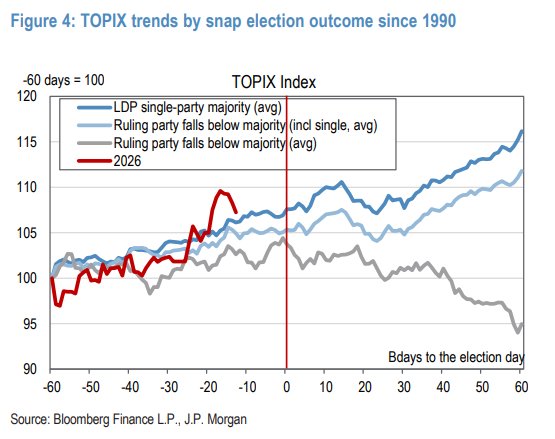
日本首相石破茂或宣布辞职 日元短线下挫、日股走高
news flash· 2025-07-23 02:33
Core Viewpoint - Japanese Prime Minister Shigeru Ishiba is expected to announce his resignation by the end of August, leading to fluctuations in the financial markets, including a short-term decline in the yen and an increase in the Nikkei 225 index [1] Market Reactions - The Nikkei 225 index has seen a significant increase, rising over 3% and surpassing the 41,000 point mark [1] - The USD/JPY exchange rate experienced a short-term increase, with the dollar rising by 60 points to reach a high of 147.14, reflecting a daily gain of 0.26% [1]