
智慧城市4.0

Search documents
“因城施策+生态共建” 联想城市超级智能体加速落地
Zheng Quan Ri Bao Wang· 2025-10-31 09:13
Core Insights - The first Urban Super Intelligent Body Development Forum was held in Shenzhen, focusing on the role of urban super intelligent bodies in activating urban genes for the development of smart cities 4.0 [1] Group 1: Urban Super Intelligent Body Concept - Urban super intelligent bodies are seen as the main lever for future smart cities, representing a complete urban intelligent ecosystem rather than a single technology product [1] - The concept was proposed by Lenovo Group in 2025, aiming to serve as a multi-modal, cross-platform intelligent hub that addresses AI demands [1] - This system is designed to assist humans in complex problem-solving and task execution, featuring capabilities in perception, interaction, cognition, decision-making, autonomy, and evolution [1] Group 2: Implementation and Collaboration - Lenovo's urban super intelligent body has already been scaled in multiple cities across the country, utilizing a "city-specific strategy" model [2] - During the forum, Lenovo signed strategic cooperation agreements with various local governments and organizations to integrate technology innovation with urban governance [2] - The construction of smart cities 4.0 is recognized as a complex system project that requires open collaboration and ecosystem co-construction among various stakeholders [2] Group 3: Future Outlook - The urban super intelligent body is expected to evolve from a technical tool to a strategic partner in urban development, with ongoing integration into more cities and industries [2] - The emphasis on "human-intelligence co-creation" signifies a shift in how technology will be utilized in urban settings, enhancing the role of urban super intelligent bodies [2]

联想签约中国—东盟信息港 共筑“数字城市丝绸之路”
Bei Jing Shang Bao· 2025-10-30 11:15
Core Insights - Lenovo Group signed strategic cooperation agreements with China-ASEAN Information Harbor Co., Ltd. and Beitou Xinchuan Group during the 2025 World Cities Conference to promote the construction and operation of urban super-intelligent systems [1] Group 1: Strategic Partnerships - Lenovo will leverage its extensive experience in urban super-intelligent systems and intelligent transformation to enhance urban governance, transportation, and cultural tourism services [1] - The collaboration with China-ASEAN Information Harbor aims to expand urban super-intelligent systems in ASEAN countries, using Laos as a model to explore applications in healthcare, education, and agriculture [1] - The partnership with Beitou Xinchuan Group focuses on developing urban super-intelligent systems in the Beibu Gulf area, covering smart transportation, energy, ports, low-altitude economy, zero-carbon parks, and manufacturing [1] Group 2: Goals and Objectives - The initiatives aim to improve urban management efficiency and optimize public service delivery [1] - The projects are part of the broader "Digital Silk Road" strategy, emphasizing the importance of digital infrastructure in the Belt and Road Initiative [1]
首届城市超级智能体论坛开幕 联想加速智慧城市4.0落地
Zheng Quan Shi Bao Wang· 2025-10-29 14:48
Group 1 - The first Urban Super Intelligent Body Development Forum was held in Shenzhen, focusing on the theme "Urban Super Intelligent Body Leading Smart City 4.0" [2] - The forum discussed the core role and practical methods of the "Urban Super Intelligent Body" in transforming urban governance and promoting social service innovation [2] - The transition from Smart City 3.0 to 4.0 involves integrating AI and big data, enabling cities to have self-perception, autonomous decision-making, and continuous evolution capabilities [2] Group 2 - Lenovo's Urban Super Intelligent Body, proposed for 2025, is described as a complete urban intelligent ecosystem rather than a single technology product [2] - The architecture of the Urban Super Intelligent Body is defined as "1+N," where "1" represents a unified intelligent core responsible for various functions, and "N" represents multiple specialized intelligent bodies focusing on specific tasks [3] - The collaboration between Lenovo and various governmental and corporate entities aims to enhance the application and innovation of the Urban Super Intelligent Body across multiple regions [5] Group 3 - Lenovo's Urban Super Intelligent Body has already been implemented in several cities, including Wuyishan, Yichang, Hongkou, Hohhot, and Xixian New Area, indicating a nationwide scale of deployment [5] - The strategic cooperation agreement signed with the Shenzhen Guangming District People's Government and other partners aims to further improve urban management efficiency through the Urban Super Intelligent Body [5]

首届城市超级智能体论坛开幕,联想加速智慧城市4.0落地
Zheng Quan Shi Bao Wang· 2025-10-29 14:02
Core Insights - The first Urban Super Intelligent Body Development Forum was held in Shenzhen, focusing on the role of urban super intelligent bodies in transforming urban governance and promoting social service innovation, as well as the direction of Smart City 4.0 development [1][2] Group 1: Urban Super Intelligent Body - The Urban Super Intelligent Body, proposed by Lenovo in 2025, is not a single technology product but a complete urban intelligent ecosystem, serving as a multi-modal, cross-platform intelligent hub that helps humans tackle complex problems and execute tasks [1][2] - Lenovo's Urban Super Intelligent Body architecture is described as "1+N," where "1" represents a unified super intelligent hub responsible for perception, interaction, cognition, decision-making, planning, and orchestration, while "N" represents multiple specialized intelligent bodies focusing on vertical tasks [2] Group 2: Trends in AI and Smart Cities - Current trends in China's AI landscape include engineering innovation and open-source ecosystems, a shift from scale competition to efficiency competition, intelligent agents leading human-intelligence co-creation, and industrial integration forming China's AI application advantages [2] - The development of artificial intelligence has transitioned from "perceptual intelligence" to "action intelligence," with a focus on proactive governance models in smart cities [2] Group 3: Implementation and Expansion - Lenovo's Urban Super Intelligent Body has been implemented in various cities across China, including Wuyishan, Yichang, Hongkou, Hohhot, and Xixian New Area, indicating a significant expansion of its operational footprint [3] - A strategic cooperation agreement was signed between Lenovo and the government of Guangming District in Shenzhen, along with other partners, to promote the application and innovation of the Urban Super Intelligent Body in multiple regions and fields [2]
联想戴炜:“1+N”驱动城市超级智能体落地 助智慧城市4.0实现经营闭环
Zheng Quan Ri Bao Wang· 2025-10-29 13:44
Core Insights - The 2025 World Digital City Conference in Shenzhen highlighted four major trends in China's artificial intelligence (AI) landscape, including engineering innovation, a shift from scale competition to efficiency competition, the emergence of intelligent agents, and the integration of industries to form China's AI application advantages [1] Group 1: Smart City 4.0 Development - Smart City 4.0 is characterized by a "city brain" equipped with robust capabilities, allowing for minimal human intervention and enabling true "human-intelligence co-creation" [2] - Lenovo's City Super Intelligent Body serves as a cognitive operating system, functioning as a multi-modal, cross-platform intelligent hub that acts as the total entry point for AI demands [2] - The architecture of the City Super Intelligent Body is based on a "1+N intelligent body" model, coordinating multiple domain-specific intelligent bodies for urban governance and social services [2] Group 2: Implementation and Applications - Lenovo aims to modularize the City Super Intelligent Body for rapid assembly, deployment, and delivery, transitioning smart cities from hardware-centric models to AI-driven operational cycles [3] - Numerous intelligent scenarios have been developed across various sectors, including tourism, education, and government, showcasing the versatility of Lenovo's intelligent bodies [3] - The City Super Intelligent Body adheres to four core principles: leading hybrid architecture, following an open-source route, deepening ecological cooperation, and focusing on industrial innovation [3] Group 3: Accelerating AI Inclusivity - The emergence of the City Super Intelligent Body stems from Lenovo's ongoing exploration in hybrid AI, addressing challenges in achieving AI inclusivity due to privacy and data security concerns [4] - Lenovo proposes a hybrid AI model that effectively combines public and private intelligence, catering to individual and enterprise data protection while enhancing overall urban and societal intelligence [4] - Lenovo has launched the world's first AIPC with five key features and the industry's first personal super intelligent body, Lenovo Tianxi, to lead AI value across various scenarios [4]
联想集团戴炜:超级智能体助力智慧城市4.0实现经营闭环
Zhong Zheng Wang· 2025-10-28 13:41
Core Insights - The article discusses the trends in artificial intelligence (AI) in China, highlighting the shift towards efficiency competition and the emergence of a new paradigm of human-AI collaboration in smart city development [1] Group 1: AI Trends in China - Current trends in Chinese AI include engineering innovation, open-source ecosystems, a shift from scale competition to efficiency competition, and the formation of application advantages through industry integration [1] - The concept of "Smart City 4.0" is introduced, which enhances traditional smart cities by integrating a "city brain" with advanced capabilities, reducing reliance on human intervention [1] Group 2: Lenovo's City Super Intelligent Body - Lenovo's City Super Intelligent Body is described as a cognitive operating system that serves as a multi-modal, cross-platform intelligent hub, acting as the main entry point for AI needs [2] - The architecture of the City Super Intelligent Body is based on a "1+N intelligent body" model, where a central hub coordinates multiple domain-specific intelligent bodies for urban governance and social services [2] - The goal is to transform smart city development from hardware-centric approaches to AI-driven operational cycles, enhancing the overall intelligence of urban governance and services [2]
智能中枢+绿色算力双轮驱动“中国云谷”迈入智慧城市4.0
Huan Qiu Wang Zi Xun· 2025-07-14 08:37
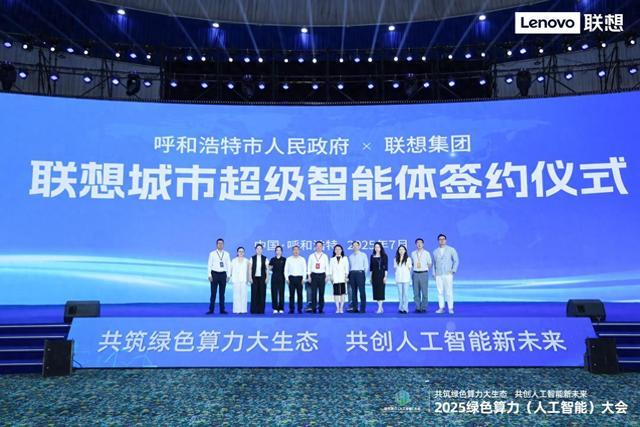
Core Insights - The article discusses the transition from traditional "city brain" systems to "city super intelligence" systems, emphasizing the enhanced capabilities for urban management and the move towards a smart city 4.0 era [1][3] - Lenovo Group has signed a strategic cooperation agreement with the Hohhot municipal government to develop a city super intelligence model, leveraging green computing and artificial intelligence [1][3] Group 1: Strategic Cooperation - Lenovo's partnership with Hohhot aims to create a smart city 4.0 model centered on "intelligent hub + green computing," focusing on governance, industry, ecology, and public welfare [3] - Hohhot is positioned as a key node in the "East Data West Computing" project, with a computing power scale of 140P and over 220,000 racks, providing a solid foundation for smart city development [1][3] Group 2: Technological Framework - The city super intelligence system utilizes a "1+N intelligent body" architecture, where one core hub coordinates multiple domain-specific intelligent bodies for complex task processing and service delivery [3] - The core hub is responsible for perception, interaction, cognition, decision-making, planning, and orchestration, enabling a collaborative system that integrates macro-level computation and resource scheduling [3] Group 3: Market Position and Growth - Lenovo's city super intelligence has been implemented in various locations, including Wuyishan, Yichang, and Hongkou, accumulating valuable practical experience [3] - According to IDC's report, Lenovo's solution services lead the Chinese IT service market, with the highest compound annual growth rate [3]
联想城市超级智能体亮相2025数字城市论坛 智慧城市4.0加速落地
Zheng Quan Ri Bao Wang· 2025-06-14 02:14
Group 1 - The core focus of the 2025 Digital City Forum is on leveraging cutting-edge technologies like artificial intelligence to modernize urban governance and develop new productive forces [1] - Lenovo's City Super Intelligent Body is introduced as a key component of the smart city 4.0 era, utilizing a "1*N" architecture to connect a city-level intelligent hub with multiple vertical intelligent bodies, enhancing urban governance and social services [1][2] - The transition from "artificial decision-making" to "human-intelligence co-creation" marks the evolution of smart cities into the 4.0 era, driven by advancements in AI and the capabilities of domestic open-source large models like DeepSeek [1] Group 2 - Lenovo has actively participated in the construction of smart cities in China, launching solutions like the "Green Smart City Solution" and the world's first City Super Intelligent Body, which has been implemented in various locations such as Wuyishan and Yichang [2] - The hybrid governance model of "silicon-based intelligence + carbon-based wisdom" is identified as a core feature of the smart city 4.0 era, with Lenovo aiming to further promote this model across more cities [2] - Lenovo's hybrid AI solutions have gained widespread recognition, contributing to its leadership in the Chinese IT service market and achieving the fastest growth rate for eight consecutive years [3]