
智能化手段

Search documents
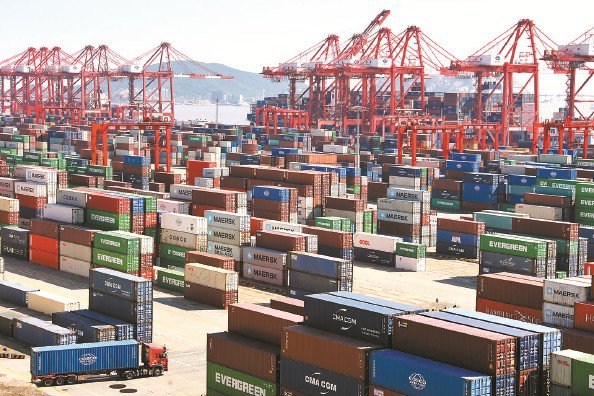
洋山深水港集装箱吞吐量突破2870.6万标箱
Xin Lang Cai Jing· 2026-01-07 06:53
Core Insights - Shanghai Yangshan Deep-Water Port is projected to achieve a container throughput of 28.706 million TEUs in 2025, marking a year-on-year increase of 10.38% and solidifying its status as a top global container hub [2] - The port's share of Shanghai's total container throughput is expected to rise from 50.5% in 2024 to 52.2% in 2025, reflecting its growing importance in the region [2] - Yangshan Port has maintained the top position in the Global Port Performance Index (CPPI) for three consecutive years from 2022 to 2024, indicating significant operational efficiency improvements [2] Operational Efficiency - In 2025, Yangshan Port is expected to handle 9,181 international mainline container ships and 17,942 feeder container ships, representing increases of 3.2% and 8.7% respectively [2] - The implementation of innovative measures such as "dual navigation," "dual window departure," "dual berth operation," and "dual dock berthing" has significantly enhanced port navigation efficiency, with berth utilization rates stabilizing around 84% [2] - The port's innovative "three-set berthing" operation during all tidal periods has been conducted 227 times in 2025, saving an average of 2 hours per ship and unlocking an additional operational capacity of approximately 1.08 million TEUs [3] Economic Impact - The "three-set berthing" initiative has improved shoreline utilization by 5%, generating approximately 300 million RMB in main business revenue for the port and providing indirect economic benefits of around 8 million RMB to shipping companies [3] - Yangshan Port has established a refined forecasting mechanism in collaboration with meteorological departments to mitigate the impact of adverse weather conditions on operations, allowing for continued operations in winds up to level 9 [3] Green Transition - The port is accelerating its green and low-carbon transition, with a significant increase in the refueling of clean fuels such as LNG and methanol [3] - In 2025, LNG refueling volume is expected to exceed 700,000 cubic meters, reflecting a year-on-year growth of over 60%, while methanol refueling has also achieved breakthroughs [3] Future Development - The construction of the Xiaoyangshan North Operation Area is progressing smoothly, with two berths expected to be completed and put into operation by the end of this year, providing strong momentum for the future development of Yangshan Port [4]

让合规化被动为主动
Jin Rong Shi Bao· 2025-05-07 03:25
Core Viewpoint - The non-bank financial institutions in China face significant compliance challenges, leading to administrative penalties due to various operational violations and governance issues [1][2] Group 1: Compliance Challenges - Non-bank financial institutions have been penalized for non-compliance with prudent operational rules, inadequate pre-loan investigations, and governance flaws [1] - Violations include improper fund management, lack of effective verification of leasing assets, and superficial post-loan management practices [1] - The integration of technology in financial services has complicated compliance management, creating ambiguities in regulatory adherence [1] Group 2: Regulatory Framework - The National Financial Regulatory Administration released the "Compliance Management Measures" to guide financial institutions in establishing comprehensive compliance systems [2] - The new regulations aim to shift from passive compliance to proactive governance, emphasizing the need for institutions to understand and implement these policies effectively [2] - Institutions are encouraged to develop internal regulations that exceed basic compliance requirements, tailored to their specific operational contexts [2] Group 3: Internal Regulation Development - Non-bank financial institutions should focus on building internal compliance systems through institutional development, technological empowerment, and cultural cultivation [3] - A clear delineation of responsibilities and a structured compliance framework are essential for effective internal governance [3] - Institutions should create dynamic feedback mechanisms to regularly assess and optimize their internal regulations in response to regulatory changes and market conditions [3] Group 4: Technological Empowerment - Utilizing digital and intelligent technologies can enhance the precision and timeliness of compliance management [4] - Advanced technologies like big data and artificial intelligence can be employed to monitor business activities and identify potential compliance risks [4] - Cultivating a compliance culture within organizations is crucial, integrating compliance education into employee training and promoting a culture that discourages violations [4]