
非银金融

Search documents
2026年一季度A股大数据排行榜
Wind万得· 2026-04-01 05:45
Market Performance - In Q1 2026, A-share market showed significant style differentiation, with the CSI 1000 index being the only broad index to rise, up by 0.32%, while major indices generally declined [1][3] - The Shenzhen Component Index, ChiNext Index, and Wind All A Index saw slight declines of 0.35%, 0.57%, and 1.15% respectively, while the Shanghai Composite Index fell by 1.94% and the CSI 300 dropped by 3.89% [3] - The North Exchange 50 performed the weakest, with a substantial decline of 13.34% in Q1 2026 [3] Industry Performance - Among 35 industries classified by Wind, 9 recorded gains in Q1 2026, with the oil and petrochemical and coal industries leading, rising by 18.27% and 17.64% respectively [5] - Utilities, building materials, and electrical equipment also performed well, with increases of 8.78%, 8.26%, and 6.02% respectively [5] - Consumer and financial real estate sectors faced significant declines, with discretionary retail down by 14.90% and non-bank financials down by 14.84% [5] Style Performance - In Q1 2026, small and mid-cap value and growth styles outperformed, while large-cap styles faced pressure [8] - Mid-cap value style was the strongest, with a cumulative increase of 7.50%, while mid-cap growth rose by 5.73% [8] - Large-cap growth index fell by 2.77%, and large-cap value index declined by 4.53% [8] Concept Performance - Energy and power infrastructure concepts led the market in Q1 2026, with the ultra-high voltage concept rising by 32.39% [10] - Fiberglass and oil and gas extraction indices also saw significant gains, exceeding 30% [10] - Other concepts like optical communication, shipping selection, TOPcon batteries, and rare metals selection rose over 20% [10] Company Listings - As of the end of Q1 2026, there were 5,496 listed companies in the A-share market, an increase of 26 from the end of 2025 [13] - The Shanghai main board had the highest number of listed companies at 1,703, accounting for 30.98% of the total [15] Market Capitalization - The total market capitalization of A-shares was 118.81 trillion yuan at the end of Q1 2026, a slight decrease of 0.1% from the end of 2025 [17] - The Shanghai main board's market capitalization was 62.94 trillion yuan, representing 52.93% of the total [19] Trading Volume - A-share market trading remained active in Q1 2026, with total trading volume reaching 144.5 trillion yuan, a quarter-on-quarter increase of 22.15% and a year-on-year increase of 66.28% [21] - The average daily trading volume was 25.97 billion yuan, up 29.43% quarter-on-quarter and 69.04% year-on-year [21] Margin Financing - As of the end of Q1 2026, the margin financing balance was 26.17 billion yuan, an increase of 2.41% from the end of 2025 and a year-on-year increase of 36.12% [25] Top Gainers and Losers - In Q1 2026, Hangzhou Electric Co. led the gainers with a cumulative increase of 253%, followed by Xuelang Environment at 232% and Tianzhong Precision at 210% [27] - The biggest loser was Tianpu Co., which fell by 55%, with Rongke Technology and Jin Hao Medical both down by 49% [27] Market Valuation - As of the end of Q1 2026, the highest P/E ratio among A-share boards was on the Sci-Tech Innovation Board at 195.68 times [43] - The lowest P/E ratio was in the financial sector at 7.72 times [47] IPO Activity - In Q1 2026, the A-share market saw 35 IPOs, a year-on-year increase of 29.63% [50] - The total fundraising from IPOs was 29.78 billion yuan, up 79.61% year-on-year [52] - The automotive and parts industry led with 6 IPOs, while the medical devices and services sector had 5 [55]


流动性、交易拥挤度、投资者温度计周报:自媒体A股搜索热度创今年以来新高-20260331
Huachuang Securities· 2026-03-31 06:09
Group 1: Liquidity and Capital Flow - The supply side of equity public offerings remains at a historically high level, with new fund issuance at 110 billion yuan, maintaining an 81% percentile over the past three years[6] - Margin financing net inflow decreased to -247.2 billion yuan, placing it in the 7% percentile over the past three years[11] - Southbound capital net inflow increased to 223.2 billion yuan, reaching the 72% percentile historically[38] Group 2: Trading Activity and Market Sentiment - Trading heat in the light industry sector rose by 13 percentage points to 38%, while the construction materials sector fell by 16 percentage points to 53%[44] - The search interest for A-shares on social media reached a new high for the year, driven by a 3.6% drop in the Shanghai Composite Index on March 23[2] - Retail investor net inflow decreased to 1200.5 billion yuan, down 610.2 billion yuan from the previous value, representing the 67.8% percentile over the past five years[2] Group 3: Stock Buybacks and Financing - The total amount of stock buybacks last week was 20.9 billion yuan, up from 9.8 billion yuan, placing it in the 59% percentile historically[23] - Equity financing amounted to 121.3 billion yuan, with IPOs contributing 45.8 billion yuan and refinancing 75.5 billion yuan, at the 58% percentile historically[26] Group 4: Investor Behavior - The number of individual investors participating in margin trading reached 8.071 million, with daily active participants decreasing by 45,000 from the previous value[14] - The overall margin trading turnover rate last week was 36.2%, down from 38.7%, placing it in the 68% percentile historically[14]
银泰证券鑫新闻:研究所日报-20260331
Yintai Securities· 2026-03-31 03:05
Regulatory Environment - The Market Regulation Administration has issued a notice to combat "involution" competition in key industries such as platform economy, photovoltaic, lithium batteries, and new energy vehicles[2] - The Ministry of Finance has announced plans to accelerate the development of local additional tax laws for 2026, marking the first official mention of such legislation[2] Market Performance - On Monday, A-shares experienced a slight decline, with the CSI 300 index down 0.24%, while small-cap indices like the CSI 2000 and CSI 1000 rose by 0.37% and 0.28% respectively[3] - The total market turnover was approximately 1.93 trillion yuan, an increase of 637 billion yuan from the previous trading day[3] Sector Analysis - The leading sectors included non-ferrous metals (+1.84%), building materials (+1.67%), and telecommunications (+1.31%), while utilities (-2.97%) and household appliances also saw significant declines[3] - The A-share market's total market capitalization reached 109.73 trillion yuan, with a year-to-date increase of 0.98 trillion yuan[15] Global Market Context - Major global indices showed mixed results, with European markets rising and the UK FTSE 100 gaining 1.61%, while the US markets, including the Nasdaq and S&P 500, experienced declines of 0.36% and 0.39% respectively[3] - The US dollar index rose by 0.33% to 100.51, and the offshore RMB appreciated slightly to 6.9164 against the dollar[12] Economic Outlook - Goldman Sachs has slightly downgraded the fair value of Chinese stocks by approximately 5% due to the impact of high energy prices and geopolitical risks, while maintaining an overweight view on the market[7] - The forecast for China's GDP growth in 2026 has been adjusted down by 20 basis points, reflecting a more resilient position compared to the US and other emerging markets[7] Investment Trends - There is a growing interest in sectors with high cash/dividend returns and earnings realization during uncertain market conditions, with expectations for A/H share profit growth to reach low double digits in 2026[9] - Signs indicate that international capital may be flowing into Hong Kong, as evidenced by a drop in interbank rates and increased trading volumes post-conflict[8]
中金公司(03908):受益于境内境外市场活跃,国际业务收入占比近30%
Soochow Securities· 2026-03-31 02:21
Investment Rating - The investment rating for the company is "Buy" (maintained) [1] Core Views - The company benefited from active domestic and international markets, with international business revenue accounting for nearly 30% [1] - The total revenue and other income for 2025 reached 40.77 billion yuan, a year-on-year increase of 22.91%, while the net profit attributable to shareholders was 9.79 billion yuan, up 71.93% year-on-year [1] - The company’s earnings per share (EPS) for 2025 is projected at 1.88 yuan, with a return on equity (ROE) of 9.4%, an increase of 3.9 percentage points year-on-year [1] Financial Performance Summary - Total revenue and other income (million yuan): - 2024A: 33,172 - 2025A: 40,770 - 2026E: 43,312 - 2027E: 44,667 - 2028E: 46,238 - Year-on-year growth rates: - 2025A: +22.91% - 2026E: +6.24% - 2027E: +3.13% - 2028E: +3.52% [1] - Net profit attributable to shareholders (million yuan): - 2024A: 5,694 - 2025A: 9,791 - 2026E: 10,311 - 2027E: 10,781 - 2028E: 11,336 - Year-on-year growth rates: - 2025A: +71.93% - 2026E: +5.32% - 2027E: +4.56% - 2028E: +5.15% [1] Business Segment Performance - Brokerage business revenue for 2025 was 6.17 billion yuan, a year-on-year increase of 44.7%, accounting for 21.6% of total revenue [1] - Investment banking revenue reached 5.03 billion yuan, up 62.6% year-on-year, with significant growth in both domestic and international equity underwriting [1] - Asset management revenue was 1.58 billion yuan, reflecting a year-on-year increase of 30.8% [1] - Investment net income (including fair value) for 2025 was 14.2 billion yuan, a year-on-year increase of 40.3% [1] Future Earnings Forecast - The company’s net profit attributable to shareholders is expected to be 10.3 billion yuan in 2026 and 10.8 billion yuan in 2027, with a growth rate of 5% for each year [1] - The projected price-to-earnings (P/E) ratios for 2026-2028 are 7.20, 6.89, and 6.55 respectively [1]
价量一致性和RSI信号本周同步转空,市场情绪指标进一步回落——量化择时周报20260329
申万宏源金工· 2026-03-31 01:02
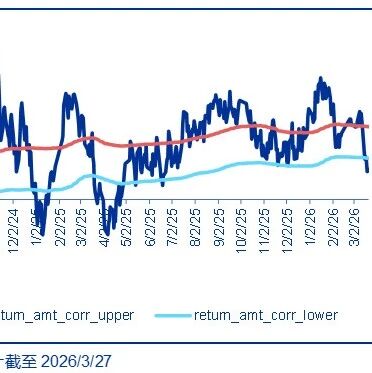
Market Sentiment - The market sentiment indicator as of March 27 is 1.2, down from 1.7 the previous week, indicating a bearish outlook as sentiment continues to decline throughout the week [1][6]. - The price-volume consistency indicator and RSI have both turned negative this week, reflecting a shift from previous oscillation to a sustained bearish view, indicating a weakening market [1][8]. Trading Volume - The total trading volume for the A-share market decreased by 0.65% week-on-week, with an average daily trading volume of 1,394.17 billion yuan, suggesting a slight decline in market activity compared to the previous week [1][10]. Industry Performance - As of March 27, the short-term score rankings for industries show that utilities, coal, power equipment, telecommunications, and oil and petrochemicals are leading, with utilities scoring 91.53, the highest among industries, and coal scoring 84.75, second [1][34]. - The industry crowding indicator shows a low correlation of 0.17 with the weekly price changes, indicating that the crowding level is not significantly impacting price movements [1][37]. Risk Appetite - The relative trading volume of the Sci-Tech 50 index remains low, indicating that market risk appetite is also low, with a slight fluctuation observed [1][13]. - The financing balance ratio has slightly increased this week, suggesting a minor rise in market sentiment and trading activity in the financing market [1][21]. Technical Indicators - The RSI indicator has penetrated the lower boundary and continues to decline rapidly, indicating a weakening short-term momentum [1][25]. - The main buying power indicator has shown a downward trend, reflecting reduced willingness from institutional investors to actively allocate capital in the market [1][28].
金融期权周报-20260330
Guo Tou Qi Huo· 2026-03-30 13:53
Group 1: Market Overview - The market showed a volatile recovery trend last week. Most indices opened lower on Monday and gradually recovered, but still ended the week with losses. The ChiNext Index led the decline, with a weekly drop of 1.67%. The non - bank financial and computer sectors were weak, with weekly declines of about 3.98% and 3.43% respectively, while the non - ferrous metals sector was prominent, with a weekly gain of 2.78% [1] - The market focus remained on the geopolitical situation. The geopolitical situation was still tense, and the uncertainty in the Strait of Hormuz supported high - level volatile energy prices. Overseas, the US dollar index continued to fluctuate strongly, and the US March PMI indicators were divided, leading to a further decline in market expectations for the Fed to cut interest rates. Domestically, the RMB exchange rate remained in a strong - oscillating pattern [1] Group 2: Options Market - In the options market last week, the implied volatility (IV) of various financial options rebounded. The IV of the STAR 50 options (IV = 29%) and ChiNext ETF options (IV = 24%) rose above the median of the past year. The IV of 50 and 300 options was in the range of 15% - 17%, and that of CSI 500 and CSI 1000 options was in the range of 25% - 28%. The PCR of most financial options was in the range of 60% - 80%, slightly lower than the previous week [2] Group 3: Strategy Outlook - The market may continue the volatile pattern, and the implied volatility of financial options will continue to rise. It is advisable to hold indices with relatively reasonable valuations, such as the SSE 50 and CSI 300, and consider selling out - of - the - money put options on the corresponding indices. For the STAR 50 Index, which has large recent fluctuations and high static valuations, if holding the underlying assets, one can consider buying out - of - the - money put options or selling out - of - the - money call options. If there are substantial spot gains, one can consider taking profits on the spot and keeping a small amount of long - term call options. The CSI 1000 - 2606 index futures basis has converged, and one can consider rolling over to the 2609 contract with a higher basis to form a covered call strategy [3] Group 4: Market Data - The report provides detailed data on various financial options, including the closing price, price change, IV, ΔIV (daily), historical quantile, IV median in the past year, option trading volume, and PCR of multiple underlying assets such as the SSE 50ETF, SSE 50 Index, CSI 300ETF, CSI 500ETF, CSI 1000 Index, ChiNext ETF, STAR 50ETF, and Shenzhen 100ETF [5] - It also presents data on the price, price change, IV of different months, and related quantiles of various underlying assets over different time periods, as well as information on IV term structure, intraday IV trends, skew index, smile curve, and the relationship between IV and trading volume [7][10][15]
——信用分析周报(2026/3/23-2026/3/29):中长端信用收益率显著下行-20260330
Hua Yuan Zheng Quan· 2026-03-30 03:02
1. Report Industry Investment Rating The provided text does not mention the industry investment rating. 2. Core Viewpoints of the Report - The central bank had a net withdrawal of 281.9 billion yuan in the open - market operations this week [5]. - The yield of medium - and long - term credit bonds decreased significantly, while the short - term yield mostly decreased slightly [2][22]. - The credit spread of the AA+ non - bank financial industry widened significantly, and the fluctuations of credit spreads of other industries and ratings were within 5BP [2][24]. - After the end of the quarter, the scale of wealth management products in April 2026 is expected to resume positive monthly growth, which will support the allocation of credit bonds [3]. - The current credit spreads of different varieties are at a relatively low historical level, and the credit spreads of 4 - 5Y credit bonds may still have some room to decline [3]. 3. Summary by Directory 3.1 Primary Market - The net financing of traditional credit bonds increased, and the net financing of asset - backed securities decreased by 36.2 billion yuan compared with last week [1][8]. - The net financing of urban investment bonds increased by 69.1 billion yuan, and that of industrial bonds increased by 55.8 billion yuan, while the net financing of financial bonds decreased by 64.2 billion yuan [8]. - The issuance volume of urban investment bonds increased by 47, and the redemption volume decreased by 49; the issuance volume of industrial bonds decreased by 21, and the redemption volume decreased by 36; the issuance volume of financial bonds decreased by 3, and the redemption volume remained unchanged [10]. 3.2 Secondary Market 3.2.1 Trading Volume - The trading volume of credit bonds decreased by 60.5 billion yuan compared with last week. The trading volume of urban investment bonds decreased by 6.7 billion yuan, that of industrial bonds decreased by 0.5 billion yuan, and that of financial bonds decreased by 53.4 billion yuan. The trading volume of asset - backed securities increased by 3.1 billion yuan [17]. - The turnover rate of traditional credit bonds decreased, while that of asset - backed securities increased slightly [17]. 3.2.2 Yield - The yields of 1Y AA, AAA -, and AAA+ credit bonds decreased by no more than 1BP; the yields of 5Y AA, AAA -, and AAA+ credit bonds decreased by 4BP, 3BP, and 2BP respectively; the yields of 10Y AA, AAA -, and AAA+ credit bonds decreased by 4BP [22]. - Taking AA+ 5Y bonds of various varieties as an example, the yields of different varieties decreased to varying degrees [23]. 3.2.3 Credit Spread - The credit spread of the AA+ non - bank financial industry widened by 10BP, and the fluctuations of credit spreads of other industries and ratings were within 5BP [24]. - For urban investment bonds, the credit spreads of different maturities fluctuated slightly within 2BP. The credit spreads of most regions decreased, except for Hainan AA+ and Xinjiang AAA [30][32]. - For industrial bonds, the short - term credit spreads continued to narrow, and the 10Y long - term spreads decreased slightly [35]. - For bank capital bonds, the credit spreads of medium - and long - term bank Tier 2 and perpetual bonds decreased slightly [38]. 3.3 Bond Market舆情 - The implied ratings of 15 debt issues issued by AVIC Industry Finance Holdings Co., Ltd. were downgraded, and the implied rating of "Gucanal A" issued by Wuxi Chengnan Construction Investment and Development Co., Ltd. was downgraded [40]. 3.4 Investment Suggestions - Overall, the credit spread of the AA+ non - bank financial industry widened significantly, and the fluctuations of credit spreads of other industries and ratings were within 5BP. - For urban investment bonds, the credit spreads of different maturities fluctuated slightly within 2BP. - For industrial bonds, the short - term credit spreads continued to narrow, and the 10Y long - term spreads decreased slightly. - For bank capital bonds, the credit spreads of medium - and long - term bank Tier 2 and perpetual bonds decreased slightly [5][42].
金融工程:AI识图关注银行、金融、公用事业、红利低波
GF SECURITIES· 2026-03-29 14:08
- The report utilizes Convolutional Neural Networks (CNN) to model price-volume data and future prices, mapping learned features to industry theme sectors[1][75] - The latest configuration themes include banking, finance, utilities, and low volatility dividends, specifically covering indices such as the CSI Bank Index, CSI 800 Bank Index, SSE 180 Financial Stock Index, CSI All Share Utilities Index, and CSI Dividend Low Volatility Index[1][75][77] - The report provides detailed configuration information for the CNN industry themes, including specific dates and index codes[76] **Quantitative Models and Construction Methods** 1. Model Name: Convolutional Neural Network (CNN) - Construction Idea: Use CNN to model price-volume data and future prices, mapping learned features to industry theme sectors[1][75] - Detailed Construction Process: - Standardize price-volume data into charts for each stock within a window period - Apply CNN to these charts to learn features - Map the learned features to industry theme sectors - Evaluation: The model effectively identifies and maps features to relevant industry themes, providing actionable insights for sector allocation[1][75] **Model Backtesting Results** 1. CNN Model, Banking Theme, CSI Bank Index[76] 2. CNN Model, Banking Theme, CSI 800 Bank Index[76] 3. CNN Model, Financial Theme, SSE 180 Financial Stock Index[76] 4. CNN Model, Utilities Theme, CSI All Share Utilities Index[76] 5. CNN Model, Low Volatility Dividends Theme, CSI Dividend Low Volatility Index[76]
非银金融行业周报:券商年报海外业务成亮点,保险4季度业绩有所承压-20260329
KAIYUAN SECURITIES· 2026-03-29 12:15
Investment Rating - The investment rating for the non-bank financial sector is "Positive" (maintained) [1] Core Insights - The report highlights that the overseas business of brokerage firms has become a bright spot, while the insurance sector's fourth-quarter performance was somewhat under pressure due to fluctuations in the stock and bond markets. The long-term logic for non-bank financial services remains positive, driven by deposit migration and a slow bull market, with both brokerage and insurance valuations at historically low levels, indicating potential for resilience and left-side opportunities [4][5][6] Summary by Sections Brokerage Firms - The average daily trading volume for stock funds was 2.67 trillion, a decrease of 3% month-on-month, while the cumulative average daily trading volume for 2026 was 3.17 billion, an increase of 84% year-on-year. The total AUM for stock and mixed funds was 9.7 trillion, a slight increase of 0.1% month-on-month [5] - In 2025, 150 brokerage firms achieved operating income of 541.2 billion, a year-on-year increase of 20%, and net profit of 219.4 billion, a year-on-year increase of 31% [5] - The report recommends focusing on brokerage firms with low valuations and high contributions from wealth management profits, such as Huatai Securities and GF Securities, as well as leading firms like Guotai Junan and CITIC Securities [5] Insurance - The report notes that the net profit of five A-share listed insurance companies showed a slowdown in growth compared to the first three quarters, with the fourth-quarter net profit slightly below market expectations due to stock market declines and bond market fluctuations impacting investment income [6] - The report indicates that the migration of deposits has led to high growth in the liability side of insurance companies, while the asset side is experiencing short-term volatility due to geopolitical tensions [6] - Recommended stocks include China Pacific Insurance and China Life Insurance [6]
量化择时周报:继续等缩量-20260329
ZHONGTAI SECURITIES· 2026-03-29 10:21
- The report introduces a timing model based on the distance between the short-term moving average (20-day) and the long-term moving average (120-day) of the Wind All A Index. The model identifies market conditions by observing the difference between these two averages. The latest data shows the 20-day moving average at 6633 and the 120-day moving average at 6485, with a difference of 2.28%, indicating a typical consolidation phase[3][7][12] - The mid-term industry allocation model highlights sectors with strong performance trends. It suggests focusing on industries related to computing power (e.g., semiconductor equipment ETF 159516.SZ, communication ETF 515880.SH), cyclical sectors (e.g., oil and gas ETF, energy chemical ETF 159981.SH), and the new energy sector. If a volume contraction signal appears, attention should shift to non-ferrous metals and military industries[3][6][8] - The report evaluates the market's valuation levels using PE and PB metrics. The Wind All A Index PE is positioned near the 90th percentile, indicating a relatively high valuation, while the PB is at the 50th percentile, reflecting a moderate valuation level[8][12] - The timing model suggests maintaining a 50% equity allocation for absolute return products based on the Wind All A Index, considering the current market environment and valuation levels[6][8][12]