智能手机涨价

Search documents
三星手机上新,涨价数百至1000元,业内:智能手机全面涨价才刚开始
Mei Ri Jing Ji Xin Wen· 2026-02-27 03:28
Core Insights - Samsung has launched the Galaxy S26 series, marking a significant entry into the 2026 smartphone market with innovations such as an anti-peeping screen and enhanced AI functionalities, alongside a notable price increase for its models [1][3][4]. Pricing Strategy - The starting prices for the Galaxy S26 series are set at 6,999 yuan for the standard version, 7,999 yuan for the S26+, and 9,999 yuan for the S26 Ultra, reflecting an increase of 1,000 yuan for the standard and S26+ versions and 300 yuan for the Ultra compared to the previous generation [1][4]. - The overall trend in the smartphone industry indicates a potential price increase across the board, with predictions suggesting that the average smartphone price could rise to 465 USD in 2026, leading to a market revenue of 578.9 billion USD, a historical high [8]. Technological Innovations - The Galaxy S26 series features a built-in anti-peeping display that allows users to customize privacy settings based on usage scenarios, which has garnered mixed reactions regarding its effectiveness and potential impact on screen quality [3][4]. - Enhanced AI capabilities are highlighted, allowing users to perform tasks such as booking movie tickets through AI operations, although some industry experts have noted that these features only replicate partial capabilities seen in competitors' products [4]. Market Context - The rising costs of memory and storage chips have been a significant factor driving the price increases in smartphones, with reports indicating that the price of DDR5 memory has surged nearly sixfold in recent months [7]. - The cost of memory semiconductors has risen from 10%-15% of smartphone costs to over 20%, with mid-range devices seeing storage costs approaching 30%, pushing some budget models into negative profit margins [7][8].
知名品牌手机上新,涨价数百至1000元!业内:智能手机全面涨价才刚开始
Mei Ri Jing Ji Xin Wen· 2026-02-27 01:57
Core Viewpoint - Samsung has launched the Galaxy S26 series, marking a significant entry into the 2026 smartphone market, featuring innovations such as an anti-peep display and increased AI functionalities, alongside a notable price increase across the models [1][3]. Pricing and Market Trends - The starting prices for the Galaxy S26 series are set at 6999 yuan for the standard version, 7999 yuan for the S26+, and 9999 yuan for the S26 Ultra, reflecting an increase of 1000 yuan for the standard and S26+ versions, and 300 yuan for the S26 Ultra compared to the previous generation [1][3]. - The rise in smartphone prices is attributed to the continuous increase in memory and storage chip costs, with predictions indicating that 2026 may see a widespread price hike across the smartphone industry [3][5]. - IDC forecasts that the average selling price of smartphones will rise to 465 USD, with total market revenue reaching 578.9 billion USD, marking a historical high [6]. Innovations and Features - The Galaxy S26 series introduces a built-in anti-peep display, allowing users to customize privacy settings based on usage scenarios, although concerns about the impact of screen protectors on this feature have been raised [2]. - The series emphasizes AI capabilities, enabling users to perform tasks such as booking movie tickets through AI operations, although some industry experts have noted that these features only replicate partial capabilities seen in competitors' products [2][3]. Supply Chain and Cost Pressures - The prices of memory chips have surged significantly, with DDR5 16Gb eTT prices increasing from 4.10 USD to 24.00 USD per unit within six months, indicating a nearly sixfold increase [5]. - The cost of memory semiconductors has risen from 10%-15% of smartphone costs to over 20%, with mid-range devices seeing storage costs approaching 30%, leading to negative profit margins for some budget smartphones [5]. - Major smartphone brands, including OPPO, Xiaomi, and others, are expected to initiate a new round of price adjustments in March due to these cost pressures [5][6].
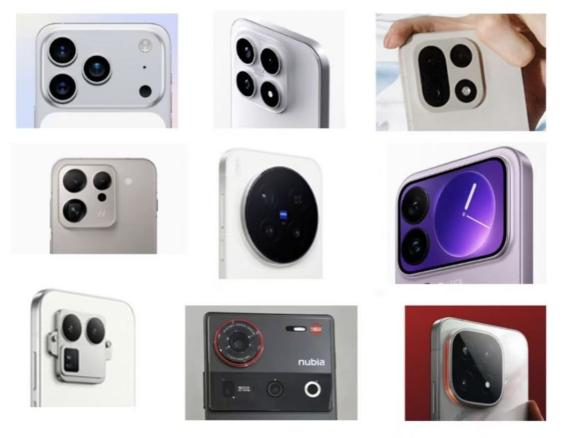
苹果登顶2025年全球出货榜 多款安卓手机被指“借鉴”iPhone
Xin Lang Cai Jing· 2026-01-18 05:02
Core Insights - Apple is projected to lead global smartphone shipments in 2025, driven by the iPhone 17 series, achieving a market share of 19.7% with shipments of 247.8 million units, marking a year-over-year growth of 6.3% [3][4][6] - The global smartphone market is expected to show resilience, with total shipments reaching 1.26 billion units in 2025, a 1.9% increase from the previous year [3][4] Global Market Overview - The top five smartphone manufacturers in 2025 are Apple (247.8 million units), Samsung (241.2 million units), Xiaomi (165.3 million units), vivo (103.9 million units), and OPPO (102.0 million units) [4][6] - Apple and Samsung are the fastest-growing companies among the top five, with growth rates of 6.3% and 7.9% respectively [3][4] High-End Market Trends - The high-end segment is becoming increasingly significant, with Apple and Samsung's combined market share rising to 39%, indicating a consumer shift towards premium devices [6] - The iPhone 17 series has been well-received, contributing to Apple's record revenue in Q4 2025, supported by significant upgrades in features and specifications [6][7] Product Innovations - The iPhone 17 has been upgraded to a more balanced "water bucket" model, featuring a high-refresh-rate display and enhanced camera capabilities, while the iPhone 17 Pro is positioned as a "professional photography phone" with advanced features [7][9] - Apple's marketing strategy has shifted to include discounts on high-end models to stimulate consumer interest [9] Chinese Market Dynamics - In China, Huawei leads with 46.7 million units shipped, followed closely by Apple with 46.2 million units, indicating a competitive landscape [10][11] - The overall smartphone market in China is projected to decline by 0.6% in 2025, with Apple and Xiaomi being the fastest-growing brands among the top five [10][11] Design Trends and Imitation - The design of the iPhone has become a reference point for many Android manufacturers, leading to discussions about design imitation in the industry [10][12] - Analysts suggest that this trend of borrowing iPhone design elements is a strategy for Android manufacturers to appeal to budget-conscious consumers while maintaining a sense of premium quality [12][14] Future Market Expectations - The smartphone market is expected to face challenges in 2026, with rising costs due to storage shortages and component price increases, leading to anticipated price hikes [18][19] - The introduction of foldable iPhones is anticipated to revitalize the market, with significant consumer interest noted in surveys [20]


iPhone 17,要涨价了?
财联社· 2025-09-04 06:06
Core Viewpoint - Apple is expected to raise the prices of its upcoming iPhone 17 series, potentially due to rising costs and market trends, despite efforts to mitigate tariff impacts through a significant investment in U.S. manufacturing [3][10][12]. Group 1: Investment and Tariff Implications - Apple announced a commitment to invest $100 billion in U.S. manufacturing over the next four years, which helped the company secure exemptions from chip tariffs [3]. - Analysts suggest that while Apple may avoid some tariff impacts, the costs could still be passed on to consumers through price increases [3][10]. Group 2: Pricing Predictions for iPhone 17 - Analysts have already raised the average selling price of the iPhone 17 by $50, with expectations for four models: iPhone 17, iPhone 17 Pro, iPhone 17 Pro Max, and iPhone 17 Air [4][5]. - The iPhone 17 Air is anticipated to replace the iPhone 16 Plus, potentially sacrificing some features for a lighter design, with a price around $899 [6][7]. Group 3: Historical Pricing Trends - Apple's pricing strategy has been cautious, maintaining the Pro model's price at $999 since its launch in 2017, but has made adjustments in the past [8]. - The entry-level iPhone price increased from $699 to $829 in 2020, and the Pro Max price rose from $1099 to $1199 in 2023 [8]. Group 4: Market Dynamics and Consumer Behavior - The global average smartphone price is rising, driven by increasing costs of core components like camera modules and chips [10]. - Analysts predict that Apple may employ a strategy of removing lower-spec versions to encourage consumers to purchase higher-capacity models, effectively raising prices without directly attributing it to tariffs [12].