iPhone17

Search documents
【招商电子】高伟电子:25H2业绩超预期,看好26年份额扩张及新品导入
招商电子· 2026-03-31 12:05
Core Viewpoint - The company reported a strong performance for the year 2025, with revenue of $3.5 billion, a year-on-year increase of 40%, and a net profit of $197 million, up 65%, exceeding market expectations [3]. Group 1: Financial Performance - In 2025, the company's revenue reached $3.5 billion, representing a 40% year-on-year growth, while the net profit was $197 million, marking a 65% increase [3]. - The gross margin for 2025 was 10.25%, a decrease of 1.41 percentage points year-on-year [3]. - For the second half of 2025, the company generated $2.14 billion in revenue, a 12% year-on-year increase and a 57% quarter-on-quarter increase, with a net profit of $130 million, up 26% year-on-year and 92% quarter-on-quarter [3]. - The net profit margin for the entire year was 5.6%, with the second half showing a margin of 6.1%, an increase of 0.7 percentage points year-on-year and 1.1 percentage points quarter-on-quarter [3]. Group 2: Market Opportunities - The company is expected to continue gaining market share in ultra-wide-angle and periscope camera segments in 2026, driven by the strong sales of the iPhone 17 series [4]. - Upcoming products from Apple, including camera-equipped headphones and the first foldable phone, present significant opportunities for the company as a key supplier [4]. - The optical module market for Apple is projected to exceed $20 billion, with the company deeply involved in major optical innovations for key clients in 2026-2027 [4]. Group 3: Strategic Initiatives - The company is actively investing in MicroLED and robotics, aiming to explore new growth opportunities in commercial displays, mobile devices, and virtual reality [5]. - The company's expertise in optical camera modules and laser radar positions it well to enter the robotics sector, enhancing data collection and automation capabilities [5].


比亚迪硬抗导弹!车身完好没起火,乘客仅轻伤;马云与阿里、蚂蚁核心管理层齐聚谈AI;OpenAI与美军方合作惹众怒:ChatGPT卸载量爆增295%
雷峰网· 2026-03-04 00:48
Group 1 - OpenAI's collaboration with the U.S. Department of Defense has led to a significant backlash, with ChatGPT's uninstall rate increasing by 295% and one-star ratings surging by 775% following the announcement [4][5] - Competitor Anthropic saw a 37% increase in downloads for its AI product Claude after announcing it would not collaborate with the U.S. Department of Defense, indicating consumer preference for its stance on AI ethics [4] - ChatGPT's downloads dropped by 13% the day after the collaboration announcement, continuing to decline by 5% the following day, while its one-star ratings increased dramatically [5] Group 2 - BYD's vehicle withstood a missile attack in Israel, sustaining damage but keeping the passengers safe with only minor injuries reported, showcasing the vehicle's durability [7][8] - BYD has established itself as a leading electric vehicle brand in Israel, with the BYD Yuan Plus being the top-selling model, achieving sales of 12,885 units in 2023, a significant increase from 7,000 units in the previous year [8] Group 3 - Alibaba's founder Jack Ma gathered with the core management teams of Alibaba and Ant Group to discuss the challenges and opportunities presented by AI, emphasizing the need for educational reform to adapt to AI advancements [10] - Ma highlighted the importance of fostering creativity and critical thinking in education rather than rote memorization, suggesting that AI can help return education to its core purpose [10] Group 4 - Amazon's AWS faced service interruptions due to drone attacks on its data centers in the Middle East, affecting operations and customer services in several countries [33][34] - The attacks resulted in significant physical damage to the facilities, complicating recovery efforts and leading to prolonged service disruptions [34] Group 5 - The company xAI, founded by Elon Musk, commented on the accusations against Anthropic regarding the alleged misuse of training data, highlighting the ongoing debate about data ethics in AI development [12][13] - The conversation around AI ethics continues to evolve, with various stakeholders voicing their opinions on the implications of AI technology and its applications [12][13] Group 6 - Amazon's acquisition of a university campus for $427 million aims to bolster its infrastructure to support AI business expansion, reflecting the growing investment in AI and technology infrastructure [43][44] - The overall spending on AI and technology infrastructure by companies in 2023 is nearing $630 billion, indicating a strong commitment to scaling operations despite potential market risks [44]


行业周报:token出海利好国产算力,海力士打响扩产第一枪-20260301
KAIYUAN SECURITIES· 2026-03-01 11:01
Investment Rating - The industry investment rating is "Overweight" (maintained) [1] Core Insights - The report highlights a significant increase in AI computing power demand driven by ongoing updates in large models, with expectations of total computing expenditure reaching $600 billion by 2030 [5] - The semiconductor sector is experiencing a positive outlook, with major companies like SK Hynix planning to increase production to meet global data center demands [6] - The A-share technology market is showing strength, with notable gains in the electronics sector, particularly in semiconductor and consumer electronics [4] Market Review - The international situation has impacted overseas markets, leading to a decline, while domestic technology stocks have shown significant growth. The electronics industry index rose by 4.02%, semiconductors by 2.18%, consumer electronics by 3.00%, and optical electronics by 4.19% during the week [3] - Major overseas tech stocks experienced mixed results, with notable gains in application optics, which surged by 62.98% [3] Industry Updates - Major smartphone manufacturers are expected to collectively raise prices, with Apple set to launch new products on March 4, including at least five new devices [4] - Collaboration in computing power is strengthening, with Meta and AMD signing a long-term agreement to deploy up to 6GW of GPUs [5] - SK Hynix announced plans to significantly increase HBM production and has initiated a global standardization strategy for next-generation memory solutions [6] Investment Recommendations - The report recommends stocks such as Jiangfeng Electronics, Tuojing Technology, Huyuan Technology, and Shenghong Technology as key investment targets, while suggesting stocks like Cambricon, Jingce Electronics, and Changchuan Technology as beneficiaries [6]

PLDT(PHI) - 2025 Q4 - Earnings Call Presentation
2026-02-26 07:30
Presentations Page (IR website) FY2025 Analysts Briefing 1 Financial Highlights Stable expansion reflected in record service revenues and EBITDA; Maya gains supported core uptick | | FY25 | FY24 | Change | % Change | | --- | --- | --- | --- | --- | | Service Revenues [net of interconnection costs] | 196.2bn | 194.7bn | +1.5bn | +1% | | Cash Opex, Subsidies, Provisions (ex-MRP) | 84.9bn | 86.1bn | -1.2bn | -1% | | EBITDA (ex-MRP) | 111.2bn 52% margin | 108.5bn 52% margin | +2.7bn | +3% | | Depreciation & Amo ...

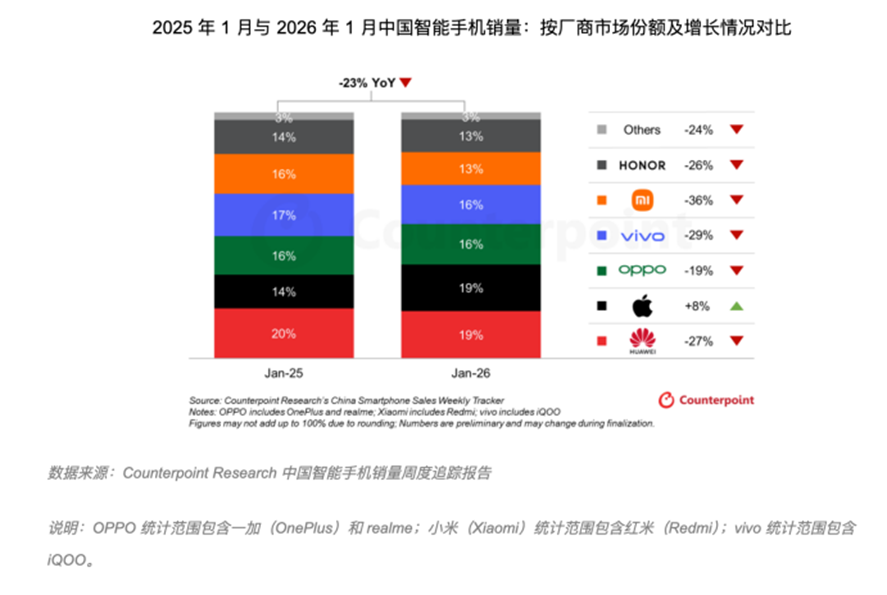
多家机构披露小米手机销量波动,1月销量同比降幅达36%
Xin Lang Cai Jing· 2026-02-24 11:06
Core Insights - Xiaomi's smartphone sales have experienced significant fluctuations, with a reported year-on-year decline of 36% in January, marking the largest drop among the six major smartphone brands in China [1][8]. Group 1: Market Performance - According to Counterpoint Research, the overall smartphone sales in China decreased by 23% year-on-year in January 2026, attributed to high base effects from subsidies and changes in the Lunar New Year timing [2][10]. - In January 2026, Apple's market share increased from 14% to 19%, while Huawei's market share remained stable at 19% despite a 27% decline in sales. Xiaomi's market share fell from 16% to 13% [2][10]. - IDC reported that Xiaomi's total shipments for 2025 reached 43.8 million units, a 4.3% increase year-on-year, with market share rising from 14.7% in 2024 to 15.4% in 2025. However, in Q4 2025, Xiaomi's shipments dropped to 10 million units, an 18% decline, the largest among the top five manufacturers [3][11]. Group 2: Product Launch and Consumer Response - Xiaomi's recent product launch of the Xiaomi 17 has been controversial, particularly due to the decision to skip the Xiaomi 16, which some consumers interpreted as a response to Apple's iPhone 17 launch [5][13]. - Analyst Guo Minghao revised the expected total shipments of the Xiaomi 17 series down by 20%, citing lower-than-expected demand for the standard version, which was anticipated to account for 50%-55% of total sales but only represented 15%-20% [13]. - Xiaomi's President Lu Weibing responded to concerns about sales, stating that the initial sales of the Xiaomi 17 series were promising, particularly for the Pro Max model, and expressed confidence that overall sales would exceed those of the previous Xiaomi 15 series [13].

苹果和英伟达打响“台积电争夺战”
日经中文网· 2026-02-13 02:46
Core Viewpoint - The competition for semiconductor production capacity between Apple and Nvidia is intensifying, with Nvidia expected to surpass Apple as TSMC's largest customer by 2026, impacting Apple's ability to meet iPhone demand due to semiconductor shortages [2][6][9]. Group 1: Apple's Situation - Apple has faced significant supply constraints, leading to an inability to meet high demand for iPhones, as acknowledged by CEO Tim Cook during a financial report [4]. - In Q4 2025, Apple achieved its highest profit ever, with iPhone sales reaching a historical peak after three years, but future production may not satisfy demand due to semiconductor shortages [4]. - The primary bottleneck for Apple is the competition for TSMC's production capacity, which is critical for the latest iPhone 17 series chips manufactured using 3nm technology [4][6]. Group 2: TSMC's Role - TSMC holds a 70% market share in the advanced semiconductor foundry sector and has been a key supplier for Apple, producing semiconductors that serve as the "brain" of iPhones [4][6]. - TSMC's sales from AI-related products have surpassed 50%, while smartphone-related sales have decreased to around 30%, indicating a shift in focus towards AI technologies [6]. Group 3: Nvidia's Ascendancy - Nvidia is projected to become TSMC's largest customer by 2026, overtaking Apple, as the demand for AI-related semiconductors grows [6][9]. - Nvidia's CEO Jensen Huang has actively engaged with TSMC to secure production capacity, indicating a strategic push to penetrate Apple's traditional dominance in semiconductor supply [7][9]. - The collaboration between TSMC and Nvidia has evolved into a partnership that shares the growth benefits from the AI boom, marking a significant shift in the semiconductor supply landscape [9].



6600亿AI开支引恐慌!科技巨头市值蒸发9000亿,苹果独善其身
Jin Shi Shu Ju· 2026-02-06 09:52
Group 1 - Major tech companies announced a total capital expenditure of $660 billion for AI this year, leading to significant stock price declines due to investor concerns about the profitability of such investments [1][2] - Amazon, Google, and Microsoft collectively lost approximately $900 billion in market value following their quarterly earnings reports, as their substantial capital spending plans overshadowed strong revenue growth [1][2] - Amazon plans to invest $200 billion this year, exceeding market expectations by $50 billion, while Microsoft reported a 66% increase in data center spending, causing its stock to drop by 18% [2][3] Group 2 - Despite a 14% annual revenue growth to $1.6 trillion, the overall market sentiment remains pessimistic, with Apple being the only major tech company not participating in the AI capital expenditure race, resulting in a 7.5% stock price increase [1][2] - Meta announced a doubling of its capital expenditure to $135 billion, but its stock initially rose by 10% before losing gains due to broader market declines [3][4] - Concerns about an AI bubble are rising, with analysts indicating that the significant capital expenditures signal a longer timeline for realizing AI-related revenue [3][4] Group 3 - Oracle's reliance on OpenAI for future cloud business is highlighted, with a recent bond issuance of $25 billion, yet its stock fell by 18% over five trading days [4] - Apple's capital expenditure decreased by 17% to $2.4 billion, with a total of approximately $12 billion for the year, benefiting from a partnership with Google to enhance AI capabilities [4][5] - Nvidia is expected to release its earnings report amid a volatile market, with investors looking for a return on their substantial capital expenditures related to AI [5]



员工被要求自带干粮参加年会,零跑汽车董事长深夜发邮件道歉
Sou Hu Cai Jing· 2026-02-03 13:11
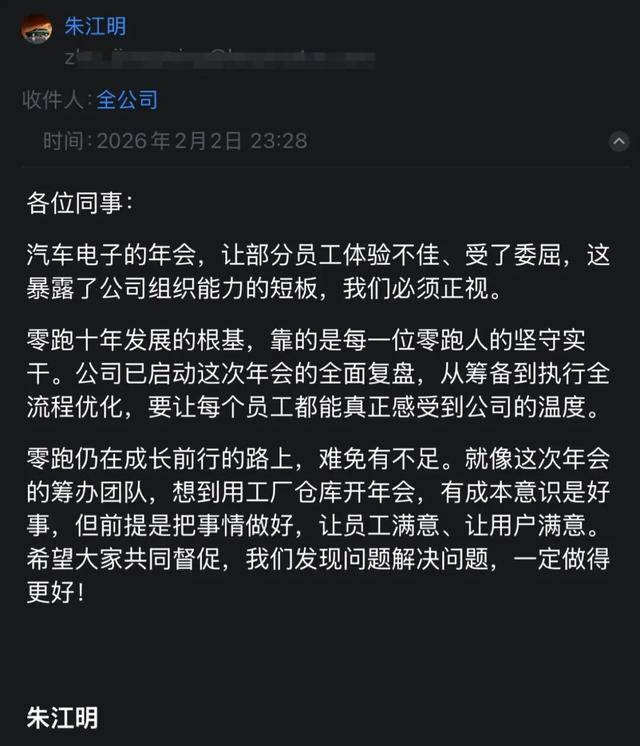
Core Viewpoint - The recent controversy surrounding Leap Motor's annual meeting highlights significant organizational shortcomings, prompting the company's leadership to acknowledge issues and commit to improvements [4][7]. Group 1: Event Overview - Leap Motor's annual meeting, held on January 30, faced backlash from employees who criticized the experience as "ridiculously poor," citing issues such as lack of food, inadequate facilities, and poor weather conditions [3]. - Employees were advised to bring their own food, and the event took place in a factory warehouse without air conditioning, leading to discomfort [3]. Group 2: Management Response - In a letter to employees on February 2, CEO Zhu Jiangming admitted the shortcomings and emphasized the need to address organizational weaknesses, stating that cost control should not compromise employee satisfaction [4]. - The company has initiated a comprehensive review of the event planning and execution processes to ensure a better experience for employees in the future [4]. Group 3: Public Reaction - The public response to the incident was mixed, with some employees defending the company by clarifying that certain criticisms were exaggerated, mentioning that prizes included high-value items like iPhone 17 and DJI products [5]. - Zhu Jiangming's candid acknowledgment of the issues and commitment to improvement received positive feedback from rational observers, indicating a recognition of the company's accountability [5]. Group 4: Implications for the Company - This incident serves as a pressure test for Leap Motor, which aims to become a leading player in the electric vehicle market by 2025, highlighting the importance of balancing cost efficiency with employee experience [7]. - The challenge for the company, as well as many startups, is to develop a more empathetic organizational culture while maintaining a focus on practical and efficient growth strategies [7].

一边赚钱一边收割,苹果如何能在中国“两头通吃”?
商业洞察· 2026-02-02 09:38
Core Viewpoint - The article discusses Apple's financial performance and the ongoing controversy surrounding its "Apple Tax," highlighting the company's strong revenue growth, particularly in the Greater China region, and the implications of its service revenue model [4][5][9]. Financial Performance - Apple reported its first-quarter financial results for fiscal year 2026, achieving record highs in several key financial metrics, driven by strong demand for the iPhone 17 and a service revenue that surpassed $30 billion for the first time, reaching $30.01 billion, a year-on-year increase of approximately 14% [5][6]. - In the first quarter of fiscal year 2026, revenue from the Greater China region reached $25.53 billion, boosted by a 38% increase in iPhone 17 demand, contributing 17.7% to Apple's total revenue growth [5][9]. Service Revenue Insights - The service segment's gross margin is approximately 77%, significantly higher than Apple's overall gross margin of 46%, indicating a highly profitable business model [9]. - The service revenue growth is closely tied to Apple's large active device base, which exceeds 2.5 billion units, creating a network effect that enhances revenue from the App Store, paid subscriptions, and other services [9]. "Apple Tax" Analysis - The "Apple Tax" in the Greater China region accounts for about 10% of total revenue, compared to 8.8% in the U.S. and 4.6% in Europe, indicating a higher burden on Chinese consumers [12]. - Estimates suggest that the revenue from the "Apple Tax" in Greater China could reach approximately 50 billion RMB in 2025, with a gross profit of around 38.5 billion RMB, highlighting its profitability [12]. Regulatory Environment - Despite rising global scrutiny and regulatory changes in other regions, the "Apple Tax" remains unchanged in China, reflecting Apple's strong market position and its dual strategy of hardware sales and service revenue generation [13][16]. - The article notes that various global jurisdictions are pushing back against Apple's commission structure, yet China has not seen similar regulatory movements, maintaining the highest commission rates globally [20][21]. Consumer Awareness and Legal Actions - There is a growing awareness among Chinese consumers regarding the fairness of Apple's pricing policies, leading to formal complaints against the company for its market dominance and high fees [23][24]. - The complaints include demands for the opening of third-party payment channels and a reduction in the commission rates, indicating a shift from passive acceptance to active advocacy for consumer rights [25][26]. Future Implications - The article suggests that the ongoing regulatory and consumer pressures could reshape the digital market landscape in China, potentially leading to a more equitable distribution of profits and enhanced competition [27][28]. - A more transparent and fair market environment is seen as essential for the long-term competitiveness of China's digital economy on a global scale [30][31].
一边赚钱一边收割,苹果如何能在中国「两头通吃」?
36氪· 2026-02-02 00:09
Core Viewpoint - The article discusses the significant financial performance of Apple, particularly in its services segment, and highlights the ongoing controversy surrounding the "Apple Tax" in China, which remains unchanged despite global regulatory pressures [6][11][19]. Financial Performance - Apple reported its Q1 FY2026 earnings, achieving record highs in several key financial metrics, with services revenue surpassing $30 billion for the first time, reaching $30.01 billion, a year-over-year increase of approximately 14% [7]. - The Greater China region contributed significantly to this growth, with revenues reaching $25.53 billion, driven by a 38% increase in demand for the iPhone 17, accounting for 17.7% of Apple's total revenue [8][11]. Services Revenue Growth - The services segment has shown consistent growth, with revenue figures from 2015 to 2026 indicating a strong upward trend, particularly in the Greater China region, which is crucial for Apple's service revenue [8]. - The gross margin for the services business is approximately 77%, significantly higher than Apple's overall gross margin of 46%, indicating a highly profitable segment [11]. "Apple Tax" Controversy - The "Apple Tax" refers to the commission Apple charges developers on its App Store, which is notably higher in China compared to other regions, with estimates suggesting it accounts for 10% of total revenue in China versus 8.8% in the U.S. and 4.6% in Europe [13]. - Analysts have indicated that any significant changes to the "Apple Tax" could impact Apple's earnings per share (EPS) by 2% to 6%, highlighting the sensitivity of Apple's profit margins to regulatory changes [16]. Regulatory Environment - Despite global movements to challenge the "Apple Tax," including court rulings in the U.S. and legislative actions in Europe and Australia, the policy remains firmly in place in China, with no signs of change [19][20]. - The article notes that consumer awareness and advocacy against the "Apple Tax" are growing in China, with recent complaints filed against Apple for its pricing practices and market dominance [26][27]. Future Implications - The article suggests that the ongoing regulatory scrutiny and consumer pushback could lead to significant changes in Apple's business model in China, potentially reshaping the digital market landscape [30][31]. - A more transparent and competitive market environment could enhance China's digital economy's adaptability and innovation, presenting both opportunities and challenges for major companies like Apple [31][32].