iPhone17系列

Search documents
机构:苹果成1月中国手机市场唯一增长品牌
Guan Cha Zhe Wang· 2026-02-12 07:28
Group 1 - The core viewpoint of the articles indicates that the overall smartphone market in China experienced a 23% year-on-year decline in January 2026, with Apple being the only brand to achieve positive growth of 8% [1][3] - Counterpoint Research attributes the decline in sales for domestic brands like Huawei, Xiaomi, OPPO, and vivo to reduced subsidies, consumer sentiment, and the upcoming Spring Festival [1] - Apple's market share increased to approximately 20%, placing it in a leading position alongside Huawei, driven by the success of the iPhone 17 series [1][3] Group 2 - Since the launch of the new iPhone in September last year, Apple's flagship product has seen a strong rebound in sales, achieving its highest market share in five years in January [3] - The iPhone 17 standard version has met government subsidy criteria, enhancing its cost-effectiveness and contributing to a 9% month-on-month sales increase [3] - The pricing strategy for the iPhone 17 series remains stable with minimal discounts, allowing for potential future price adjustments or profit optimization, especially with the upcoming Lunar New Year expected to drive seasonal purchasing [3]



苹果1:1前置引华为OPPO跟进,影像赛道正从卷画质转向卷手法
Xin Lang Cai Jing· 2026-02-03 12:52
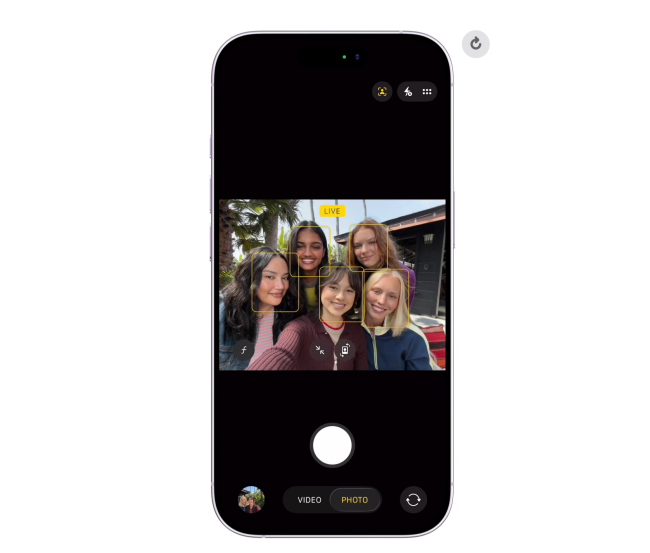
Core Viewpoint - The competition in mobile imaging is shifting, with Apple's introduction of the Center Stage 1:1 square front sensor in the iPhone 17 series marking a significant change in user experience and design [1][7]. Group 1: Innovation and Design - The Center Stage sensor allows users to capture wide-angle images while holding the phone vertically, breaking away from traditional 4:3 or 16:9 aspect ratios [1][7]. - This innovation parallels the success of DJI's Osmo Pocket 3, which addresses the pain point of switching between horizontal and vertical shooting with a rotating screen [3][9]. Group 2: Industry Response - The introduction of the 1:1 sensor has prompted major Chinese brands like Huawei and OPPO to explore similar technology for their front imaging solutions [5][11]. - The industry recognizes that user demand for comfortable handling in selfie and Vlog scenarios outweighs the traditional focus on pixel counts, indicating a shift in consumer preferences [5][11]. Group 3: Future Implications - The adoption of the square sensor technology suggests that flagship imaging products by 2026 will prioritize shooting experience over lens quality, indicating a broader trend in social imaging [5][11]. - Apple's innovation not only defines a new sensor but also sets the stage for future social imaging practices [5][11].
2026年第3周:数码家电行业周度市场观察
艾瑞咨询· 2026-01-31 00:04
Industry Environment - In 2026, brands must take AI GEO seriously as AI chat assistants become essential tools for 96.8% of the youth, shifting information acquisition from "search" to "dialogue," thus transforming consumer decision-making [3][4] - The current AI companion market faces challenges due to high competition and low user willingness to pay, with significant operational costs and regulatory risks impacting independent developers [5] - The AI wave is transforming healthcare, with the global AI medical market projected to reach $504.17 billion by 2032, growing at a CAGR of 44%, driven by personalized health advice and efficiency improvements [6] - CES 2026 showcased a focus on consumer-grade AI hardware, with major companies like Samsung launching AI life companion plans, indicating a key entry point for AI adoption [7] - The XBOT coffee robot exemplifies embodied intelligence in consumer settings, achieving high precision and personalization, marking a significant milestone in commercial applications of AI [8] Automotive Industry - In 2025, China's new energy vehicle market penetration surpassed that of fuel vehicles, with companies like Li Auto and Xpeng focusing on intelligent competition and profitability strategies [9] AI Glasses - AI glasses did not achieve breakout success at CES 2026, facing challenges such as technical limitations and fragmented ecosystems, although long-term potential remains [10][11] Marketing Trends - In 2025, emotional marketing became a core driver, with AI technology enhancing user engagement and marketing strategies evolving towards intelligent and personalized approaches [12] AI Chip Market - The AI chip sector is experiencing a power shift, with domestic alternatives gaining traction in China, while global competition intensifies between Nvidia and cloud providers like Google and Amazon [12] Robotics and Automation - The rise of robot leasing platforms like "QingTian Rent" indicates a shift towards light asset operations, although challenges in technology and user retention persist [13] Smartphone Market - The smartphone market in 2025 faced fluctuations, with Apple performing well in the high-end segment, while mid-range devices struggled due to rising costs and competition from AI-integrated phones [14] AI Toys - 2025 marked the emergence of AI toys, driven by large model technologies, although challenges related to user demand and data privacy remain [15] Advertising Industry - The advertising sector is witnessing a divide, with tech giants dominating the digital ad market, while smaller businesses face pressure from increased platform fees and competition [16] Company Developments - Nvidia's CEO highlighted the transition to "physical AI," emphasizing the need for AI to interact with the physical world, which presents both opportunities and challenges [18] - Fookai plans to raise 700 million yuan for expansion into energy storage and robotics, aiming to enhance competitiveness in the smart appliance sector [19] - DeepSeek is set to release a new model that aims to outperform existing coding models, potentially leading to significant advancements in programming [20] - OpenAI's launch of ChatGPT Health reflects a strategic move into the AI healthcare space, focusing on privacy and personalized health planning [21] - Zhiyu AI became the first large model company to go public, highlighting the growth of AI technology in the capital market [22] - Midea's Weiling Robotics achieved a significant technological breakthrough in core components, enhancing the quality of China's robotics industry [24]

苹果2026年Q1营收1437亿美元创纪录,大中华区暴涨38%成最大亮点
Jin Rong Jie· 2026-01-30 04:09
Core Insights - Apple's Q1 FY2026 revenue reached $143.76 billion, a 16% year-over-year increase, with net profit at $42.10 billion, also up 16%, marking multiple historical highs [1] - iPhone sales were the primary growth driver, generating $85.27 billion in revenue, a 23% increase, accounting for over 59% of total revenue, with record sales across all global markets [1] - The Greater China region showed exceptional performance, with revenue of $25.53 billion, a 38% increase, significantly outpacing growth in the Americas, Europe, and Japan [1] Group 1 - The iPhone 17 series was a major contributor to growth in Greater China, with the iPhone 17 Pro and Pro Max attracting high-end users due to new design and performance features [2] - The iPhone 17 standard version saw significant demand due to notable upgrades, ranking seventh among the top ten global models sold in 2025, despite being on the market for only three months [2] - Apple is currently facing inventory shortages due to unexpected demand for the iPhone 17 series, and is working to catch up with supply, although supply chain constraints are impacting predictions for supply-demand balance [2] Group 2 - Apple CEO Tim Cook noted that the increase in iPhone users upgrading from other brands in Greater China reached double-digit growth [1] - The rising prices of memory chips are expected to have a minimal impact on Apple's gross margin for Q4 2025, but the effect is anticipated to expand in Q2 FY2026 [2] - Apple is considering various options to mitigate cost pressures, including supply chain optimization and adjustments to pricing strategies [2]
不到一周就降价2500元?网友:退钱!
Shen Zhen Shang Bao· 2026-01-26 11:35
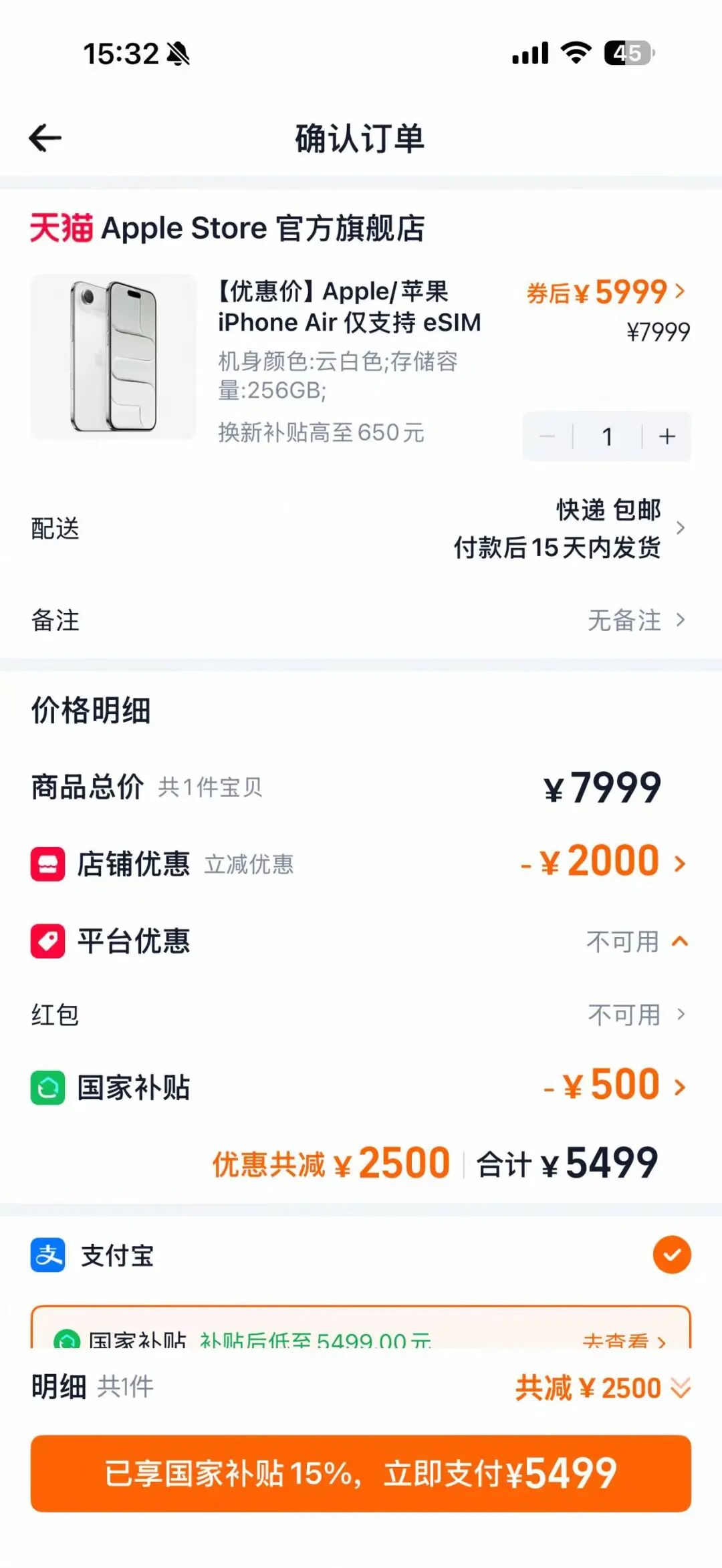
Group 1 - Apple launched a New Year discount event for its products on January 25, with significant price reductions for the iPhone Air and iPhone 17 series [1][4] - The iPhone Air, which was released just over three months ago, saw a total price drop of 2,500 yuan, now priced at 5,499 yuan after various discounts [1][4] - The discount event is exclusive to online platforms like Taobao and JD, with no participation from physical stores [4] Group 2 - The iPhone Air is facing challenges in the market as the first eSIM phone in China, with users finding the activation process cumbersome compared to traditional SIM cards [5] - IDC reported that the iPhone Air's sales were only about one-third of Apple's expectations, leading to a 50% reduction in its production plan shortly after launch [7] - Competitors like Huawei and Honor have started releasing their own lightweight models, such as the Huawei Mate70 Air and Honor Magic8 Pro Air, at significantly lower prices [7]
数码家电行业周度市场观察-20260125
Ai Rui Zi Xun· 2026-01-25 03:02
Investment Rating - The report does not explicitly provide an investment rating for the digital home appliance industry. Core Insights - The digital home appliance industry is experiencing significant transformations driven by AI technologies, particularly in consumer engagement and product innovation. Brands must adapt to the evolving landscape shaped by AI tools and consumer preferences. Industry Trends - In 2026, brands need to take AI GEO seriously as AI chat assistants become essential tools for consumers, with 96.8% of the youth viewing them as indispensable. The shift from "search" to "dialogue" is changing consumer decision-making processes, making AI the primary advisor for consumers [4] - The current AI companion market faces challenges due to high competition and low user retention, with many applications suffering from homogenization and low monetization potential. Successful models may include subscription services and advertising [4] - The healthcare sector is being transformed by AI, with the global AI healthcare market expected to reach $504.17 billion by 2032, growing at a CAGR of 44%. Companies like OpenAI and Ant Group are leading innovations in personalized health advice [6] - The CES 2026 showcased a focus on consumer-grade AI hardware, with major companies like Samsung and ByteDance competing in the smart home and AI glasses markets. The industry anticipates a multi-billion market driven by consumer adoption [6][9] - The emergence of coffee robots at CES 2026 highlights the commercialization of embodied intelligence, with products like the XBOT coffee robot demonstrating significant market potential and consumer engagement [7] - The electric vehicle market in China is evolving, with new players like Li Auto and Xpeng focusing on smart features and profitability, while traditional brands face challenges in brand positioning and market competition [8] - AI glasses did not achieve expected market success at CES 2026, facing issues like technical limitations and fragmented ecosystems, but long-term potential remains as technology improves [9] - The advertising industry is seeing a shift towards AI-driven strategies, with major tech companies dominating the digital ad market, leading to a concentration of power and resources [14] Top Brand News - NVIDIA's CEO Huang Renxun announced a new phase of AI development focused on "physical AI," emphasizing the need for AI to interact with the physical world, which could lead to the emergence of human-level robots [17] - Fuhua Co. plans to raise 700 million yuan for projects in energy storage and robotics, aiming to enhance its competitive edge in the smart appliance sector [18] - DeepSeek is set to release a new model that aims to outperform existing AI models in code generation, potentially revolutionizing programming [19] - OpenAI launched ChatGPT Health, a feature aimed at providing personalized health advice, reflecting a growing trend in AI healthcare applications [19] - Zhiyuan Huazhang Technology became the first AI model company to go public, highlighting the growing importance of AI in the capital market [20] - Midea's Weiling Robotics received recognition for its advancements in core components, showcasing China's progress in robotics technology [20]
华为破了vivo的金身
3 6 Ke· 2026-01-23 03:52
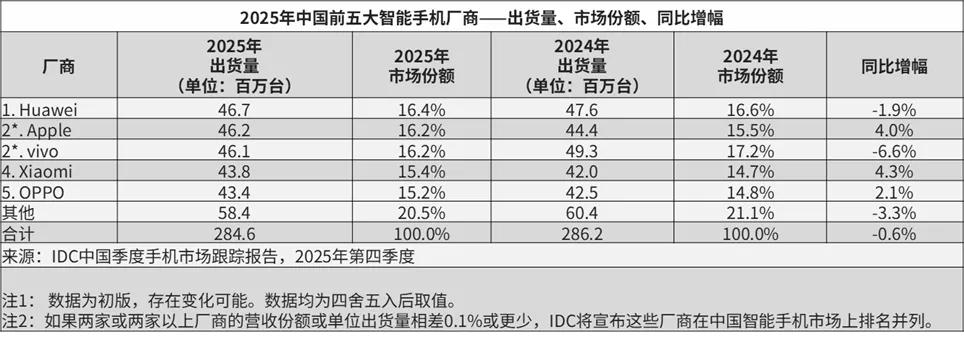
Core Viewpoint - The Chinese smartphone market has experienced significant changes in rankings, with Huawei regaining the top position in market share after several years, despite a slight decline in overall shipment volume [1][4]. Market Overview - In 2025, the total shipment volume of smartphones in China is projected to be 285 million units, reflecting a year-on-year decrease of 0.6% [1][4]. - The competitive landscape is intensifying, with major brands closely contending for market share [3][4]. Key Players and Market Share - The top five smartphone manufacturers in China for 2025 are: 1. Huawei: 46.7 million units, 16.4% market share, down 1.9% from 2024 2. Apple: 46.2 million units, 16.2% market share, up 4.0% from 2024 3. Vivo: 46.1 million units, 16.2% market share, down 6.6% from 2024 4. Xiaomi: 43.8 million units, 15.4% market share, up 4.3% from 2024 5. OPPO: 43.4 million units, 15.2% market share, up 2.1% from 2024 [2]. Vivo's Market Position - Vivo has dropped from first to third place in market share, with a significant year-on-year decline in shipment volume [2][11]. - The brand's strategy of releasing a high number of models (81 in 2025) is under scrutiny as the market shifts towards high-end devices [11][12]. Industry Trends - The smartphone market is transitioning from an incremental growth phase to a saturated market, with a notable increase in the share of high-end devices priced above 4,000 RMB [12][13]. - The competition is expected to intensify in 2026, particularly due to rising costs in components like memory [5][23]. User Experience and Brand Loyalty - Vivo's user retention rate is lower than competitors like Huawei and Apple, indicating potential issues with customer satisfaction [22]. - The brand has faced criticism regarding user experience, particularly in areas such as camera performance and software functionality [16][21]. Future Outlook - Vivo needs to enhance its focus on high-end market segments to remain competitive, especially as the overall market is expected to decline further in 2026 [14][23].
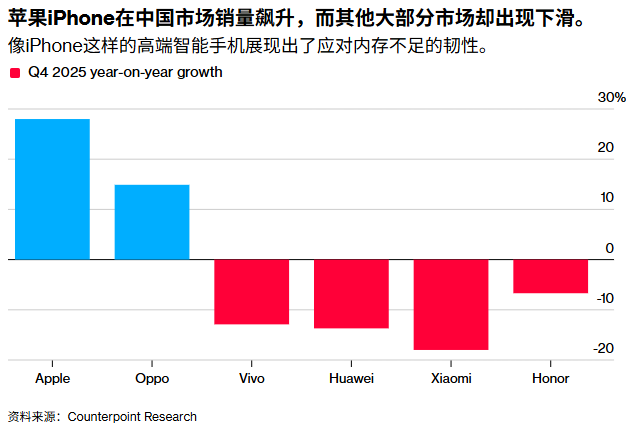
苹果(AAPL.US)Q4在中国手机销量猛增28%夺回榜首,但内存短缺危机恐吞噬利润
Zhi Tong Cai Jing· 2026-01-19 08:41
Group 1 - Apple Inc. (AAPL.US) experienced a 28% increase in iPhone shipments during the holiday season, regaining its leading position in the Chinese market despite a worsening shortage of key memory chips [1] - The iPhone 17 series attracted many consumers, with Apple's global smartphone shipments accounting for one-fifth of total shipments in the fourth quarter, while competitors like Huawei saw a double-digit percentage decline [1] - Overall, the global smartphone market saw a 1.6% decrease in shipments [1] Group 2 - In the annual shipment rankings, Apple was slightly behind Huawei, holding approximately 17% market share, with a 7.5% increase in shipments expected by 2025 [4] - The newly launched iPhone Air faced poor sales due to its late release in China and compromises made between thinness and functionality [4] - Apple's return to the top position is largely attributed to its integrated Apple Intelligence features, but future iPhone models will require larger RAM capacities, which poses financial challenges due to rising memory prices [4] Group 3 - Many consumer hardware manufacturers, including Apple and HP (HPQ.US), are under significant pressure due to high memory component costs, which have become an investment risk [5] - The semiconductor shortage is exacerbated by manufacturers allocating more capacity to high-end memory production for Nvidia's AI chips, leading to rising prices and squeezing smaller companies [5] Group 4 - The surge in memory demand has led to an unprecedented shortage, described as a "crisis" by IDC, with manufacturers facing skyrocketing chip prices [6] - Future memory prices are expected to rise by 40% to 50% in Q1 2026, followed by an additional 20% increase in Q2 2026, prompting OEMs to optimize their product lines [6] - Apple's significant shipment volumes will face material cost challenges, especially as low-price long-term supply agreements expire, impacting its gross margin [6] Group 5 - TSMC's CEO highlighted the uneven impact of memory shortages, stating that high-end smartphones have been less affected, with Apple benefiting from its strong market position and bargaining power [7] - Despite rising memory prices, Apple can prioritize supply, while competitors may face both high prices and supply shortages [7] - New consumer subsidies in China are helping alleviate cost pressures for manufacturers, but Apple's ability to maintain its leading position by 2026 will depend on how it manages the cost impacts of the memory shortage [7]
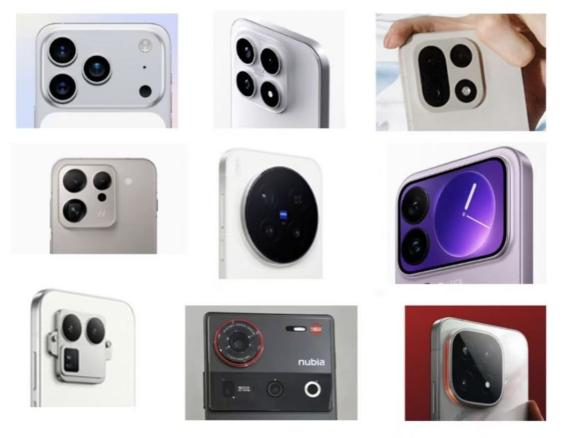
苹果登顶2025年全球出货榜 多款安卓手机被指“借鉴”iPhone
Xin Lang Cai Jing· 2026-01-18 05:02
Core Insights - Apple is projected to lead global smartphone shipments in 2025, driven by the iPhone 17 series, achieving a market share of 19.7% with shipments of 247.8 million units, marking a year-over-year growth of 6.3% [3][4][6] - The global smartphone market is expected to show resilience, with total shipments reaching 1.26 billion units in 2025, a 1.9% increase from the previous year [3][4] Global Market Overview - The top five smartphone manufacturers in 2025 are Apple (247.8 million units), Samsung (241.2 million units), Xiaomi (165.3 million units), vivo (103.9 million units), and OPPO (102.0 million units) [4][6] - Apple and Samsung are the fastest-growing companies among the top five, with growth rates of 6.3% and 7.9% respectively [3][4] High-End Market Trends - The high-end segment is becoming increasingly significant, with Apple and Samsung's combined market share rising to 39%, indicating a consumer shift towards premium devices [6] - The iPhone 17 series has been well-received, contributing to Apple's record revenue in Q4 2025, supported by significant upgrades in features and specifications [6][7] Product Innovations - The iPhone 17 has been upgraded to a more balanced "water bucket" model, featuring a high-refresh-rate display and enhanced camera capabilities, while the iPhone 17 Pro is positioned as a "professional photography phone" with advanced features [7][9] - Apple's marketing strategy has shifted to include discounts on high-end models to stimulate consumer interest [9] Chinese Market Dynamics - In China, Huawei leads with 46.7 million units shipped, followed closely by Apple with 46.2 million units, indicating a competitive landscape [10][11] - The overall smartphone market in China is projected to decline by 0.6% in 2025, with Apple and Xiaomi being the fastest-growing brands among the top five [10][11] Design Trends and Imitation - The design of the iPhone has become a reference point for many Android manufacturers, leading to discussions about design imitation in the industry [10][12] - Analysts suggest that this trend of borrowing iPhone design elements is a strategy for Android manufacturers to appeal to budget-conscious consumers while maintaining a sense of premium quality [12][14] Future Market Expectations - The smartphone market is expected to face challenges in 2026, with rising costs due to storage shortages and component price increases, leading to anticipated price hikes [18][19] - The introduction of foldable iPhones is anticipated to revitalize the market, with significant consumer interest noted in surveys [20]
2025华为手机出货量5年来重回中国第一
日经中文网· 2026-01-16 03:05
Core Viewpoint - Huawei is projected to lead the Chinese smartphone market in 2025 with a shipment of 46.7 million units, despite a slight decrease of 1.9% from 2024, primarily due to the decline of competitor Vivo [3][5]. Group 1: Huawei's Performance - Huawei's flagship Mate series and budget nova series are performing well, both equipped with self-developed Kirin semiconductors [6]. - The company has managed to recover from a decline in sales caused by U.S. sanctions that limited semiconductor procurement, leading to a drop in product performance since 2019 [1][6]. - The latest model, Mate 80, launched in November 2025, features enhanced performance and AI capabilities while being priced lower than its predecessor, aiming to increase the user base of the HarmonyOS [6]. Group 2: Competitor Analysis - Apple ranks second with a shipment of 46.2 million units, showing a growth of 4%, bolstered by strong sales of the iPhone 17 series launched in September 2025 [6]. - Vivo, which held the top position in 2024, saw a significant decline of 6.6%, resulting in a shipment of 46.1 million units in 2025 [3][5]. - Xiaomi and OPPO follow with shipments of 43.8 million and 43.4 million units, respectively, with Xiaomi experiencing a growth of 4.3% and OPPO a modest increase of 2.1% [5]. Group 3: Market Overview - The overall smartphone shipment in China for 2025 is projected to be 284.6 million units, a decrease of 0.6% year-on-year, marking the first decline in two years [6]. - Government incentives for trade-ins have had a positive impact, but some regions have exhausted their subsidy quotas, leading to a slowdown in demand [6]. - IDC forecasts a further decline in shipments to 278 million units in 2026, continuing the downward trend [6].