智驾摩尔定律

Search documents
“人工智能+”如何重塑千行百业?一场对话,看未来已来
Xin Lang Cai Jing· 2025-12-20 15:58
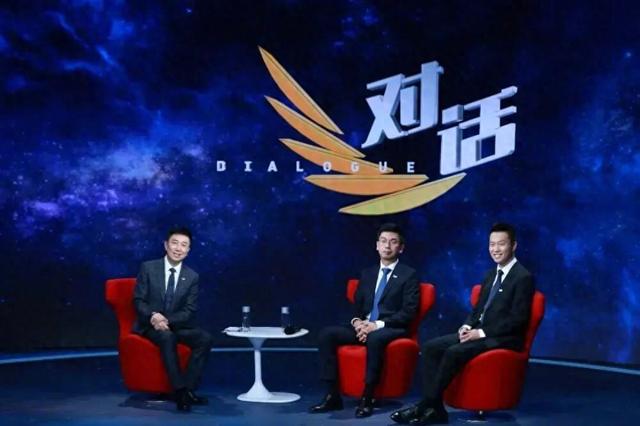
Group 1 - The Central Economic Work Conference emphasizes the need to deepen and expand "AI+" and improve AI governance, alongside implementing a new round of high-quality development actions for key industrial chains [1] - The integration of AI technology into various industries is seen as a significant transformation of productivity and industrial forms, moving beyond mere technical challenges [1] Group 2 - Xu Li, Chairman of SenseTime, compares the company's model to an "aircraft carrier," with the strategy of "1+X," where the carrier serves as a base for various applications, aiming to deliver AI as a fundamental infrastructure to households [3] - Cao Xudong, CEO of Momenta, describes the company's approach as a "icebreaker," focusing on new product forms, business models, and technologies, emphasizing a culture of low-cost and short-cycle hypothesis testing [5] Group 3 - Momenta has produced over 500,000 vehicles, leveraging reinforcement learning large models to achieve significant driving experience, equating to 100,000 times human driving experience [7] - The "Intelligent Driving Moore's Law" proposed by Cao suggests that industry capabilities will improve tenfold every two years, with leading companies potentially achieving 10 to 100 times this improvement, predicting that by 2028-2030, autonomous driving may reach or exceed human levels [8] Group 4 - Xu Li shares a case where an office assistant gained over 3 million users in six months, with 10% being primary and secondary school teachers, leading to the development of a teaching version focused on reducing teachers' workload through AI [8] - The integration of AI into everyday life is emphasized, with a quote from philosopher Wang Gen highlighting that AI should address practical daily needs rather than just grand narratives [8]

自动驾驶再现融资热,24起融资超350亿元,但行业尚未进入盈利期
Mei Ri Jing Ji Xin Wen· 2025-10-20 11:30
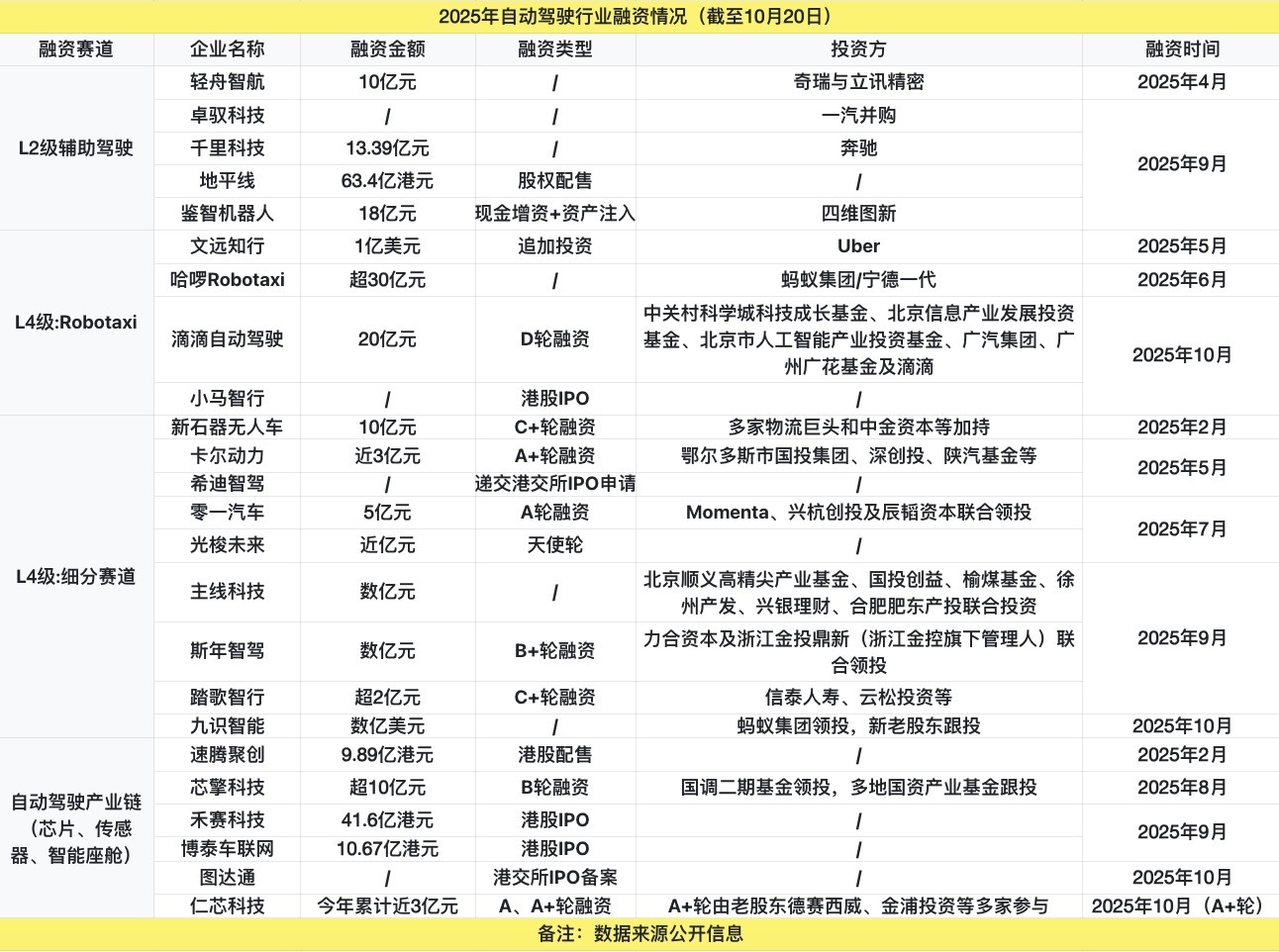
Core Insights - The autonomous driving industry is experiencing a significant resurgence in investment, with over 100 billion RMB raised in 11 financing events in the past month alone, totaling 350 billion RMB for the year as of October 20, 2025, indicating a strong recovery from the previous three years of capital winter [1][2][6] - The financing landscape is characterized by a preference for companies with clear application scenarios, with state-owned and industrial capital increasingly replacing traditional financial investors as key drivers of industry development [6][7] Financing Overview - As of October 20, 2025, there have been 24 financing events in the autonomous driving sector, with a total amount exceeding 350 billion RMB, including 10 events with disclosed amounts of 10 million RMB or more, accounting for 50% of the total financing [2][3] - The L2 level assisted driving segment has seen five financing events, with the largest being Horizon Robotics raising approximately 58.12 billion RMB through a share placement [2][3] - The Robotaxi segment has attracted significant investment, with notable financing events including Didi's 20 billion RMB Series D round and Hello's over 30 billion RMB funding [3][4] Market Dynamics - The L4 level autonomous driving sector is entering a phase of accelerated commercialization, particularly in specific scenarios such as mining and logistics, with nine companies raising over 30 billion RMB [4][6] - The supply chain for autonomous driving, particularly in chips and lidar technology, has also seen substantial financing, with companies like Hesai Technology raising approximately 38 billion RMB through an IPO [4][6] Policy and Technological Support - The autonomous driving industry is supported by a surge in relevant policies, with over 71 policies released in the first half of 2025, including national-level approvals for L3 vehicle production [7][8] - Technological advancements and increased market acceptance are crucial for commercial viability, with L2 level assisted driving penetration exceeding 50% in China, the highest globally [7][8] Financial Performance and Challenges - Despite the financing boom, many companies in the autonomous driving sector remain unprofitable, with significant losses reported alongside revenue growth, indicating ongoing challenges in achieving stable profitability [8][10] - Companies like Horizon Robotics reported a revenue of 1.567 billion RMB in the first half of 2025, a 67.6% increase, but also faced a loss of 5.233 billion RMB, highlighting the financial strain in the industry [8][10] Future Outlook - The market for intelligent connected vehicles in China is projected to grow from 161.1 billion RMB in 2023 to 222.3 billion RMB by 2025, with expectations that China will become the largest autonomous driving market globally by 2030 [10][11] - The emphasis on safety and the gradual expansion of application scenarios for autonomous driving technologies are critical for the industry's future development [11]